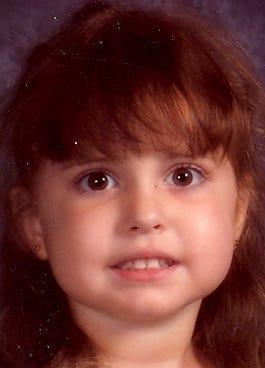
Rebecca Jeanne Riley was born on April 11, 2002, in Springfield, Massachusetts, to Carolyn and Michael Riley. Rebecca lived with two older siblings, Gerard and Kaitlynne. She also had an older half-sister, Ashley, who Carolyn had surrendered in an open adoption at two years old.
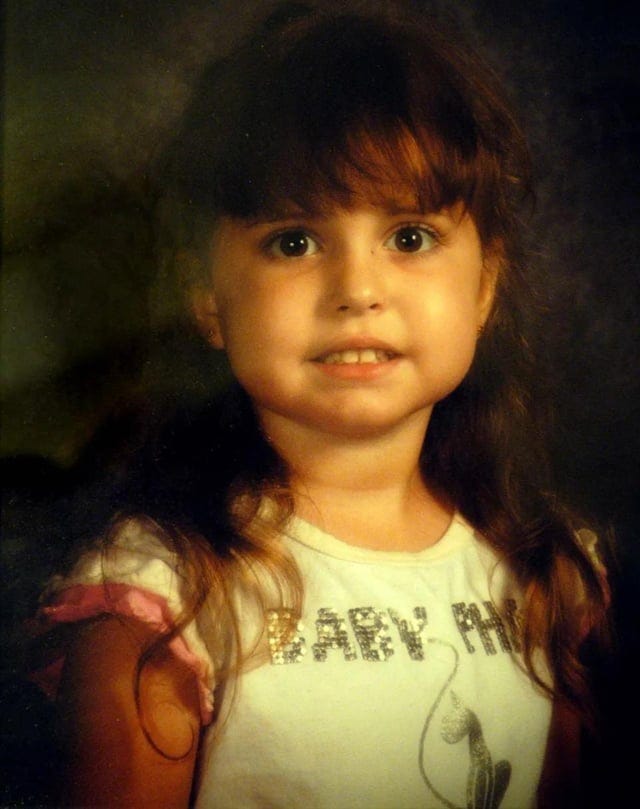
Most of the Riley family had been diagnosed with mental illness. Michael, who had unmedicated bipolar disorder and “intermittent rage disorder”, had reportedly been arrested for assault and battery in 1998. Carolyn took medication for migraines and Paxil for depression and anxiety. Gerard and Kaitlynne were reportedly under care of child psychiatrist Kayoko Kifuji for pediatric bipolar disorder and attention-deficit hyperactivity disorder (ADHD). Kaitlynne had been diagnosed with bipolar disorder in April of 2003, when she was two years old, and prescribed the mood stabilizer Depakote (valproate). A social worker disagreed with Kaitlynne’s diagnosis, stating that her behavior was normal for a toddler.
Both parents were unemployed, lived in Section 8 housing and received monthly Social Security Disability Income. Gerard and Kaitlynne both qualified for Supplemental Security Income payments, which totaled about $2,300 per month. The family received an estimated total of $2,700 per month.
Relatives and Kifuji noted that the Riley parents did not administer medication according to doctor’s orders. Both parents reportedly nicknamed mood stabilizers and clonidine “happy medicine” and “sleep medicine,” respectively. Carolyn allegedly offered her Paxil and migraine medications to a housemate, and had given Kaitlynne some of Gerard’s clonidine tablets before Kifuji had prescribed the medication for her.
Kifuji last saw Rebecca and Carolyn at an appointment on December 7, 2006. Kifuji told Carolyn that if Rebecca continued improving, they could discuss reducing her clonidine prescription at the next appointment.
On Friday, December 8, Rebecca developed symptoms of what first appeared to be a cold. Within a day, she developed a “barking cough” like that of croup. By December 10, she had developed a fever, begun vomiting and refusing to eat, and reportedly spat out the cough syrup Carolyn attempted to give her. Later that day, she began wandering aimlessly around the house, appearing restless. Williams and McGonnell, the Riley’s housemates, concerned about Rebecca’s health, repeatedly encouraged Carolyn to take Rebecca to the doctor or emergency room. Though Carolyn told them that Rebecca had an appointment with her pediatrician on December 11, she had not attempted to schedule an appointment.
Rebecca showed minimal improvement on December 11, with an ear thermometer registering her temperature at 100.7 degrees F. Despite her illness, the parents took her to a Social Security office to inquire about a delayed payment, but had to reschedule the meeting when Rebecca vomited in the waiting room. She continued to wander listlessly around the house and refused food.
Throughout Rebecca’s illness, McGonnell and Williams had both grown increasingly angry with Michael’s and Carolyn’s refusal to take Riley to a doctor, but believed that calling emergency services themselves would be unsuccessful because they were not Riley’s parents. In the afternoon of December 12, McGonnell reportedly threatened to beat Michael “so that the ambulance will come and take both of you,” and allegedly broke a shelf off of the wall in anger. Michael told McGonnell that he and Carolyn had an appointment with Rebecca’s pediatrician the following morning, though no such appointment was scheduled.
The evening of December 12, 2006, a visibly unfocused Rebecca knocked on her parents’ bedroom door. According to Williams, the girl asked for her mother, but was unable to say “mama” or “Mommy” without choking. Michael told the girl, “Go to your fucking room,” and did not allow Rebecca inside. She returned to her parents’ bedroom twice afterwards; both times, Michael shouted at her and made her return to her room.
That evening, the girl’s parents administered her nighttime dose of medication; they then left for Carolyn’s mother’s home, leaving Williams to watch Rebecca and her siblings. While the Riley parents were out, Rebecca again wandered to her parents’ bedroom, calling for her mother. Williams repeatedly explained to Rebecca that her parents were not home, but Rebecca apparently did not seem to understand.
At one point when Rebecca appeared to be searching for her mother, Williams called out to Rebecca, who did not react. Upon picking up the child, she noticed that the girl was cold, clammy, and hung stiffly from her arms, which alarmed Williams: Rebecca would usually cling “like a monkey” when picked up. After several hours, the Riley parents returned home, where Williams again pushed for the girl’s parents to take her to the hospital; Michael falsely claimed that they had an appointment with her pediatrician the next morning. Shortly afterwards, Carolyn gave Rebecca Children’s Tylenol, a liquid cough medicine containing cough suppressant dextromethorphan and antihistamine chlorpheniramine, and a tablet of clonidine.
Rebecca wandered back to her parents’ bedroom around 10 PM. Michael spun Rebecca by the arm, pushed her, and shouted at her, “Go to your own fucking room.” Rebecca began crying and said that she felt sick, but Michael did not allow her in the room. Though McGonnell pleaded with Michael to take her to the hospital, his attempts were unsuccessful, and Williams eventually took Rebecca back to her bedroom.
McGonnell was awoken around 1 AM by a phone call from the tow truck company he worked for, at which point he heard Rebecca struggling to breathe. Upon entering Rebecca’s room, he discovered her “gurgling” and with vomit on her face. One court document reports that she coughed up a reddish substance onto McGonnell’s clothing. McGonnell went to Carolyn and Michael’s bedroom, kicking their door in when they did not open it, and kicking the parents’ bed to wake them up. McGonnell told the parents of Rebecca’s rapidly-worsening condition and demanded they bring her to the emergency room, reportedly asking, “What if she dies?” Michael again refused to seek treatment for the girl; McGonnell later testified that Michael had acted as though “it was a big joke.”
Carolyn convinced Michael to allow Rebecca—reportedly “stiff, gasping for air, and moaning”—to sleep on the floor of their bedroom. Michael agreed, but told Carolyn to administer more clonidine to the girl. Before going to sleep, Carolyn provided another half-tablet of clonidine to Rebecca, allegedly to help the girl sleep.
Carolyn and Michael awoke around 6:30 AM to discover Rebecca dead. A pink-tinted foam, originating from her nose and mouth, coated her face and hair and had pooled onto the carpeting. At 6:36 AM, Michael called 911 to tell the operator that his daughter had died during the night. Afterwards, Michael reportedly started shouting, “Rebecca’s dead, Rebecca’s dead. I’m sorry, I’m sorry.” Upon hearing the news, McGonnell reportedly responded with, “I told you she was dying.”
Gerard and Kaitlynne were immediately transferred to foster care by DSS. Rebecca’s body was eventually cremated; her ashes were first given to her parents, then to Carolyn’s mother upon the parents’ arrest.
Immediately following Rebecca’s death, Kifuji voluntarily surrendered her medical license. The Tufts-New England Medical Center released a statement in support of Kifuji, stating that the medication she had prescribed to Rebecca “was appropriate and within professional standards.” Some psychiatrists voiced concern over the fact that she prescribed medications to young children who were not receiving behavioral treatment; others stated that her method for diagnosing the children was not unusual. The Massachusetts Board of Registration in Medicine ruled against indicting Kifuji on September 2, 2009. Her license was reinstated, and she returned to practicing psychiatry.
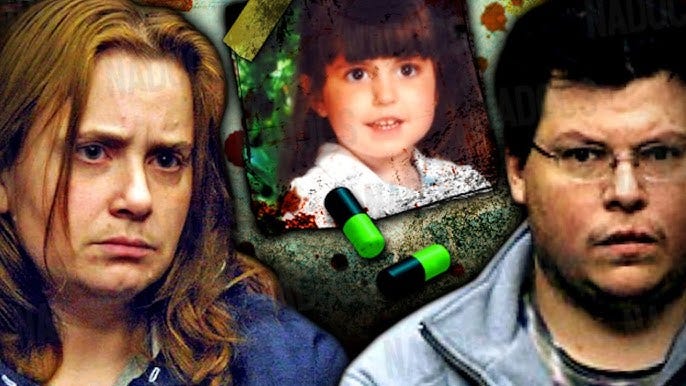
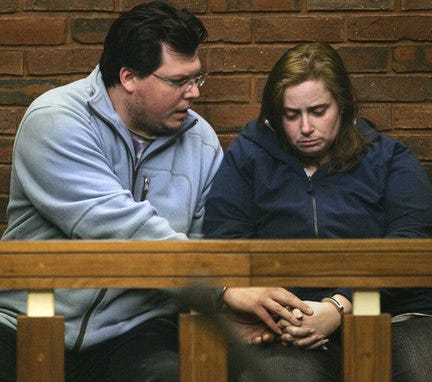
On February 9, 2010, Carolyn Riley was found guilty of second-degree murder. She was sentenced to life in prison with the possibility of parole in 15 years.
Michael Riley was found guilty of first-degree murder on March 27, 2010. Per Massachusetts law, he was automatically sentenced to life in prison without the possibility of parole.
In 2008, Rebecca Riley’s estate filed a medical malpractice claim against Kifuji for her role in administering psychotropic medications to Riley. The suit was settled for $2.5 million in January 2011, with Tufts Medical Center stating it did not wish to cause further distress to Rebecca’s siblings.
I have never heard of a toddler being diagnosed with mental illness and put on psychiatric meds. That’s terrible for the growing brain. That doc needs to be brought up on charges.
She was failed every step of the way. Poor girl.
Thanks for reading True Crime Weekly,
-AJ
 True Crime Weekly
Leave a comment