Known as “The Butcher of Plainfield,” Gein’s heinous crimes in the 1950s shocked the world and were horrific.
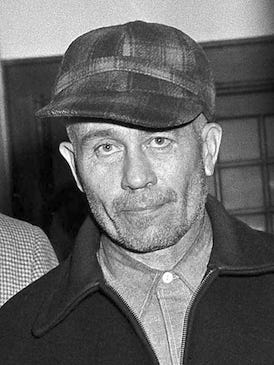
Edward Theodore Gein was born on August 27, 1906, in La Crosse County, Wisconsin, to Augusta and George Gein. His childhood was dominated by a toxic family environment. His father George was an alcoholic who struggled to hold down a job, while his mother, Augusta, was a domineering and fanatically religious woman who instilled in her sons a fear of women and sex. Augusta frequently quoted passages from the Bible particularly those that depicted women as sinful and immoral.
Augusta’s controlling nature made sure that Ed and his older brother, Henry, had little contact with the outside world. She forbade them from forming friendships and insisted on raising them in isolation on a 155-acre farm in Plainfield, Wisconsin. Despite her abusive behavior Ed idolized his mother viewing her as the ultimate authority on morality and virtue.
The death of Ed’s father in 1940 was the beginning of a series of events that would plunge him deeper into isolation. Henry who had begun to question their mother’s teachings, became increasingly concerned about Ed’s attachment to Augusta. In 1944, Henry died under mysterious circumstances during a controlled fire on their property. Although his death was officially ruled an accident some investigators later speculated that Ed may have been involved.
Augusta’s death in 1945 had a huge impact on Ed. Losing the one person he looked up to left him alone. He boarded up most of the farmhouse, preserving his mother’s room as a shrine while living in squalor in a small section of the house. Without Augusta’s oppressive influence, Ed’s mental state deteriorated and his fascination with death and the human body began to manifest in disturbing ways.
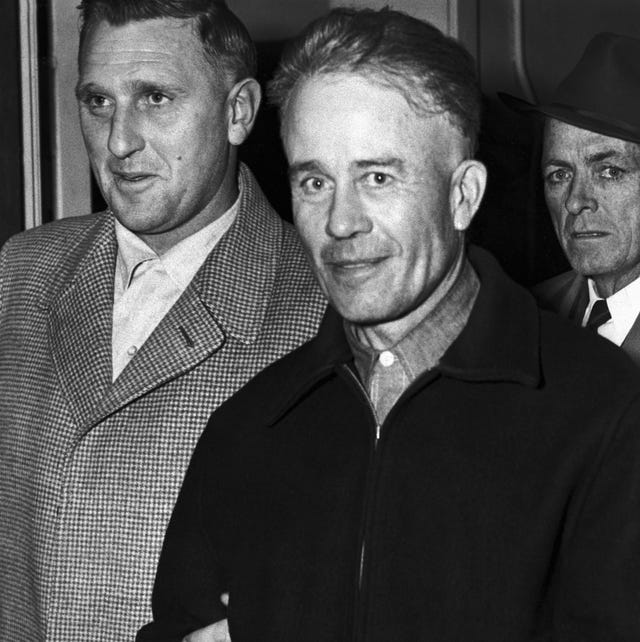
The Crimes
Ed Gein’s criminal activities came to light in 1957 but they likely began years earlier. Following Augusta’s death, Gein started visiting local cemeteries, exhuming bodies, and taking parts of the corpses back to his home. He claimed that he was driven by a desire to reconnect with his mother and create a “woman suit” to “become” her.
On November 16, 1957, Plainfield hardware store owner Bernice Worden went missing. Police found the store’s cash register open and a trail of blood leading out the door. Suspicion quickly fell on Gein, who had been spotted at the store the day before.
When investigators arrived at Gein’s farm, they uncovered a scene of horror. In a shed, they found Worden’s decapitated and mutilated body hung upside down and gutted like a deer. Inside the house authorities discovered a gruesome collection of human remains, including:
– Bowls made from human skulls
– Lampshades, belts, and upholstery made from human skin
– A wastebasket made of human flesh
– A corset fashioned from a female torso
– Masks made from human faces
– A collection of preserved genitalia
Gein later confessed to murdering two women—Bernice Worden and Mary Hogan, a local tavern owner who disappeared in 1954—but most of the remains in his home were from bodies he had exhumed from graves. He admitted to visiting local cemeteries, digging up recently buried women who reminded him of his mother.
Psychological Profile
Ed Gein’s crimes were not driven by greed or malice but by a deeply disturbed psyche. Psychologists diagnosed him with schizophrenia and a severe form of necrophilia. His obsession with his mother’s strict morality and his inability to form normal relationships contributed to his fixation on death and the female form.
Experts believe that Gein’s actions were an attempt to resolve his conflicting feelings about women. He both revered and feared them, viewing them through the lens of his mother’s teachings. His creation of a “woman suit” was a manifestation of his desire to bring Augusta back to life or, in some twisted way, become her.
Trial and Incarceration
Gein’s trial began on November 7, 1968, after years of evaluation to determine his mental competency. He was found guilty of first-degree murder but was deemed legally insane and sentenced to life in a mental institution. He spent the rest of his life at the Central State Hospital for the Criminally Insane in Waupun, Wisconsin, and later at Mendota Mental Health Institute in Madison.
Ed Gein died of respiratory failure on July 26, 1984, at the age of 77. He was buried in Plainfield Cemetery, not far from the graves he had desecrated.
He became the inspiration for numerous fictional characters, including:
– Norman Bates in Robert Bloch’s Psycho (and Alfred Hitchcock’s film adaptation)
– Leatherface in The Texas Chainsaw Massacre
– Buffalo Bill in The Silence of the Lambs
Truly one of the most disturbed individuals that we know about.
 True Crime Weekly
Leave a comment