The Honolulu Strangler, an unidentified serial killer, terrorized the Hawaiian island of Oahu between 1985 and 1986. Considered Hawaii’s first known serial killer, the Strangler was linked to the deaths of at least five women. Despite an extensive investigation the perp was never caught and the case remains unsolved to this day.
The Victims and Crime Pattern
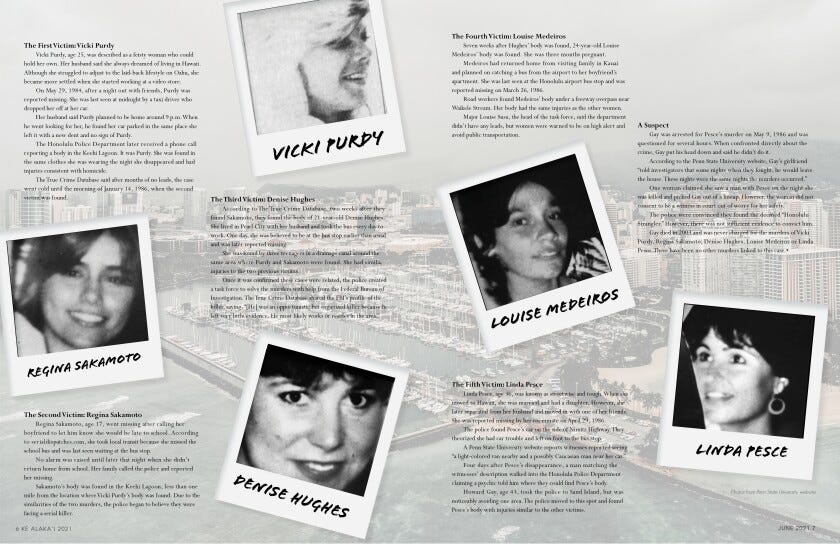
The first victim, 25-year-old Vicki Gail Purdy, was last seen on May 29, 1985. A young woman who had just returned from a night out in Waikiki she never made it home. Her body was found the following day at Keehi Lagoon, showing signs of sexual assault and strangulation. This set off a string of similar murders, with all the victims being women between 17 and 36 years old.
The other known victims included:
Regina Sakamoto (17) – Last seen waiting for a bus in January 1986, she was a high school student with aspirations for college. Her body was later discovered near an embankment at Keehi Lagoon.
Denise Hughes (21) – A secretary for a local telephone company. She was known to be hardworking and responsible. She was found strangled and bound in a stream, discarded in a similar fashion to the previous victims.
Louise Medeiros (25) – Last seen returning home from a trip to Kauai, she never made it home. Her remains were found near a secluded area, reinforcing the belief that the killer targeted women in vulnerable moments.
Linda Pesce (36) – The final known victim, Linda was a businesswoman and was reported missing after failing to show up for work. Her body was found wrapped in a tarpaulin near an abandoned road.
Each of these women was bound, sexually assaulted, and strangled, leading authorities to believe a serial predator was at large. The killer appeared to target women who were alone, abducting them in vulnerable situations before discarding their bodies in remote locations.
The Investigation
The Honolulu Police Department with assistance from the FBI launched one of the largest manhunts in Hawaiian history. Profilers suggested the killer was likely a local who was familiar with the area and had access to multiple locations where he could dump the bodies undetected.
Investigators noted similarities in how the victims were found, leading them to believe that the killer had a specific modus operandi. The victims were found partially clothed, their hands bound, and evidence suggested they had been sexually assaulted before being strangled.
Witnesses reported seeing a mysterious man in a van near some of the crime scenes. Some recalled seeing victims in the presence of an unidentified male, described as a local Hawaiian or Polynesian man, possibly in his 30s or 40s. Police created composite sketches based on these descriptions, but no concrete leads emerged.
In April 1986, authorities arrested a suspect based on witness testimonies and circumstantial evidence. The suspect, a man who was allegedly seen with one of the victims before her disappearance, failed a polygraph test and was linked to suspicious activity around the time of the murders. His estranged ex-wife even reported that he had a disturbing fascination with bondage and control, traits often associated with serial offenders. However, due to a lack of physical evidence, no charges were filed.
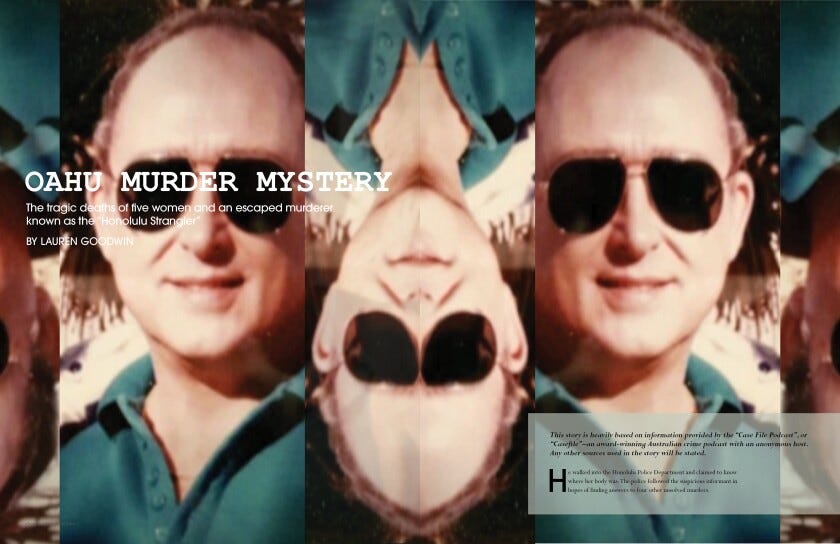
Gay was arrested for Pesce’s murder on May 9, 1986 and was questioned for several hours. When confronted directly about the crime, Gay put his head down and said he didn’t do it.
According to the Penn State University website, Gay’s girlfriend “told investigators that some nights when they fought, he would leave the house. These nights were the same nights the murders occurred.”
One woman claimed she saw a man with Pesce on the night she was killed and picked Gay out of a lineup. However, the woman did not consent to be a witness in court out of worry for her safety.
The police were convinced they found the deemed “Honolulu Strangler.” However, there was not sufficient evidence to convict him.
Gay died in 2003 and was never charged for the murders of Vicki Purdy, Regina Sakamoto, Denise Hughes, Louise Medeiros or Linda Pesce. There have been no other murders linked to this case
Challenges and Cold Case Status
The investigation was hindered by the limitations of forensic technology at the time. DNA testing was in its infancy, and authorities lacked the ability to definitively connect the suspect to the crimes. Witnesses’ accounts were inconsistent, and without surveillance footage or strong physical evidence the case began to stall.
Additionally, public fear played a role in complicating the investigation. The Honolulu community, unaccustomed to serial killings, became deeply scared with many women avoiding traveling alone at night. Increased police presence and patrols in key areas may have forced the killer to stop or change his methods, but the attacks seemingly ended as abruptly as they began.
With no further leads and no new victims the case went cold by the late 1980s. Despite advancements in forensic science including modern DNA analysis, no new evidence has emerged to conclusively identify the Honolulu Strangler. Over the years, various theories have emerged, including speculation that the killer was either incarcerated for an unrelated crime or had died, preventing further murders from taking place.
To this day the case remains one of Hawaii’s most haunting unsolved mysteries. In recent years there have been calls for a renewed investigation using modern DNA analysis techniques, but no official progress has been reported.
 True Crime Weekly
Leave a comment