A Normal House on a Normal Street
At 25 Cromwell Street, there was nothing outwardly alarming. It was a narrow, red-brick terraced house on a working-class street in Gloucester. Children played nearby. Neighbors came and went. The West family blended in chaotic, perhaps, but not unusual.
Behind that front door, however, was a sustained campaign of cruelty that would eventually be described as one of the most horrifying chapters in British criminal history.
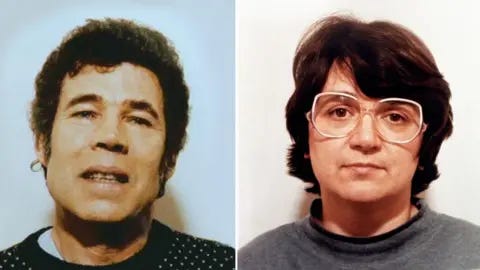
For nearly two decades, Fred and Rose West used their home as a site of sexual violence, torture, murder, and burial. Victims were not only strangers or vulnerable young women they were also members of their own family.
What makes the West case uniquely disturbing is not just the brutality, but the domestic normalcy that surrounded it.
Upgrade here to get my latest True Crime Newsletters:
Fred West:
Fred West’s life was shaped by dysfunction long before his crimes escalated to murder. Born in 1941, he grew up in an isolated rural environment marked by neglect, incest, and violence. Fred was illiterate, socially stunted, and sexually confused. He reportedly suffered repeated abuse and was exposed to incestuous behavior within the household.
By adolescence, Fred was already violent. He committed sexual assaults and showed little empathy. Women were objects to dominate, control, and punish.
Long before Rose entered his life, Fred had already killed.
Get this awesome true crime shirt here:

Rose Letts:
Rose Letts was just 15 years old when she met Fred West. She came from a troubled home and was emotionally vulnerable. Fred exploited that vulnerability, grooming her into a relationship built on fear, dependency, and coercion.
At first, Rose appeared to be another victim controlled, isolated, and abused.
But over time, something shifted.
Rose did not merely endure Fred’s violence. She joined it.
True Crime Weekly is a reader-supported publication. To receive new posts and support my work, consider becoming a free or paid subscriber.
By the time the murders escalated, Rose had become an active participant, assisting in assaults, restraining victims, and helping conceal crimes. The partnership between Fred and Rose was not accidental it was deliberate and mutually reinforcing.
The Victims:
Many of the Wests’ victims were young women some hitchhikers, some acquaintances, some tenants, some runaways. They were targeted precisely because they were vulnerable.
Victims were:
- Lured into the home under false pretenses
- Restrained using ropes, chains, or handcuffs
- Subjected to prolonged sexual assault
- Tortured over hours or days
- Strangled or suffocated
Several were buried beneath the house itself, sealed behind concrete or hidden under floorboards.
The most devastating revelation came later:
Fred and Rose murdered their own daughter, Heather West, burying her beneath the garden patio.
The house became both a prison and a grave.
A Family Living Above the Dead
Perhaps the most unsettling aspect of the case is that children were living in the house while bodies were buried below.
The West children grew up surrounded by violence. Some were sexually abused. Some witnessed crimes. Some were threatened into silence. Others were unaware of the full horror until adulthood.
The family functioned outwardly school, neighbors, routine while atrocities continued beneath their feet.
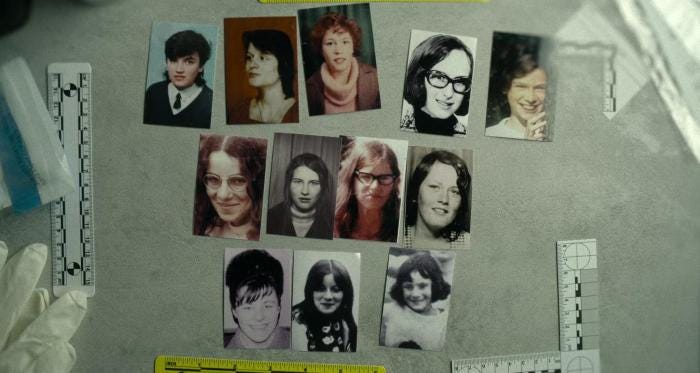
It wasn’t secrecy that protected the Wests.
It was disbelief.
The Investigation Begins to Crack the Foundation
For years, victims went missing with little follow-up. Some were assumed to have run away. Others were never formally reported.
The case only began to unravel in 1994, when police reopened inquiries into missing women linked to Fred West particularly the disappearance of Heather.
When officers began excavating the garden at 25 Cromwell Street, they uncovered human remains.
Then more.
Then more.
As excavation continued, the scale of the crimes became impossible to ignore. Bodies were found beneath the patio, in the cellar, and embedded within the structure of the house itself.
The home had been designed and renovated to hide the dead.
Arrest, Confession, and Cowardice
Fred West was arrested and charged with multiple murders. Faced with overwhelming evidence, he began to confess sometimes bragging, sometimes deflecting blame, sometimes minimizing Rose’s role.
Before trial could begin, Fred West died by suicide in prison in January 1995.
For many families, this was a second betrayal. Fred took answers with him. He avoided public accountability. He controlled the narrative to the very end.
Rose did not.
The Trial of Rose West
Rose West stood trial later in 1995. Prosecutors presented harrowing evidence: witness testimony, forensic findings, and accounts from surviving family members.
Rose attempted to portray herself as a passive victim of Fred’s control.
The jury did not believe her.
She was convicted of 10 murders and sentenced to life imprisonment, with judges emphasizing her active and knowing participation in the crimes.
She remains incarcerated today.
The House Is Destroyed
In 1996, 25 Cromwell Street was demolished. The land was cleared. The address erased.
But demolition does not erase memory.
The West case permanently altered:
- Child protection practices in the UK
- Awareness of domestic abuse dynamics
- Policing of missing young women
- Media ethics around reporting violent crime
It also forced a reckoning with an uncomfortable truth:
Some of the worst crimes happen inside families, not outside them.
Why This Case Still Matters
The Fred and Rose West case is not simply about sadism. It’s about:
- Grooming
- Coercive control
- Institutional failure
- Silence enforced by fear
- Abuse hidden behind routine
Sometimes it wears the face of normality.
 True Crime Weekly
Leave a comment