The Horse & Groom pub on North Street, Guildford, was busy on the evening of Saturday, October 5, 1974. It was a regular haunt for soldiers stationed at Pirbright Barracks nearby, and on a cool autumn Saturday the place was packed young men in their early twenties, a few civilian regulars, the ordinary noise of a weekend. Nobody was thinking about the Irish Republican Army.
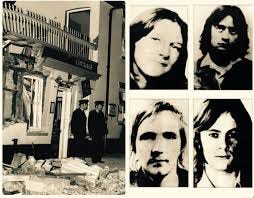
At 8:30 p.m., a bomb detonated inside the pub.
It had been planted by someone who had walked in and walked out again without attracting attention the device later described as having been placed by what appeared, to witnesses, to be a courting couple. When the gelignite exploded, it killed five people: civilian Paul Craig, Scots Guards soldiers William Forsyth and John Hunter, and Women’s Royal Army Corps privates Ann Hamilton and Caroline Slater. Sixty-five more people were injured, many of them severely.
Help me continue this newsletter by supporting my writing and research here:
Within minutes of the Horse & Groom explosion, a second bomb went off at the Seven Stars pub in nearby Swan Lane. The landlord had been in the process of searching his premises after a telephoned warning came too late. His wife was injured. The landlord himself survived with a fractured skull. No one died in the Seven Stars, but the second explosion made unmistakably clear that this was a coordinated attack planned, targeted, and coldly executed.
The Guildford pub bombings, as they became known, sent shockwaves through Britain. The country was already living through a period of sustained IRA activity on the mainland: in the preceding twelve months, more than seventy explosive devices had been planted in and around London. But the particular ferocity of this attack, the deliberate targeting of young soldiers on a night out, the body count it triggered something. Politicians demanded action. The press demanded arrests. The police were under enormous pressure to find someone, fast.
They found the wrong people.
Four People the IRA Would Never Have Used
Gerry Conlon was twenty-one years old, from Belfast’s Falls Road. He had come to London looking for work and had been living in a squat in the Kilburn area, surviving largely through petty theft. He had been in London on the night of the Guildford bombings visiting his aunt, Annie Maguire and by his own account, he would have been the last person the IRA would have recruited.
He was unreliable, known to the police for shoplifting, and he drank too much. Even Conlon himself would say, years later, that his criminal record for petty crime would have made him a liability to any serious paramilitary organization.
Paul Hill was also twenty-one, from Belfast. He had come to England for similar reasons: work, escape, the possibility of something better. He was impulsive and had a history of run-ins with the law.
Paddy Armstrong was twenty-five, also Irish, living rough in London. He and seventeen-year-old Carole Richardson an English girl from south London were a couple, sharing a squat together, subsisting on the margins. Both used drugs. Neither had any documented connection to the IRA. Neither fit the profile of an IRA operative by any stretch of assessment: the IRA, as investigators knew from years of experience, prized discipline, secrecy, and operational reliability. Paddy Armstrong and Carole Richardson, by every account, had none of these qualities.
This was noticed at the time. There was, as one account put it, “a feeling from the very outset” that Armstrong and Richardson didn’t belong in the frame. But by December 1974, all four were under arrest. The Prevention of Terrorism Act, rushed through Parliament in the aftermath of the bombings, gave police the power to detain suspects for up to seven days without a warrant. That power would be used to the absolute limit.
Seven Days
What happened during those seven days in police custody has never been fully or officially acknowledged, but the accounts given by the four are consistent, detailed, and corroborated by the medical and legal investigations that followed decades later.
Paul Hill described being stripped naked and beaten. He described mock executions police officers placing firearms in his mouth and dry-firing the weapon. He described interrogations lasting twenty hours at a stretch, conducted in rotating shifts by officers from the Guildford police, the bomb squad, and Scotland Yard’s anti-terrorism branch. Threats were made against his family. Sleep was denied.
Gerry Conlon described similar treatment. All four did.
The officers conducting the interviews had, in some cases, already written in their notebooks before the interviews even began information they would later claim the suspects had voluntarily provided. When the detention sheets were eventually examined by investigators, the originals were found buried in a file. The versions produced at trial had been altered. The forgery bore the signatures of thirty-two police officers.
Under these conditions, all four signed confessions. The confessions were full of inconsistencies: dates that didn’t match, descriptions that didn’t align with known facts about the bombings, details that had been fed to the suspects by interrogators and then attributed to the suspects’ own knowledge. Defense lawyers would later identify the problems clearly. The prosecution, at trial, had a ready answer for every inconsistency: the IRA, they argued, trained its operatives in counter-interrogation techniques designed to introduce confusion and doubt.
It was an unfalsifiable argument. Any discrepancy in the confessions became evidence of IRA sophistication rather than evidence of their unreliability.
The four couldn’t prove their alibis held. Carole Richardson, in particular, had witnesses who could place her at a concert in London on the night of the bombings but those witnesses were friends who used drugs, and the prosecution dismissed them as unreliable.
True Crime Weekly is a reader-supported publication. To receive new posts and support my work, consider becoming a free or paid subscriber.
The Trial and Conviction
The Guildford Four went to trial at the Old Bailey in London in September 1975. From the beginning, the atmosphere was poisoned. Britain was living through a sustained campaign of IRA violence. The jury pool had been exposed to months of saturation coverage of terrorist attacks. The four defendants young, Irish (three of them), shabby, countercultural made poor impressions. Paul Hill was, by accounts from the time, openly hostile and confrontational. It cost him.
The judge, Justice Donaldson, summed up in a manner that left little room for doubt about which way he expected the jury to fall. He told them they had a binary choice: believe the police officers experienced professionals with careers built on upholding the law or believe four young people whose signed confessions placed them at the scene.
On October 22, 1975, the jury convicted all four. The sentences were savage. Conlon was recommended to serve thirty years. Armstrong thirty-five. Hill was sentenced with the instruction that he should stay in prison until he reached “great age.” Richardson, a minor at the time of the bombings, received an indeterminate sentence at Her Majesty’s pleasure.
Justice Donaldson, in passing sentence, expressed regret that he could not charge them with treason which still carried the death penalty.
The Evidence That Was Buried
Even as the four were taken down to begin their sentences, the evidence that should have freed them was already in existence. It was simply being concealed.
The IRA unit truly responsible for the Guildford and Woolwich bombings was a London-based Active Service Unit that had been operating since early 1974. Known eventually as the Balcombe Street Gang, they were responsible for dozens of bombings and shootings across London and the surrounding area. In the late summer of 1975 before the Guildford Four trial had even concluded Roy Habershon, the head of Scotland Yard’s Bomb Squad, compiled a detailed report that linked the Guildford and Woolwich attacks to this same unit. The fingerprints, the methodology, the device configurations: all of it traced back to the same four men, none of whom were among the convicted.
Habershon did not stop the trial.
In December 1975, the Balcombe Street Gang were cornered in a flat in Marylebone after an armed standoff. When one of the unit’s members, Eddie Butler, was interviewed afterward by senior detective Peter Imbert, Butler spoke openly about his role in a succession of attacks including the Woolwich pub bombing, for which Hill and Armstrong had been convicted. Imbert’s colleague asked directly: had Butler been with Hill and Armstrong at Woolwich? Butler’s answer was unambiguous: he had never heard of them.
Imbert informed the prosecutors. The prosecutors, already holding Habershon’s report, said nothing to the defense.
During the Balcombe Street Gang’s own trial in 1977, the four IRA men instructed their lawyers to formally state that four entirely innocent people were serving massive sentences for crimes their unit had committed. This declaration was entered into court records. It was not acted upon.
The prosecutors had made a choice: to say nothing. The DPP had suppressed Gerry Conlon’s alibi evidence. They had suppressed the Balcombe Street confessions. They had suppressed Habershon’s report. The convictions would stand, because allowing them to fall would mean admitting that the police had fabricated evidence, that the prosecutors had buried the truth, and that the entire apparatus of British anti-terrorist justice in 1974–1975 had been built on a lie.
Fifteen Years
The Guildford Four served their sentences in conditions that Gerry Conlon later described in terms that are almost impossible to read without flinching.
In a piece published in The Guardian in 2009, Conlon wrote about the experience of knowing he was innocent while the years simply passed. He described prison officers urinating in the food of Irish prisoners, putting glass in it. He described cell doors left open so that other inmates could come in to beat them. He described officers using batteries in socks as weapons. He wrote that he saw two people murdered during his imprisonment, witnessed suicides, watched a man set himself on fire at Long Lartin Prison.
His father, Giuseppe Conlon an innocent man who had come from Belfast to support his son after his arrest and had been swept up in the subsequent net died in prison in 1980, in his third year of a twelve-year sentence, having never been guilty of anything. This became the other axis of Gerry Conlon’s grief: not only his own stolen years, but the direct death of his father by incarceration.
The other three members of the Four endured similarly. Carole Richardson, seventeen at the time of her arrest, spent her entire adolescence and young adulthood behind bars, with a sentence that carried no fixed end point. She was not released until she was thirty-two years old.
Outside the prison walls, a small number of people refused to let the case die. The solicitor Alastair Logan, who had represented the Four from near the beginning, spent years building what should have been an overwhelming case for appeal. Gareth Peirce later immortalized in the film In the Name of the Father took over as solicitor in the 1980s and became the driving force behind the final push to freedom. Investigative journalists, including Labour MP Chris Mullin, kept the story alive in the press. The Irish government applied quiet diplomatic pressure.
In 1987, the case was referred to the Home Secretary. In 1989, the police confronted with the original, unaltered detention sheets that proved the trial documents had been forged, and with records of interviews of Paul Hill that had taken place after he was charged and without legal representation, which police had sworn under oath had never occurred could no longer hold the story together.
The Release
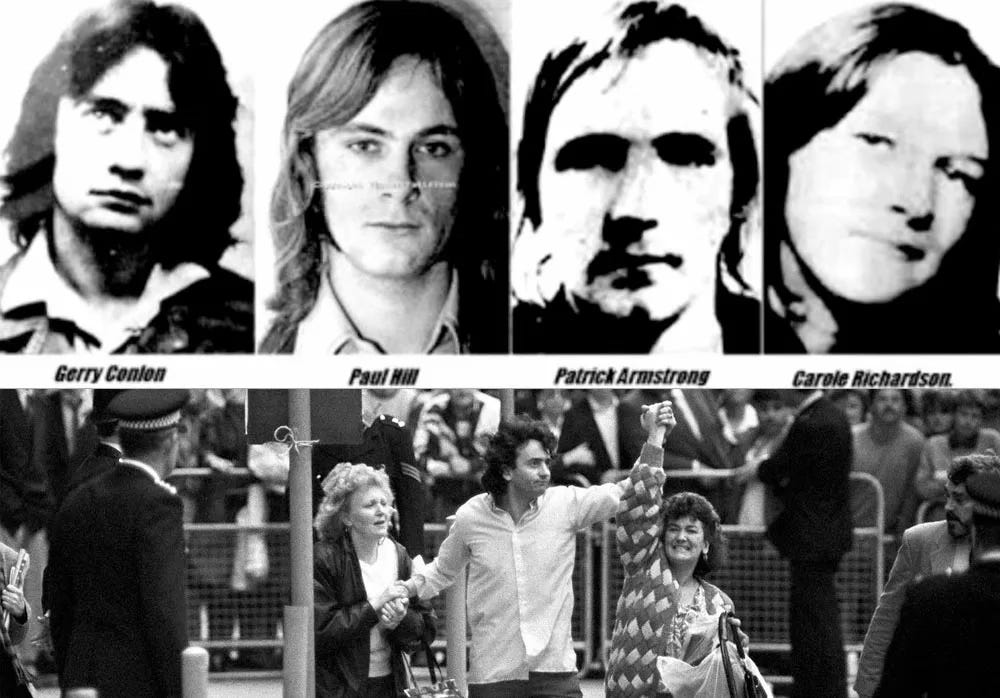
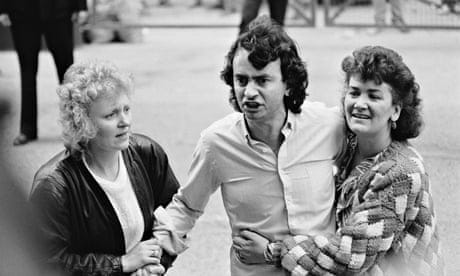
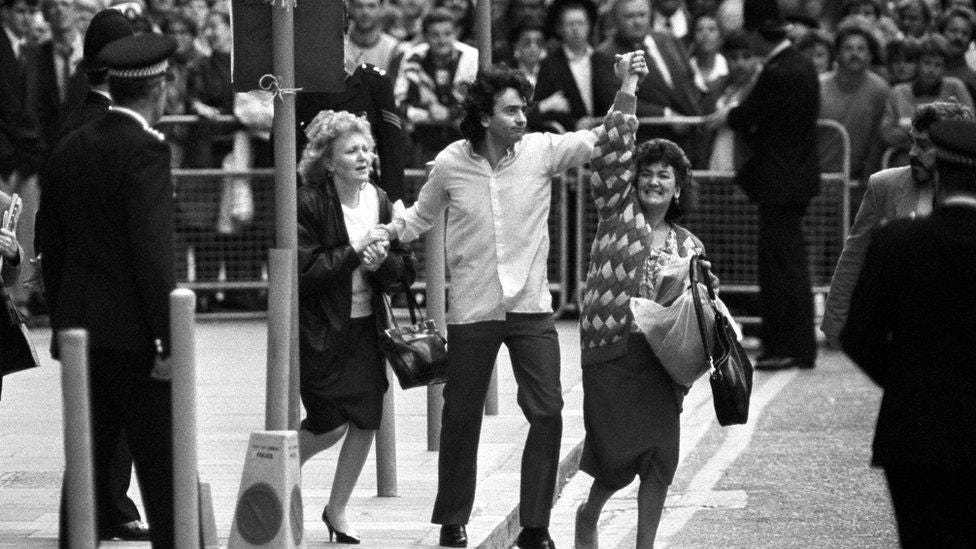
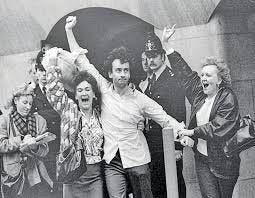
On October 19, 1989, Gerry Conlon, Paul Hill, Paddy Armstrong, and Carole Richardson walked out of the Court of Appeal as free people. The court stated that the police had manufactured evidence and that the convictions were incorrect and unsatisfactory.
The footage of Gerry Conlon on the steps of the Old Bailey that day is one of the defining images of late-twentieth-century British justice. He raised his fist and addressed the crowd and the cameras. He said, very clearly: My father died in a British prison for something he didn’t do. I spent fifteen years in prison for something I didn’t do. I am an innocent man. My father is an innocent man.
The crowd roared. Inside the court building, the apparatus of the state that had imprisoned them said nothing.
In the aftermath of the exonerations, a public inquiry was appointed under Sir John May, a retired Lord Justice of Appeal. May’s inquiry found serious failings and sharp criticism including specific censure of the decision to withhold alibi evidence at trial. But it resulted in no criminal convictions.
Three Surrey police officers Thomas Style, John Donaldson, and Vernon Attwell were charged with conspiracy to pervert the course of justice. All three were acquitted.
No one else was charged. No one who suppressed the Balcombe Street confessions was held accountable. No one who forged the detention sheets that thirty-two officers had signed was convicted of anything. No prosecutor who buried the evidence that could have freed the Four fifteen years earlier faced professional consequences.
Peter Imbert, who had learned in December 1975 that the Balcombe Street Gang were the real bombers and who had informed prosecutors without ensuring the information reached the defense he went on to become the Commissioner of the Metropolitan Police.
In 2005, Prime Minister Tony Blair issued a formal apology to the eleven people the Guildford Four and the Maguire Seven who had been wrongfully imprisoned. The apology acknowledged that the justice system had failed them. It offered no consequences.
The files compiled by Sir John May’s inquiry over seven hundred documents including secret testimony were due to be unsealed for public access in January 2020. On December 31, 2019, the Home Office removed them from the National Archives and placed them back under government control. They remain sealed.
In 2024, marking the fiftieth anniversary of the bombings, police announced that new evidence had been found and referred to the Independent Commission for Reconciliation and Information Recovery. The nature of the new evidence has not been disclosed.
The three men who planted the bombs at the Horse & Groom and the Seven Stars members of the Balcombe Street Gang who had claimed responsibility as early as 1977 were never charged with the Guildford and Woolwich attacks. They were eventually released under the terms of the Good Friday Agreement.
What the Guildford Four Were
They were four young people who happened to be Irish, or who happened to be associated with young Irish people, at a moment when British society had decided that Irishness itself was close enough to guilt.
Gerry Conlon stole things. Paddy Armstrong used drugs. Paul Hill was argumentative. Carole Richardson was seventeen and in love with someone who got arrested. These were their crimes the actual ones. The crimes for which they were sentenced amounted to being available, being young, being Irish, and being unable to resist what was done to them in custody over seven days in December 1974.
The solicitor Alastair Logan, who worked on the case for more than a decade, said in 2024 that the acquittals of the Four had revealed “perjury on an industrial scale.” He estimated that the full truth of what happened who orchestrated the framing, who made the decisions to suppress evidence at each stage, who signed off at every level is still being covered up to protect reputations of people still alive, some of them in the House of Lords.
The files are still sealed.
Gerry Conlon
Of the four, Gerry Conlon became the most public face of the case. He campaigned for other wrongful convictions after his release. He struggled with addiction a direct consequence, his family and supporters said, of what prison had done to him. He gave interviews, made speeches, became something of an accidental icon.
The 1993 film In the Name of the Father, directed by Jim Sheridan and starring Daniel Day-Lewis as Conlon and Pete Postlethwaite as his father Giuseppe, brought the story to global audiences. Conlon himself consulted on the film and appeared at its premiere. He spent the rest of his life simultaneously grateful for the attention and exhausted by having to keep telling the same story.
He died of lung cancer on June 21, 2014, at his home on Falls Road, Belfast. He was sixty years old. He had been free for twenty-five years, which was ten years less than the number of years they had intended him to serve.
What Remains
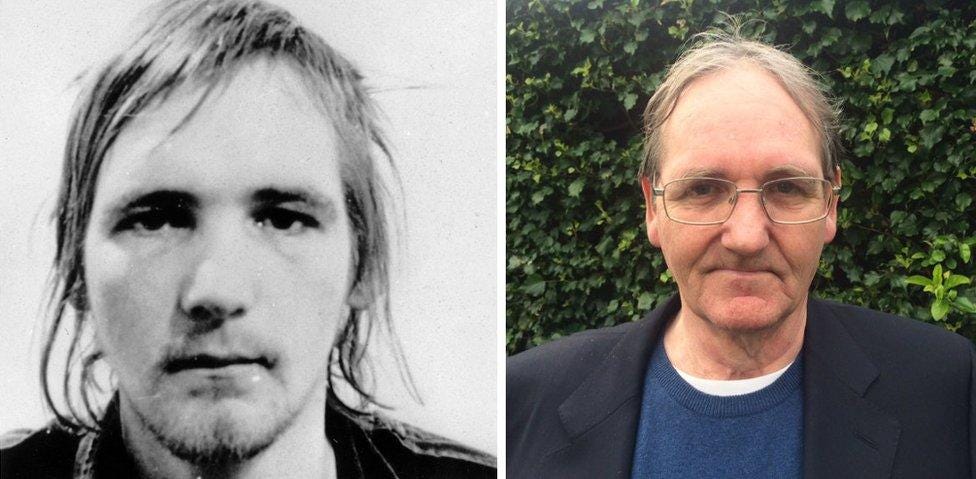
Paul Hill, Paddy Armstrong, and Carole Richardson are still alive. Paul Hill has continued to speak publicly about the case and about miscarriages of justice more broadly. Carole Richardson, who spent her formative years in prison and emerged into a world she had never really known as an adult, has largely withdrawn from public life. Paddy Armstrong lives quietly.
Annie Maguire the aunt at whose home Gerry Conlon had been staying on the night of the Guildford bombings, who was convicted along with six members of her family as the supposed operators of a “bomb kitchen,” whose thirteen-year-old son was among those convicted was eventually exonerated along with the rest of the Maguire Seven in 1991. She has spent the intervening decades seeking a full public acknowledgment of what was done to her family.
The five people who actually died at the Horse & Groom on October 5, 1974 Paul Craig, William Forsyth, John Hunter, Ann Hamilton, Caroline Slater have never seen justice for their murders. The men who killed them were never charged with those specific crimes. The families of the victims have, in many cases, spent decades caught between grief for the dead and outrage at a system that punished the wrong people in their names.
The case is usually described, in retrospect, as a terrible miscarriage of justice that the British justice system eventually corrected. Alastair Logan and others push back against this framing with some force. The system did not self-correct. It was forced, over fifteen years, by individuals a stubborn solicitor, a tenacious journalist, a dedicated barrister, a dead man’s son who refused to stop shouting to acknowledge what it had done. And when that acknowledgment finally came, it was followed by sealed files, acquitted officers, and a Prime Minister’s apology that came with no consequences attached.
The Horse & Groom still stands on North Street in Guildford. It is a bar again. Most people who drink there on a Saturday night don’t know the story. The ones who do tend to find it difficult to finish their drinks without thinking about what happened when four young people were put in a room with police officers who had already decided what they were going to write in their notebooks.
 True Crime Weekly
Leave a comment