A Village Girl from Low Moorsley
She was born Mary Ann Robson on the last day of October, 1832, in the village of Low Moorsley in County Durham a place of coal dust and Methodist chapels and men who went underground every morning and came back up every evening smelling of the earth. Her father, Michael Robson, was a colliery sinker. Her mother, Margaret, was a woman of strict religious conviction. The family moved several times during Mary Ann’s childhood as her father followed the work, eventually settling in the village of Murton.

When Mary Ann was eight or nine, her father fell down a mine shaft and died. Her mother remarried. Mary Ann, by several accounts, did not get on with her stepfather. She left home at sixteen to work as a nursemaid to a local family, returning a few years later to train as a dressmaker. She was described by contemporaries as an attractive woman charming when she chose to be, capable of genuine warmth, and skilled at presenting herself as respectable. In mid-Victorian County Durham, respectability was nearly everything for a woman of her class. It was almost the only currency she had.
I need your support to keep this newsletter going. Please support my true crime writing here:
She would spend the next twenty years spending it, and replacing it, and spending it again, as she moved from husband to husband and town to town, leaving behind her a trail of small graves and insurance claims that nobody, for a very long time, connected to the woman walking away.
The Mowbray Years
In 1852, Mary Ann married William Mowbray, a labourer. They had a large family estimates vary, but between five and nine children were born to them in the first years of their marriage. What is documented is that most of those children died young. Contemporary records attributed the deaths to gastric fever, a catch-all diagnosis of the era that covered a spectrum of intestinal complaints and was, crucially, almost indistinguishable in its symptoms from arsenic poisoning: vomiting, stomach cramps, diarrhoea, a rapid and distressing decline.
Arsenic, in mid-Victorian England, was not a substance requiring any special knowledge to obtain. It was sold freely in pharmacies, used as a pesticide for rats, woven into wallpaper dyes, incorporated into women’s clothing and cosmetics. It was as ordinary as it was lethal. And for a poisoner with patience, it had remarkable properties: administered in small doses over time, it killed slowly and mimicked illness; in larger doses, it killed faster but still looked like sickness. Medical understanding of poisoning was still developing. Most general practitioners in rural County Durham had neither the training nor the equipment to test routinely for arsenic, and they had no reason to suspect foul play from a grieving wife and mother.
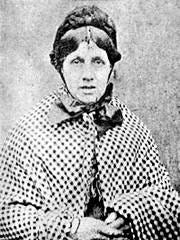
In 1863, William Mowbray died. Gastric fever. He had recently taken out a life insurance policy. Mary Ann collected the payment approximately £35, a meaningful sum for a working-class widow at the time and moved on. One surviving child, a daughter named Isabella, was left with Mary Ann’s mother. Mary Ann went to work as a nurse at the Sunderland Infirmary.
There she met her second husband, George Ward, a patient in her care. They married in 1865. Within a year, Ward was dead. Gastric fever. Insurance was collected.
True Crime Weekly is a reader-supported publication. To receive new posts and support my work, consider becoming a free or paid subscriber.
She met James Robinson, a widower with children, when she took employment as his housekeeper. They married.
Shortly after Mary Ann’s arrival in the Robinson household, one of his existing children from his previous marriage fell ill and died. Then Mary Ann’s mother became ill Mary Ann had brought Isabella to live nearby and died of stomach pains in 1867. Then Isabella herself developed stomach pains and died. Then two of Robinson’s other children from his previous marriage died. A baby born to Mary Ann and Robinson also died.
Robinson, unlike most people in Mary Ann’s orbit, grew suspicious not of murder, but of financial dishonesty. He discovered she had stolen money from him, accumulated debts in his name, and was pressing him insistently to take out life insurance policies he didn’t want. He refused. The refusal probably saved his life. He threw her out.
It was 1869. Mary Ann was thirty-seven. She had buried two husbands, her mother, most of her children, and several stepchildren. She had collected insurance payments after most of these deaths. She had been moving through the villages of County Durham and the Sunderland area for seventeen years. No one had yet connected any of it.
The Cotton Years
Homeless and, for once, without a husband, Mary Ann fell in with Margaret Cotton a friend who introduced her to her brother, Frederick Cotton, a recently widowed pitman from Walbottle. Margaret Cotton, who had been helping raise Frederick’s two surviving children, died not long after the introduction, from a stomach ailment. Mary Ann was left to console the grieving Frederick.
She was also already pregnant by him. They married in September 1870, bigamously Mary Ann’s marriage to Robinson had never been formally dissolved at St Andrew’s Church in Newcastle. She had become Mary Ann Cotton.
The pattern, by now refined through years of practice, proceeded with grim efficiency. Life insurance policies were taken out on Frederick Cotton and his sons. Frederick died in December 1871. Gastric fever. His son Frederick Jr. died in March 1872. The infant Robert, Mary Ann’s son by Frederick, died shortly after. Joseph Nattrass, a former lover who had become a lodger, died in April 1872, just after revising his will in Mary Ann’s favour.
The only life remaining in the Cotton household with a policy outstanding was Charles Edward Cotton Frederick’s seven-year-old son by his first wife, a child who had survived everything so far.
Mary Ann was, by this point, pregnant again, this time by a local excise officer named Richard Quick-Mann, and she wished to marry him. Charles Edward was, in her calculation, an obstacle.
Thomas Riley and the Remark That Ended Everything
In the summer of 1872, a parish official named Thomas Riley came to Mary Ann with a request: would she help nurse a local woman who was ill with smallpox? Mary Ann complained. Charles Edward was in the way, she said. She wanted to commit him to the workhouse so she could be free of the burden.
Riley said no. The child could only go to the workhouse if Mary Ann accompanied him.
What happened next was the kind of remark that only made sense once you understood who she was. Mary Ann told Riley, in tones that accounts describe as oddly casual: “I won’t be troubled long. He’ll go like all the rest of the Cottons.”
Riley recorded the exchange and moved on. Five days later, Mary Ann came to tell him that Charles Edward had died.
Riley went directly to the village police. He persuaded the doctor who had attended the boy to delay signing the death certificate until the circumstances could be reviewed. The post-mortem examination found arsenic in the child’s stomach. Mary Ann Cotton was arrested.
Her first action after Charles Edward’s death had not been to call the doctor. It had been to visit the insurance office.
With Mary Ann in custody, investigators began looking back. What they found was extraordinary in its scope.
The bodies of Joseph Nattrass and two of the Cotton children were exhumed. All tested positive for arsenic. The pattern of deaths surrounding Mary Ann across two decades husbands, children, stepchildren, her mother, a lover, a friend began to be assembled as a coherent record rather than a series of isolated misfortunes.
Estimates of her victims range from fifteen to twenty-one, depending on which deaths researchers attribute to her directly versus natural causes. The most conservative accounting still involves the deaths of three husbands, a lover, her own mother, and at least eight of her children. More expansive assessments add stepchildren and others who died while within her domestic orbit.
The arithmetic of her motive was straightforward: insurance payments on husbands and children, and the freedom to move on to the next situation without encumbrance. Victorian working-class women had almost no economic independence. Mary Ann had found a method brutal, patient, precise that gave her both income and mobility. Each death cleared the board. Each policy paid out enough to fund the next chapter.
The method itself arsenic administered in food or drink was simple to execute and difficult to detect without deliberate testing. The symptoms it produced were indistinguishable from common illness. The social assumption that a respectable wife and mother would not poison her family was not merely a prejudice; it was structurally embedded in how death investigations were conducted. Doctors had no reason to suspect. Coroners rarely tested. Neighbours saw a woman in mourning and offered condolences.
The Trial and the Defence That Almost Worked
Mary Ann Cotton was tried in March 1873 at Durham Assizes, charged with the murder of Charles Edward Cotton a single count, though the prosecution was permitted to introduce evidence of the other deaths to establish a pattern.
The defence mounted by her lawyers was not entirely without substance. Arsenic, they argued, was present in the wallpaper dye used in Victorian homes a green pigment derived from arsenic compounds was indeed common and the child might have inhaled arsenic dust through exposure to the wallpaper in his bedroom. This was a conceivable explanation in 1873. The science of distinguishing between environmental arsenic and administered arsenic was not yet fully developed, and the argument introduced genuine doubt in some quarters.
The prosecution’s response was the pattern. One death from wallpaper was possible. Two was coincidence. Twenty across two decades from a single woman who stood to benefit from each one that was something else entirely.
The jury convicted in under an hour.
The Execution
Mary Ann Cotton was hanged at Durham Gaol on March 24, 1873. She maintained her innocence to the end she never admitted a single killing, either to investigators, to the prison chaplain, or to the press, which covered her final weeks with considerable attention. She gave birth to her thirteenth child in prison in January 1873, two months before her execution. That infant, and one other surviving child from earlier, were the only two of her children to outlive her.
The hanging was botched. The drop was set too short whether by accident or design is a question that has interested historians ever since, given that some at the time expressed a kind of dark sympathy for her. Rather than dying instantly from a broken neck, Mary Ann Cotton died by strangulation, slowly, as she hung at the end of the rope. The executioner, William Calcraft, was reported to have pressed down on her shoulders to hasten the end.
A journalist who witnessed the execution wrote that she had taken her place on the drop “with remarkable composure,” scowling at the crowd and muttering. She did not beg or weep. Whatever she felt in those final moments, she kept it to herself just as she had kept everything else to herself for twenty years.
After her death, she was placed in wax at Madame Tussaud’s Chamber of Horrors, alongside Burke and Hare. The exhibition catalogue described her as a “wretch” whose crimes “no punishment in history can atone for.” Children in County Durham sang a rhyme about her:
Mary Ann Cotton, she’s dead and she’s rotten, She lies in her bed with her eyes wide open.
It is still sung today, in some corners of the Northeast.


Leave a comment