A Summer Night in 1968
Barbara Locci was thirty-two years old and known in her neighbourhood as a woman who had affairs. This was considered relevant. In the Italy of 1968, a woman’s reputation was a kind of moral inventory that investigators and prosecutors consulted before deciding how much effort to spend on her case.
On the night of August 21, 1968, Barbara Locci and her lover Antonio Lo Bianco twenty-nine, a bricklayer were parked in a car on a dirt road near Signa, a small town in the hills southwest of Florence. They were shot, multiple times, with a .22 calibre Beretta pistol. The killer fired through the car window, then opened the door. Lo Bianco was stabbed after death. The shots and the silence that followed them were heard by no one who came forward.
If you enjoy my true crime coverage, please help me continue my newsletter by upgrading here:
In the back seat of the car, still in his seat, asleep through the gunfire, was Barbara Locci’s six-year-old son. He woke up at some point and walked to a nearby house to get help.
The child survived.
His mother’s husband, Stefano Mele, was arrested and convicted of the murders. He was an erratic, limited man, and investigators found his involvement plausible. He went to prison. The case was closed.
It would be reopened six years later, and then reopened again, and then again, across a span of decades that consumed investigators, prosecutors, innocent men, and eventually the credibility of the Italian justice system itself, as the hills above Florence gave up body after body and the Beretta pistol always the same weapon, always the same Winchester Series H bullets kept appearing at new crime scenes while the man who had used it remained invisible.
The Weapon That Connected Everything
The key to understanding the Monster of Florence case is the gun.
At some point between 1968 and 1974, the investigation established through ballistic analysis that the .22 calibre Beretta used to kill Barbara Locci and Antonio Lo Bianco was the same weapon used in a second double homicide committed in September 1974. Pasquale Gentilcore, nineteen, and Stefania Pettini, eighteen, were found in a parked car near Borgo San Lorenzo, northeast of Florence. Shot. Stabbed. Pettini’s body had been removed from the car and sexually mutilated.
The gun was the same. The bullets were the same. Stefano Mele had been in prison since 1968. He could not have committed the 1974 murders.
The wrong man had been convicted. The real killer had been free for six years, and had now killed again.
This fact was processed with less urgency than it deserved. Italian law enforcement in the 1970s had extensive experience with organised crime, political terrorism, and crimes of passion. It had almost no experience with what American law enforcement was beginning to recognise as a serial killer a single perpetrator selecting strangers according to an internal logic, returning again and again to the same method, the same signature. The conceptual framework barely existed yet in Italian investigative culture, and the evidence of a single recurring weapon, rather than triggering an immediate task force, was absorbed into an investigation that moved slowly and in multiple contradictory directions at once.
In the six years between 1974 and 1981, the killer did not strike or at least, not in ways that were conclusively linked to him. Then, in the summer of 1981, he returned.
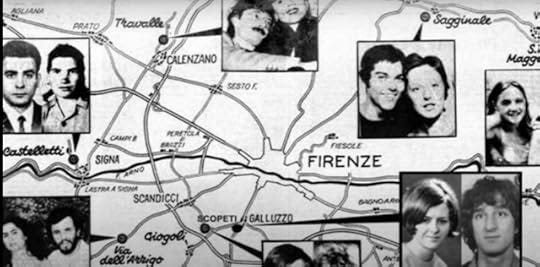
Between June 1981 and September 1985, six more double murders were committed in the hills around Florence. The same gun. The same bullets. A consistent pattern: couples parked in secluded areas on dark roads, chosen for privacy, found shot through car windows on weekend nights. The male victim shot and sometimes stabbed. The female victim removed from the car, stabbed extensively, and in several cases subjected to precise surgical mutilations the removal of the pubic area, and in the later cases the left breast, performed with a bladed instrument and a degree of anatomical knowledge that suggested something more deliberate than frenzied violence.
In several cases the bodies were found on moonless nights. This was not coincidence. The killer was selecting his nights as carefully as he was selecting his locations.
True Crime Weekly is a reader-supported publication. To receive new posts and support my work, consider becoming a free or paid subscriber.
The dates and victims:
June 6, 1981: Giovanni Foggi, thirty, and Carmela De Nuccio, twenty-one, an engaged couple, parked near Scandicci. Shot and stabbed. De Nuccio’s body mutilated.
October 22, 1981: Stefano Baldi, twenty-six, and Susanna Cambi, twenty-four, also engaged, parked near Calenzano. Shot and stabbed. Cambi mutilated in the same manner as De Nuccio.
June 19, 1982: Paolo Mainardi, twenty-two, and Antonella Migliorini, twenty, parked near Baccaiano. Shot. When police arrived, Mainardi was still alive conscious, unable to speak, dying. He died in hospital without being able to identify anything. Migliorini was stabbed. In this case, the mutilation was not completed, suggesting the killer had been interrupted or disturbed.
September 9, 1983: Two German university students, Wilhelm Friedrich Horst Meyer, twenty-four, and Jens-Uwe Rüsch, twenty-four, parked near Giogoli in a camper van. Shot and stabbed. Investigators noted that both victims were male, but concluded that Rüsch’s long hair may have caused the killer to mistake him for a woman. This case disturbed investigators: it implied that the Monster’s selection process was not infallible, that he was acting in darkness and could err.
July 29, 1984: Claudio Stefanacci, twenty-one, and Pia Gilda Rontini, eighteen, parked near Vicchio. Shot and stabbed. Rontini’s body was mutilated pubic area removed, left breast removed.
September 8, 1985: Jean-Michel Kraveichvili, twenty-five, and Nadine Mauriot, thirty-six, a French couple camping in a tent in the woods near Scopeti, south of Florence. Shot in their tent. Stabbed. Mauriot’s body mutilated in the same manner as Rontini.
Several days after the Scopeti murders, the Florence prosecutor’s office received a package in the mail. Inside was a taunting letter. And part of Nadine Mauriot’s left breast, excised and mailed to a prosecutor as a statement that the killer had not been caught and had no fear of being caught.
After the Scopeti murders, the killings stopped.
The City That Changed Its Behaviour
Florence is not a large city. The area of the killings the hills and rural roads surrounding the city, the places where young couples went for the privacy they couldn’t find in shared apartments and family homes was a geography known to everyone who had grown up there. By 1981, after the return of the murders, this geography had become a source of dread so acute that it functionally changed how people lived.
Couples stopped going to isolated roads. Lovers’ lane culture so deeply embedded in Italian youth life as to be almost a rite of passage effectively ended in the hills around Florence. Those who had to drive at night on remote roads reported doing so with windows closed and doors locked and eyes scanning the darkness. In a city that had never had to think this way, the Monster had created an invisible perimeter of fear that moved with him and outlasted each killing.
The media coverage was total and, as it went on, increasingly unhinged. Every new murder generated weeks of front-page coverage. Investigators gave interviews. Theories multiplied. The case acquired the qualities of a national obsession not merely because of its horror, but because of the specificity of the horror, the regularity of it, the impossibility of explaining it in terms that made ordinary sense. This was not passion, not organised crime, not terrorism, not robbery. This was something Italian culture did not have a prepared category for, and the struggle to find a category consumed enormous intellectual and investigative energy.
Thomas Harris attended the trial of Pietro Pacciani in the 1990s and based portions of his novel Hannibal set in Florence, featuring an FBI agent pursuing a predatory killer on the atmosphere and details of the case. The Monster of Florence became the scaffolding for a work of global popular culture while remaining unsolved.
If you enjoy my true crime coverage, please help me continue my newsletter by upgrading here:
The Sardinian Trail
The initial investigative theory in the years after 1981 was what became known as the “pista sarda” the Sardinian trail. It ran as follows: the 1968 murders of Barbara Locci and Antonio Lo Bianco had a Sardinian dimension. Locci had been involved with a number of men, several of them Sardinian immigrants. The gun used in 1968 might have passed through Sardinian hands. The killer might be connected to this community.
Several men were arrested and investigated. Francesco Vinci, a former lover of Barbara Locci’s, was among the primary suspects. He and various relatives of Stefano Mele were scrutinised extensively. Some were imprisoned while the investigation continued.
While they were imprisoned, the Monster killed again.
Each murder that occurred while a suspect was in custody eliminated that suspect. Each elimination sent the investigation in a new direction. The Sardinian trail was followed, then abandoned. New names emerged. New theories. The investigation was simultaneously too large too many investigators, too many competing theories, too little coordination and too small, lacking the resources and the conceptual framework to do what a case of this complexity actually required.
Pietro Pacciani
In 1985, after the Scopeti murders, the Florence prosecutor’s office received an anonymous letter suggesting they look at a man named Pietro Pacciani. The letter described him as “a dangerous violent man who mistreats his wife and daughters.”
This was accurate, as far as it went. Pacciani was a sixty-year-old itinerant farmer from San Casciano Val di Pesa, a town south of Florence. He had a documented history of violence. In 1951 he had been convicted of murder: he had discovered his fiancée with a travelling salesman and had beaten the man to death with a rock, then raped his fiancée over the body. He had served fourteen years. In 1987, he was convicted again, this time for raping his two daughters repeatedly over a period of years; he served four years.
He was, in other words, a brutal man with a proven capacity for sexual violence. Investigators building a psychological profile of the Monster working from FBI profiling methods, one of the first applications of this methodology in Italian law enforcement found a plausible match in Pacciani’s history.
He was also, by the time of his 1994 trial, a sixty-eight-year-old man with a cardiovascular disease and a convincing performance of simple rural bewilderment. He sat in court looking confused and frightened. He cried. He prayed. He called himself “a simple little man.” The Italian press loved him and hated him simultaneously, and the trial became a media spectacle that drew international attention.
He was convicted in 1994 of seven of the eight double murders and sentenced to life in prison.
In 1996, the Florence Court of Appeal overturned the conviction due to insufficient evidence and sloppy investigative work. Pacciani walked free.
The Italian Supreme Court quashed the acquittal and ordered a new trial.
Pacciani died of a heart attack in February 1998, at home, before the new trial could begin. He was found dead on his kitchen floor with his trousers around his ankles. A toxicology report found a pharmaceutical compound in his system consistent with either voluntary overdose or administration by another person. No one was charged.
He died, in the eyes of Italian law, neither convicted nor acquitted. The legal position was and remains that Pacciani was a suspect who died before his case was resolved.
The Snack Buddies
The investigation did not end with Pacciani’s death. Investigators had developed the theory that the Monster had not acted alone that Pacciani was one member of a small group, and that the group included at least two other men.
Mario Vanni and Giancarlo Lotti were arrested in 1996. Vanni, known locally as “Torsolo,” had been a witness at Pacciani’s original trial, during which he had described their relationship with a phrase that became darkly famous: they were “snack buddies” (”compagni di merende”), men who got together to eat snacks. Nothing more.
Lotti eventually confessed. Under sustained questioning, he admitted to having been present at several of the murders. He implicated both Pacciani and Vanni. He described a division of roles in which Pacciani fired the gun and Vanni handled the knife and the mutilations, while Lotti served as a lookout though under further pressure he admitted to having also participated more directly in at least one killing.
Lotti’s testimony was the primary basis for the convictions that followed. In 2000, Vanni and Lotti were convicted of four of the eight double homicides and sentenced to life imprisonment and twenty-six years respectively. Lotti’s confession, as the foundation of those convictions, was decisive.
It was also deeply problematic. Lotti was an alcoholic with limited cognitive function who had been extensively questioned before his confession. The physical evidence linking him and Vanni to the specific crimes was minimal. No DNA, no fingerprints, no forensic trace connected either man to the crime scenes. The gun was never found. The anatomical materials removed from victims were never found. The convictions rested largely on the word of one of the convicted men against his co-defendants, corroborated by the testimony of a man named Fernando Pucci, Lotti’s friend, whose account was also contested.
True Crime Weekly is a reader-supported publication. To receive new posts and support my work, consider becoming a free or paid subscriber.
Many Italian legal scholars, journalists, and investigators believe that while Vanni and Lotti may have had some peripheral connection to some of the crimes, the actual Monster the man who fired the gun, who selected the victims, who sent the letter with the excised tissue was someone else entirely. Someone who has never been named in any indictment. Someone who, if still living, is now in his seventies or eighties.
The Satanic Sect Theory
In 2001, with the Vanni and Lotti convictions secured but the case still feeling incomplete, a new theory emerged from prosecutors in Florence: the murders had been committed at the behest of a shadowy sect of wealthy men who collected the excised body parts. The victims had been ritual offerings. The Monster whether Pacciani, Lotti, Vanni, or someone else had been a tool of something larger and darker.
This theory consumed years of investigation and the careers of several prosecutors. A doctor named Francesco Narducci, who had died under suspicious circumstances in Lake Trasimeno in 1985, was exhumed and re-examined. Wealthy individuals in Tuscany were investigated. The journalist Mario Spezi, who had covered the Monster case for his entire career and had co-authored a book on it with American novelist Douglas Preston, was arrested in 2006 on charges of defamation and obstruction of justice related to his disagreements with the prosecutors’ theory.
Douglas Preston was also interrogated and told he was a suspect. He left Italy.
Spezi was eventually released and the charges did not result in conviction. The satanic sect theory was never proven. It produced no additional convictions and is widely regarded, by serious analysts of the case, as a digression that allowed the investigation’s underlying failures to be obscured by a more dramatic narrative.
The Gun
The .22 calibre Beretta fired Winchester Series H bullets. The same weapon appeared in every confirmed Monster killing from 1968 to 1985, linking eight double homicides across seventeen years.
It was never found.
This is perhaps the single most important fact in the case, because it speaks to a killer with sufficient discipline and planning to retain the weapon to keep it, move it, use it again and again without it ever being traced. A man who kept a murder weapon for seventeen years and used it eight times is not an impulsive killer. He is not a spontaneous killer. He is not a simple man in the grip of compulsions he cannot control.
He is someone who made considered decisions.
In 2024, a DNA analysis of bullets recovered from three of the later crime scenes found a consistent profile a profile that did not match any convicted person and did not match any of the named suspects. Investigators cautioned that the DNA could represent contamination from evidence handlers over the decades. Others found it significant.
The gun remains missing. The DNA profile remains unmatched. The case remains, officially, open.
Thomas Harris and the Legacy
In 1999, Thomas Harris published Hannibal, the sequel to The Silence of the Lambs. Set partly in Florence, it drew explicitly on the atmosphere of the Monster case and on a character type that Harris had developed partly from his observations of the Pacciani trial. The Florentine backdrop the beauty of the city, the horror in the surrounding hills, the sense of an ancient evil operating just beyond the reach of modern rationality was something Harris captured in ways that brought the case to an international audience that had never heard of Pietro Pacciani or Mario Vanni.
The Monster of Florence as a cultural object became partly what Harris made it, and partly what Douglas Preston and Mario Spezi made it in their 2006 nonfiction account of the same name, and partly what the Netflix drama of 2025 made it. Each version emphasised different elements. None of them resolved what the actual investigation could not resolve.
The sixteen people killed in the Florentine hills between 1968 and 1985 remain the unorganised centre of the case the fact around which the theories, the trials, the books, and the films orbit without landing. Their names are: Barbara Locci, Antonio Lo Bianco, Pasquale Gentilcore, Stefania Pettini, Giovanni Foggi, Carmela De Nuccio, Stefano Baldi, Susanna Cambi, Paolo Mainardi, Antonella Migliorini, Wilhelm Friedrich Horst Meyer, Jens-Uwe Rüsch, Claudio Stefanacci, Pia Gilda Rontini, Jean-Michel Kraveichvili, Nadine Mauriot.
They range in age from eighteen to thirty-six. They were killed in cars, in a camper van, in a tent. Most of them had gone somewhere private for the most ordinary of human reasons, and the last thing they saw was a shape approaching in the dark.
What We Know and What We Don’t
What is certain: a single .22 calibre Beretta was used in eight double homicides in the hills around Florence between 1968 and 1985. The gun was used consistently across seventeen years by someone who knew how to use it, how to conceal it, and how to select victims and locations with a degree of planning that minimised risk of discovery.
What is probable: Stefano Mele, convicted of the 1968 murders, was almost certainly not the primary perpetrator, having been in prison when subsequent murders were committed with the same weapon. The Monster was someone else someone who may have been present at the 1968 scene, or who may have acquired the gun afterward.
What is contested: whether Pacciani, Vanni, and Lotti were genuinely involved in any of the murders, or whether they were convicted on the basis of an inadequate investigation desperate for closure, with a particularly unreliable confession as its primary evidence.
What is unknown: the identity of the person who fired the gun. Why the killings stopped after 1985. What happened to the missing anatomical materials. Who sent the taunting letter and the excised tissue. Whether the DNA found on bullets in 2024 will eventually match anyone.
The Monster of Florence is sometimes described as Italy’s Jack the Ripper an unsolved serial murder case that became a cultural landmark, that inspired fiction and obsession in roughly equal measure, that exposes something about the society in which it occurred. The comparison holds in some respects. Like the Ripper case, it generated more investigative confusion than clarity. Like the Ripper case, it attracted theorists whose investment in their theories sometimes exceeded their investment in the truth.
Unlike the Ripper case, the Monster of Florence resulted in criminal convictions. Whether those convictions represent justice for the victims is a question that Italian courts, Italian journalists, and the families of the dead have been asking for over twenty years, without arriving at an answer that satisfies everyone or perhaps anyone.
The last murders attributed to the Monster of Florence occurred on September 8, 1985. Jean-Michel Kraveichvili was twenty-five. Nadine Mauriot was thirty-six. They were camping in a tent in the woods south of Florence. The killer found them in the dark. Days later, his letter arrived at the prosecutor’s office. He has never been conclusively identified. The tent is long gone. The hills are still there.
 True Crime Weekly
Leave a comment