The Capital in 1971
Washington DC in the spring of 1971 was a city at war with itself.
On May 3rd and 4th, less than two weeks after the first murder in this story, the city became the site of the largest mass arrest in American history. Tens of thousands of anti-Vietnam War protesters descended on the capital with the stated intention of shutting the government down. They blockaded bridges, blocked intersections, lay down in traffic.

The Nixon administration responded with overwhelming force: 12,000 people were arrested in two days, packed into makeshift detention centres, denied basic legal rights. It was, depending on who was telling the story, either the suppression of legitimate dissent or the restoration of order, and it consumed the attention of every journalist, every politician, every law enforcement resource in the city for weeks.
If you enjoy my true crime coverage, please help me continue my newsletter by upgrading here:
In Southeast DC, in the neighborhoods around Anacostia poor, Black, underserved, largely invisible to the parts of the capital that made the news a thirteen-year-old girl named Carol Spinks had been missing since April 25th. Her body had been found on May 1st. Police were investigating. The media were not interested.
This was not a coincidence. It was a pattern. And the pattern would persist for the next seventeen months, through five more murders of Black girls and young women, as the nation’s capital proved incapable of or uninterested in protecting its most vulnerable residents.
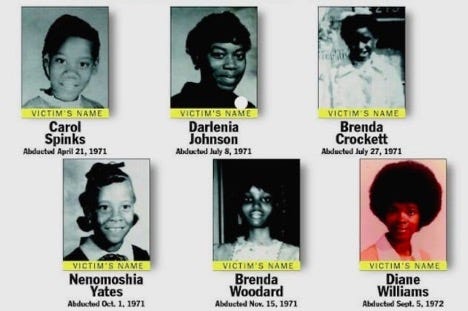
Carol Denise Spinks, 13
Carol Spinks was one of eight children raised by her mother, Allenteen Van Thompson Reeves, in Southeast DC. Her family called her “Bay Bay.” She had an identical twin sister named Evander. On the evening of Sunday, April 25, 1971, she was sent by an older sibling to buy groceries at a 7-Eleven located half a mile from their home, just across the DC-Maryland line.
She bought the groceries. Witnesses saw her leave the store. Then she vanished.
True Crime Weekly is a reader-supported publication. To receive new posts and support my work, consider becoming a free or paid subscriber.
Six days later, at 2:46 in the afternoon, her body was found on a grassy embankment behind St. Elizabeths Hospital on the northbound lanes of I-295, approximately 1,500 feet south of Suitland Parkway. She had been raped and strangled. She was dressed, but her shoes were missing. The medical examiner determined she had been killed only a few days before her body was discovered, meaning she had been held alive for some period after her abduction a detail that was noted, filed, and would prove significant only in retrospect.
The investigation generated no significant leads… what came next was shocking
Darlenia Denise Johnson, 16
On July 8, 1971 ten weeks after Carol Spinks was abducted sixteen-year-old Darlenia Johnson left her home in Congress Heights in Southeast DC to walk to her summer job at the Oxon Hill Recreation Center across the Maryland line. She was outgoing, social, the kind of teenager who had a job and spent her summers working it. She did not arrive.
Her body was found on July 13th in a wooded area near the Suitland Parkway, not far from where Carol Spinks had been found. She had been raped and strangled. Her shoes were missing. Green fibres later identified as rayon, possibly from a bath rug or carpet were found on her clothing.
The green fibres would reappear. That detail connected her to what was coming.
Still, the city did not treat these deaths as an emergency. The press did not make them front page. The Metropolitan Police Department, under substantial pressure from the anti-war protests and the political turbulence of the summer of 1971, did not assign the resources that two murdered children warranted.
The mothers of these girls working-class Black women in Southeast DC had to find out more from news reporters canvassing their neighbourhoods than from the police investigators assigned to their daughters’ cases. That asymmetry of information, of attention, of urgency, is the subtext of everything that follows.

Brenda Faye Crockett, 10
Brenda Faye Crockett was ten years old. She lived in Northwest DC near Cardozo High School. On July 27, 1971, her mother sent her to the store. She didn’t come home.
About two hours after she failed to return, the telephone rang in the Crockett household. Brenda’s seven-year-old sister answered.
It was Brenda.
She was crying. She told her sister: “A white man picked me up, and I’m heading home in a cab.” She said she thought she was in Virginia. She said goodbye and hung up.
A short time later, the phone rang again. This time Brenda’s stepfather answered. Brenda repeated what she had told her sister. She added: “Did my mother see me?” She said she was alone in a house with a white male. Her stepfather asked to speak to the man. Heavy footsteps were heard in the background. Brenda said “I’ll see you” and hung up again.
Investigators could not trace the calls. They noted the information a white man, Virginia and proceeded on that basis. Later analysis would suggest the calls were almost certainly scripted, with false information provided to misdirect the investigation. The killer, most investigators came to believe, was almost certainly not white. The detail about Virginia was almost certainly false. Brenda was almost certainly not calling from a place where she had any freedom of movement.
She was describing, in fragments, what she had been told to describe.
The next morning, Brenda Crockett’s mother screamed. A hitchhiker had found Brenda’s body along US Route 50 near the Baltimore-Washington Parkway in Prince George’s County, Maryland. She had been raped and strangled. Her shoes were missing. The green rayon fibres were on her clothing.
She was ten years old.
Her sister Bertha, who had answered that first call, was seven. She told interviewers fifty years later: “I was scared for me, and every other little girl after that.”
A Name and a Pattern
It was after the fourth murder twelve-year-old Nenomoshia Yates, abducted on October 1, 1971, while walking home from a Safeway a single block from her home in Northeast DC, found three hours later on the shoulder of Pennsylvania Avenue in Prince George’s County, raped, strangled, shoes missing, green fibres on her clothing that a reporter at the Washington Daily News finally gave the killer a name.
The Freeway Phantom.
The name stuck because the bodies were found near freeways. It also stuck because it described, with inadvertent accuracy, the quality of the investigation: something glimpsed but never apprehended, something real but lacking substance, something that the city’s systems couldn’t quite seem to grasp.
A witness reported seeing Nenomoshia getting into a blue Volkswagen near the Safeway. The lead was investigated. It went nowhere.
The FBI was brought in. A telephone hotline was established. Tips poured in from the community priests, police officers, doctors, every category of man that the neighbourhood could imagine. None of them led to an arrest.
Brenda Denise Woodard, 18
The fifth victim was different in several ways that the investigation would fixate on for decades.
Brenda Denise Woodard was eighteen years old, from Baltimore, visiting a high school classmate in DC. On the evening of November 15, 1971, she boarded a city bus at around 11:30 pm to return to her Maryland Avenue home. About six hours later, a police officer found her body in a grassy area near Prince George’s County Hospital along an access road. She had been stabbed multiple times and strangled. A velvet coat had been laid over her body, a gesture of deliberateness that stood apart from the disposal method in other cases. Her shoes were missing.
Police found a handwritten note inside the coat pocket.
The note read: “This is tantamount to my insensitivity to people, especially women. I will admit the others when you catch me, if you can!”
The Freeway Phantom had communicated directly. The note was analysed exhaustively. Handwriting experts studied it. Linguists noted the vocabulary “tantamount” was not a word in common casual use, suggesting education or deliberate performance of education. The killer was taunting. He was confident. He was specific about the gender of his contempt: especially women.
The note transformed the case in the public mind. It turned an investigation into something more chilling a correspondence, a dare, a relationship between killer and city that the city was losing.
Diane Williams, 17
The killings stopped after Brenda Woodard. Ten months passed. The investigation continued. The FBI remained involved. Media attention, which had finally arrived, began to wane. The city’s attention moved to Watergate, which was beginning to gather momentum as a political story through the spring and summer of 1972.
On September 5, 1972 almost a year to the day after Nenomoshia Yates’s murder seventeen-year-old Diane Williams cooked dinner for her family and then went to visit her boyfriend in Southeast DC. She was a senior at Ballou High School. She was seen boarding a bus at 11:20 pm near her boyfriend’s house. A few hours later, her strangled body was found alongside I-295, just south of the District line. Her shoes were missing. No signs of sexual assault were found, though traces of semen assumed to be from her boyfriend were present.
The Freeway Phantom had returned. And then, after Diane Williams, he stopped.
No further murders were conclusively linked to him. Whether he died, moved, was imprisoned for another crime, or simply stopped for reasons unknown is one of the case’s many unanswered questions.
What the Investigation Found
The physical evidence, assembled across all six cases, told a consistent story about method and habit.
The killer bathed his victims before disposing of their bodies. Investigators concluded this was either an expression of guilt washing away what he had done or, more likely, a deliberate attempt to destroy trace evidence. What he didn’t know, or didn’t fully account for, was that when he placed the bodies on the ground, the cleaned skin picked up new trace evidence from the surface. The green rayon fibers found on multiple victims were almost certainly from a bath rug or carpet in a location where he held the girls. The fibers were consistent across cases. He was bringing them somewhere, keeping them for some period, cleaning them, and then transporting them to freeway embankments.
The locations where bodies were found clustered around a particular geographic anchor: St. Elizabeths Hospital, a large federal psychiatric facility in Southeast DC. Investigators noted that the Phantom had to know the area well the roads, the embankments, the places where a body could be left in darkness and not found immediately. He was almost certainly local, or had been local long enough to move through the neighbourhood with familiarity.
The missing shoes appeared in every case but the last. No explanation for this signature was ever definitively established. It may have been a trophy. It may have been a compulsion. It may have been something else entirely that investigators never publicly speculated about.
The Suspects
Three men were seriously investigated as potential Freeway Phantom suspects. None was ever charged with the murders.
Robert Elwood Askins was a fifty-eight-year-old computer technician arrested in March 1977 for abducting and raping a twenty-four-year-old woman inside his Washington DC home. When investigators began examining his history, they found a record that dated back to 1938, when Askins then nineteen had served cyanide-laced whiskey to five women at a brothel, killing one of them. He had been institutionalised, then released, then had accumulated further charges over the following decades. He had spent time at St. Elizabeths Hospital as a patient.
The geographic connection was significant. His history of violence against women was significant. His age and circumstances during 1971–1972 placed him in the area. Investigators considered him seriously. They were never able to gather sufficient evidence to charge him with the Freeway Phantom murders. He died in prison, serving time for the 1977 rape.
Edward Leonard Sellman and Tommie Bernard Simmons, two former DC police officers, were arrested in connection with the murder of a fourteen-year-old girl named Angela Denise Barnes, who had initially been considered a possible Freeway Phantom victim. The investigation ultimately concluded that Barnes’s murder was not connected to the Freeway Phantom series. Sellman and Simmons were pursued for her death specifically, not the broader murders.
The Freeway Phantom was never charged.
Why Nobody Knows
The case has generated, in retrospect, a substantial accounting of its own failures.
The jurisdictional problem was fundamental. The murders occurred across multiple jurisdictions the District of Columbia and Prince George’s County, Maryland, primarily and the Metropolitan Police Department and the Prince George’s County Police had no effective mechanism for sharing evidence and intelligence in real time. They communicated by phone and letter. Investigators who needed to compare notes drove to meet each other. The infrastructure for the kind of coordinated multi-jurisdictional response the case required did not exist.
The racial dynamics of the investigation are impossible to separate from its failures. The victims were Black girls from Southeast DC a community that had, by 1971, well-established reasons to distrust the predominantly white Metropolitan Police Department and to expect that their concerns would not be treated with the urgency afforded to wealthier or whiter victims. When investigators looked at the case files decades later, they found police reports in which the parents of these children were asked whether the girls might have gone off with boyfriends asked, in some cases, to account for their daughters’ behaviour in ways that implicitly questioned whether the girls were in fact victims. One girl was described in a police report as dressed provocatively. She was wearing her school gym clothes.
The community knew things that the police didn’t know they knew, because trust ran in one direction only. The phone tips that came into the hotline were real and numerous and produced almost nothing actionable because the framework for evaluating them was inadequate and the relationship between police and community was too damaged to function as an intelligence network.
The timing compounded everything. The city was consumed by politics the anti-war movement, then Watergate, then the 1972 election in ways that absorbed both investigative resources and media attention. Six Black girls murdered in Southeast DC competed for column inches against the most consequential political scandal in American history and lost, repeatedly and completely.
The Families
The families of the six victims have waited fifty-three years for an answer that has not come.
Carol Spinks’s sister Evander, who was Carol’s identical twin, has spoken publicly about the case for decades. She says that what she wants, still, is to be able to tell Carol who did it. The desire is not abstract. It is specific and present and has not diminished.
Brenda Crockett’s sister Bertha who at seven years old answered the phone and heard her sister crying and understood even then that something was wrong has also spoken publicly, and described the fear of that summer in terms that make clear it never fully left her. “I was scared for me, and every other little girl after that.”
The families were not given information during the investigation. They were not kept informed as the years passed and the case went cold. They learned about developments in their daughters’ cases, sometimes, from news reporters. The Metropolitan Police Department established a reward of up to $150,000 for information leading to the identification of the killer, even if deceased. Podcast producers matched that figure, bringing the total reward to $300,000. No one has collected it.
The case remains open. The Metropolitan Police Department’s Major Case/Cold Case Unit lists it as an active investigation. Forensic genealogy technology has transformed the solvability of cold cases across the country in recent years; in principle, if biological material from the Freeway Phantom’s victims survives in adequate condition, it may one day yield a profile, and a profile may one day yield a name.
In the meantime, the note sits in an evidence file somewhere in DC. I will admit the others when you catch me, if you can.
They haven’t caught him yet.
Carol Spinks was thirteen years old. She had an identical twin. She was sent to buy groceries half a mile from home. Brenda Crockett was ten years old. She called home twice from wherever she was being held, crying, trying to tell her family where to find her. Neither of them came home. Neither of them has received justice. Their killer is still unidentified.


Leave a Reply