Baltimore, Maryland, 1994–1996 a drifter who started killing to find his family and kept killing because he found he liked it, and the stand along the highway where nobody asked questions about the meat
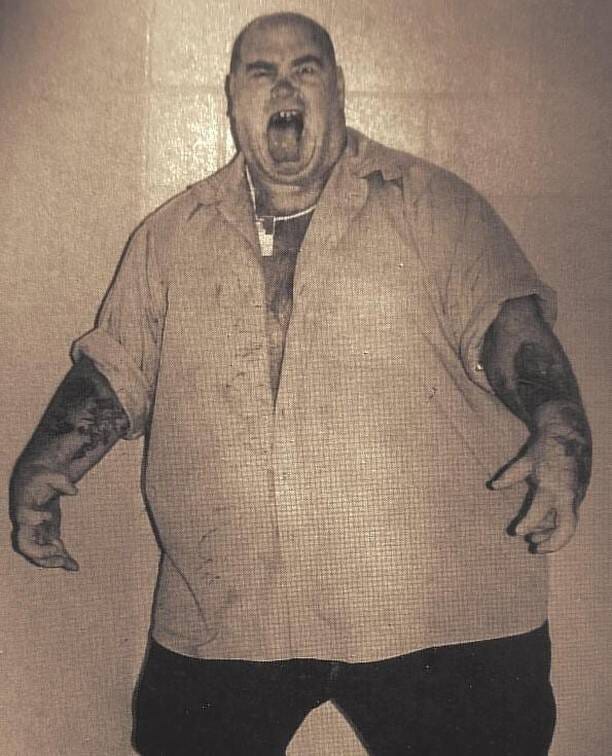
Essex, Maryland
If you enjoy my true crime coverage, please help me continue my newsletter by upgrading here:
Joseph Roy Metheny was born on March 2, 1955, in Baltimore, Maryland, the second of six children raised in Essex, a blue-collar suburb east of the city. His father was an alcoholic who died in a car accident when Joe was six years old.
His mother worked double shifts to keep the family fed. There is some dispute about the quality of the childhood that followed Metheny’s attorneys claimed the children were frequently neglected and that his parents arranged informal foster situations, sending him off to live with other families without explanation or stability; his mother disputed this, saying that despite their poverty the children had a normal upbringing and never went hungry. The truth is probably somewhere between these accounts, as it usually is.
What is not disputed is that Joe Metheny left home in 1973 when he was nineteen, joined the Army, and drifted steadily away from anything resembling a fixed life. He had a wife and a son at some point. He worked blue-collar jobs lumberyards, truck driving, labor with varying degrees of reliability. He used drugs heavily and consistently.
By the early 1990s he was effectively homeless, living in camps near the Baltimore waterfront, large and unkempt and angry in ways that had been building since childhood and that the drugs had accelerated rather than relieved.
He was enormous. That detail appears in every account: six feet one inch and somewhere between three hundred and four hundred pounds, a physical presence that was in itself a form of intimidation. He had not done anything catastrophically violent yet, though he had accumulated charges for assault and other offences. He was exactly the kind of man who appears in arrest records and missing persons investigations and background checks and never quite crosses into the category of someone law enforcement is actively looking for.
Until the summer of 1994.
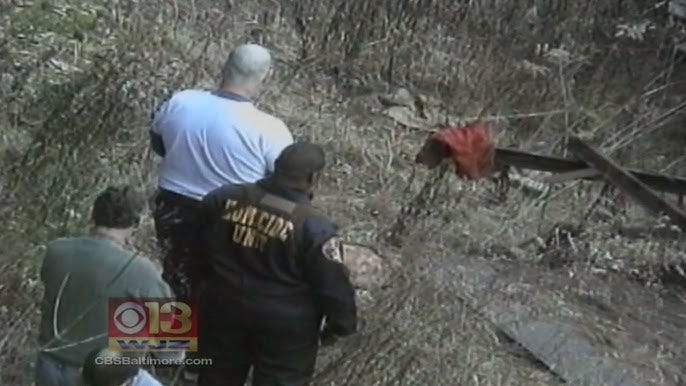
The Wife and the Ax
Joe Metheny’s wife had left him. She had taken their young son and moved in with another man who lived in the homeless camps near the waterfront area of Baltimore the same camps where Metheny had been spending his time. The exact circumstances of the separation and her relocation are not documented in detail, but the result was clear enough: Metheny knew where she was, he knew who she was with, and he was furious.
He went looking for her.
He searched the camps along the waterfront. He asked questions. He was told, by residents of those camps, that she had moved on. He didn’t believe it, or he couldn’t accept it, or both. He kept looking.
One night, drunk and armed with a hatchet, he encountered two homeless men near the camps men who had nothing to do with his wife, men who happened to be in the wrong place at a moment when his anger had nowhere productive to go. He killed them both.
In August 1995, Metheny was charged with those two murders. The evidence was not sufficient to convict him. He was acquitted. He walked out of the courtroom a free man.
If you enjoy my true crime coverage, please help me continue my newsletter by upgrading here:
He later described the acquittal as confirmation that the world would let him do what he wanted. Whether this is retrospective rationalisation or genuine psychological accounting is impossible to determine, but the killings that followed the acquittal had a different quality to them than the waterfront murders they were planned, they were targeted, and they were followed by what Metheny did with the bodies, which was something he could not claim was improvised or reactive.
The Stand
The next phase of Metheny’s killing career targeted sex workers near the truck stops and industrial corridors of Baltimore. He lured them to his trailer he worked for a pallet company and had access to the company’s truck lot near Interstate 95 with offers of drugs or money or shelter. Once inside, he murdered them.
Then he brought out the knives.
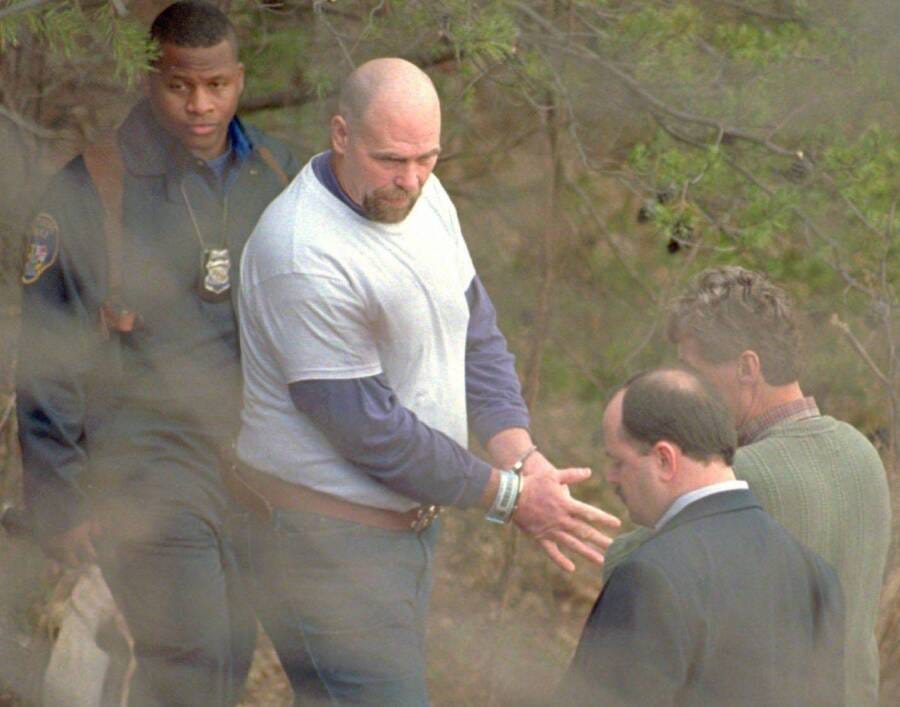
He dismembered the bodies. He stored the usable flesh in a freezer in his trailer. What didn’t fit, or what had decomposed beyond utility, he buried in the truck lot under the pallets.
Over the following weekends, he opened a roadside barbecue stand.
The stand was not elaborate. It was the kind of operation familiar to anyone who has driven through the industrial outskirts of an American city: a pit grill, a folding table, a man selling burgers and sandwiches to passing truckers and workers looking for a cheap meal near the highway. It was the kind of stand that nobody questioned because there was no framework for questioning it it was familiar, it was cheap, it was convenient.
He mixed the flesh of his victims with ground pork and ground beef, formed the mixture into patties, cooked them on the grill, and sold them.
He later told investigators, with the matter-of-fact tone he maintained throughout his confession: “They were very good. The human body taste was very similar to pork. If you mix it together no one can tell the difference.”
He received no complaints.
He told police that when he ran out of what he called his “special meat,” he simply went out looking for another victim. The stand, at that point, had ceased being a method of disposal and had become a routine a cycle of acquisition, preparation, and sale that he had built into his weekly life with the same unremarkable efficiency that someone might bring to any other regular activity.
He warned people, in later interviews, to be careful about where they bought roadside meat. He offered this as a sincere public service announcement.
The Victims
The number of Metheny’s victims is one of the uncertainties of the case. He confessed to ten murders. He was convicted of two and received two death sentences. One additional charge the murder of a woman named Tony Lynn Ingrassia was dropped due to insufficient evidence.
The two murders for which he was convicted were Kimberly Lynn Spicer, thirty-three, and Cathy Ann Magaziner, twenty-seven both women who had come to his trailer and not left it. Their remains were found when investigators, acting on the tip that would ultimately end his run, searched the truck lot and the trailer.
The eight additional murders Metheny confessed to were treated with varying degrees of seriousness by investigators. Some could be corroborated. Others could not. The nature of his victims women in precarious circumstances, some with no fixed address, some estranged from family, some known to law enforcement only as names in police contact logs meant that establishing definitive lists of the missing was genuinely difficult.
True Crime Weekly is a reader-supported publication. To receive new posts and support my work, consider becoming a free or paid subscriber.
Metheny himself was not helpful in the sense of providing consistent, verifiable information. He was helpful in the sense of being forthcoming and unapologetic, which made his confessions detailed but not necessarily reliable. He had a flair for his own notoriety that complicated the question of how much to take at face value.
Rita Kemper and the Fence
The end came in 1996, and it came because Rita Kemper was tougher than Joe Metheny expected.
Kemper was a sex worker who came to Metheny’s trailer and survived an attack in which he beat her severely. The specific details of what happened inside the trailer are not fully documented in public records, but what is documented is what happened next: Metheny turned around for a moment, and Kemper ran.
He described it later with a combination of grudging respect and self-recrimination: “I turned around for a split second, and that was my mistake, for she ran out the door before I could get to her.”
The truck lot was surrounded by an eight-foot chain-link fence topped with barbed wire. Stacked near the fence was a pile of wooden pallets approximately ten feet high. Rita Kemper ran to the pallets, climbed them, cleared the fence, and got away.
She reported the attack to police.
Investigators who searched the property found the bodies. They found the freezer. They found the buried remains in the lot. They found enough to understand what had been happening at the roadside stand.
Metheny was arrested on December 19, 1996.
The Confession
His confession was given without hesitation or reluctance. He did not minimise what he had done. He did not construct excuses or defences. He provided investigators with an account of his crimes that was comprehensive in its self-incrimination and disturbing in its tone, which was throughout the tone of a man describing events he found neither shameful nor particularly dramatic.
He explained the stand. He explained the mixing ratios. He explained that he had received no complaints from customers about the taste or quality of the meat. He explained that he had never personally consumed the meat himself a distinction he appeared to consider meaningful, or at least worth noting.
He told investigators he had enjoyed killing. Not the aspect of it that connected to his original rage about his wife, the aspect that had produced the waterfront murders those he described in the register of grievance. The later killings, he said, were enjoyable in a way that was independent of any specific target or provocation. He had found something in them that he was not willing to characterise as wrong or regrettable.
He said he would never apologise for what he had done.
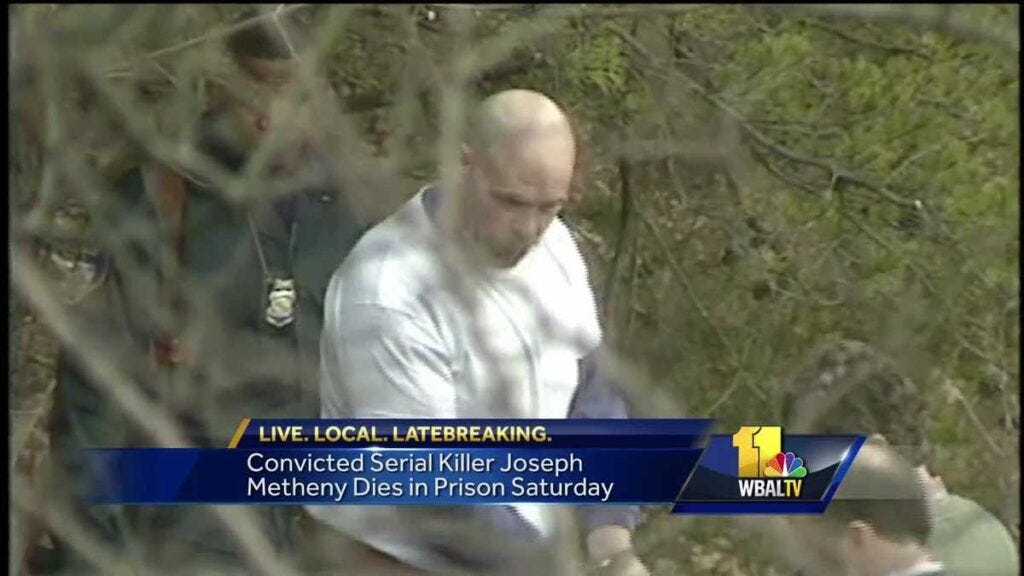
Trial and Sentence
Metheny was tried and convicted of first-degree murder for the killings of Kimberly Spicer and Cathy Magaziner. He received two death sentences. The death sentences were later commuted to life imprisonment without parole under the terms of Maryland’s repeal of its death penalty an irony Metheny noted publicly and without evident satisfaction. He had been prepared to die. Being prepared to die, and then being told you would live instead, was not something he experienced as relief.
He was incarcerated at the Maryland Correctional Institution at Jessup. He gave interviews. He wrote about his crimes with a reflective quality that was not exactly remorse the word he would have used was probably closer to analysis and that documented in his own words the trajectory from the waterfront murders through the stand and everything that followed.
On August 5, 2017, Joe Metheny was found dead in his cell. He was sixty-two years old. The cause was cardiac arrest. He died having never recanted his confessions, having never expressed anything that qualified as regret, having made it clear in multiple forums that if circumstances had been different he would have continued.
The Question of Numbers
The truthful answer to how many people Joe Metheny killed is: we don’t know.
The confirmed answer is two the murders for which he was convicted. The confessed answer is ten, but the confession came from a man who had strategic reasons to inflate his notoriety and no particular incentive toward precision. The suspected answer, based on the pattern of disappearances in the areas where he worked and lived during the years in question, is somewhere between two and thirteen, with investigators at various points suggesting the middle of that range was most plausible.
The stand itself complicates the accounting in a specific way: some of the victims Metheny described disposing of through the stand may have been people whose disappearances were never formally reported, whose absence was noted but not documented, whose names are not in any missing persons database because no one who knew them had the information or the inclination to file a report. Women in the circumstances Metheny targeted drug-addicted, sex-working, marginalised, often estranged from family disappeared regularly from the streets of Baltimore without generating official records.
The number of people who bought food from his stand and ate what he served them is also unknown, because the stand was exactly the kind of informal roadside operation that doesn’t generate receipts or customer lists. Truckers stopping on the highway between loads. Workers grabbing lunch near the industrial park. People who thought they were getting a cheap burger and went home and never knew otherwise.
The Joe Metheny case is frequently discussed as a story about cannibalism filed in the same category as Jeffrey Dahmer and Albert Fish, classified by the consuming detail of the stand and the mixing ratios and the customers who had no idea. The cannibalism angle is what makes it famous, insofar as it is famous.
But the case is actually about something more mundane and more disturbing than the grand transgression of eating human flesh, which is this: Joe Metheny killed people because he found that he could, and then because he found that he enjoyed it, and then because he had integrated it into a routine so ordinary that it included a weekend barbecue stand. The stand was not theatrical. It was not the act of someone making a statement or enacting a fantasy or performing for an audience. It was the act of someone who had converted murder into housekeeping who had found a practical solution to the logistical problem of what to do with a body, and who saw no reason to discard a workable system once he had developed it.
The customers who complained about nothing, who told him the meat was good, were not participants in anything. They were the accidental recipients of a system of disposal that worked because it was disguised as the most ordinary and unthreatening thing in the American landscape: a man at a grill, selling burgers by the highway on a weekend afternoon.
Kimberly Lynn Spicer was thirty-three years old. Cathy Ann Magaziner was twenty-seven years old. Their names are the ones confirmed. The others the full ten that Metheny confessed to, the possible additional victims in the missing persons records of Baltimore in the mid-1990s are a number that closes at an uncertain figure and stays there.
 True Crime Weekly
Leave a comment