The First Body
On March 6, 2025, human remains were discovered in Framingham, Massachusetts. It was a quiet find, the kind of discovery that generates a police report and a brief local news item a body in an unremarkable location, cause of death under investigation, nothing to suggest anything beyond the individual tragedy of one person’s end.
This newsletter is possible thanks to your support. If you enjoy my true crime coverage, please help me continue my newsletter by upgrading here:
Nobody paid much attention.
By the time the thirteenth body was found three months later, all of New England was paying attention. Facebook groups with names like “New England Serial Killer” were amassing tens of thousands of members. Cable news was running nightly segments. Online amateur investigators were mapping the discoveries, drawing lines between the locations, constructing theories with the confidence of people who had watched too many true crime documentaries and perhaps not enough forensic science lectures.
The authorities were saying, consistently and with some frustration: there is no confirmed connection between these cases. Law enforcement agencies had consistently stated that the deaths were not linked. Each case was being investigated independently.
The internet didn’t believe them. Here is the rest…
The Timeline
What follows is a chronological accounting of the cases that fuelled the panic between March and June 2025.
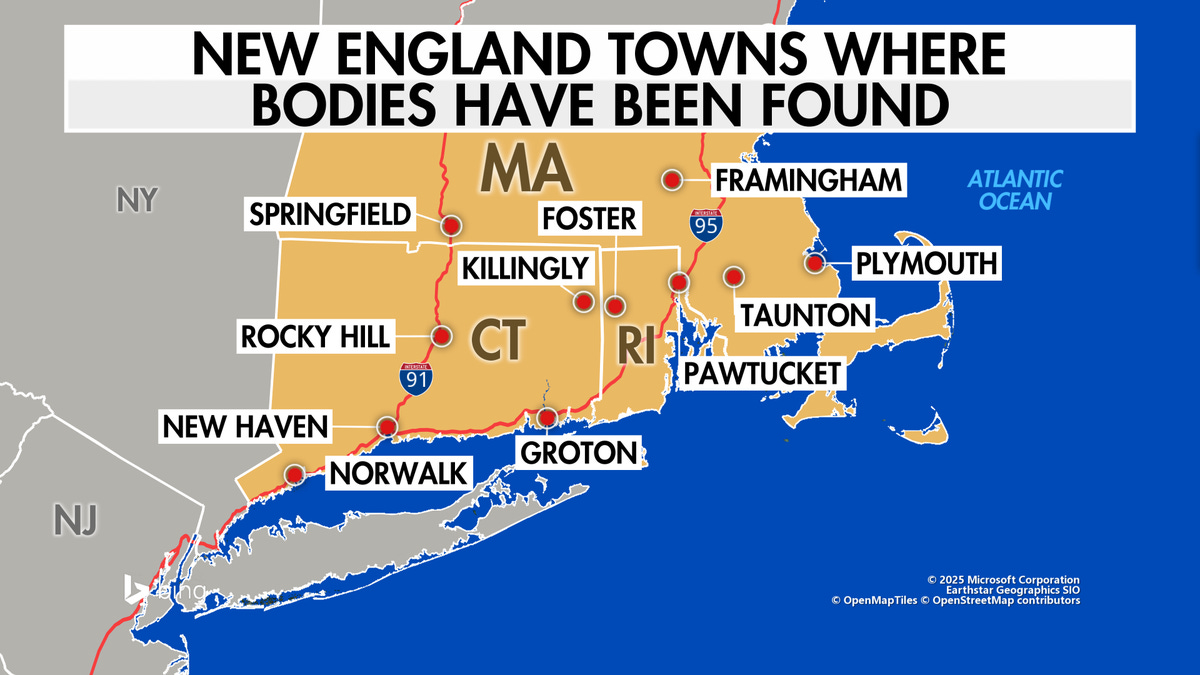
March 6, Framingham, Massachusetts. Human remains discovered. Initial investigation found no obvious signs of foul play.
March, Plymouth, Massachusetts. Remains found in a condition that varied significantly from the Framingham case a skull, rather than an intact body, suggesting a death that had occurred considerably earlier than its discovery.
March-April, New Haven, Connecticut. A body found in the city. One of the Connecticut cases that would cluster with several others in the public imagination as part of a pattern.
April 9, Killingly, Connecticut. Unidentified remains discovered.
April 20, Pawtucket, Rhode Island. A body pulled from the Seekonk River.
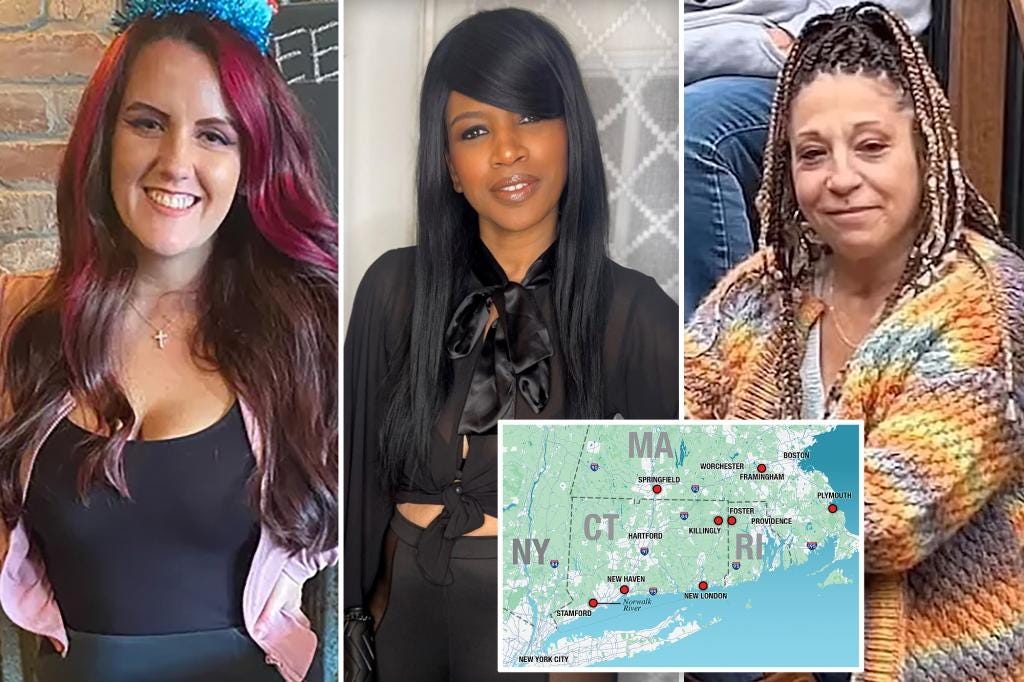
April 22, Springfield, Massachusetts. The body of forty-five-year-old Meggan Meredith was found near a bike path at the 1500 block of Hall of Fame Avenue. Springfield police and the Hampden District Attorney’s murder unit confirmed her death was being investigated as a homicide. This was the case that generated the most immediate media attention a named victim, a confirmed homicide investigation, found near a public path in a city people knew.
April 27, Rocky Hill, Connecticut. A body found in the Connecticut River.
April 27, Taunton, Massachusetts. Another body, the same day as Rocky Hill, across the state line.
Groton, Connecticut; Norwalk, Connecticut; Foster, Rhode Island. Additional remains found in this period, the exact dates varying across reports.
May 30, New Haven, Connecticut. Thirty-four-year-old Jasmine Wilkes found deceased in Edgewood Park.
June 1, Milton, Massachusetts. The discovery that brought the count to thirteen and pushed the story to national prominence: twenty-one-year-old Adriana Suazo, a Boston resident, found by a passerby in a wooded area in Milton, approximately eight miles south of the city, at 11:45 in the morning. The Norfolk District Attorney’s Office said there were no obvious signs of trauma, and the cause of death was under investigation by the Office of the Chief Medical Examiner.
Suazo’s sister Melanie Pizarro told reporters she “just wants to know the truth.”
The Fear
What happened online in the weeks between the first discoveries and the final count was a demonstration of how quickly a pattern real or imagined can be constructed from coincident data and distributed fear.
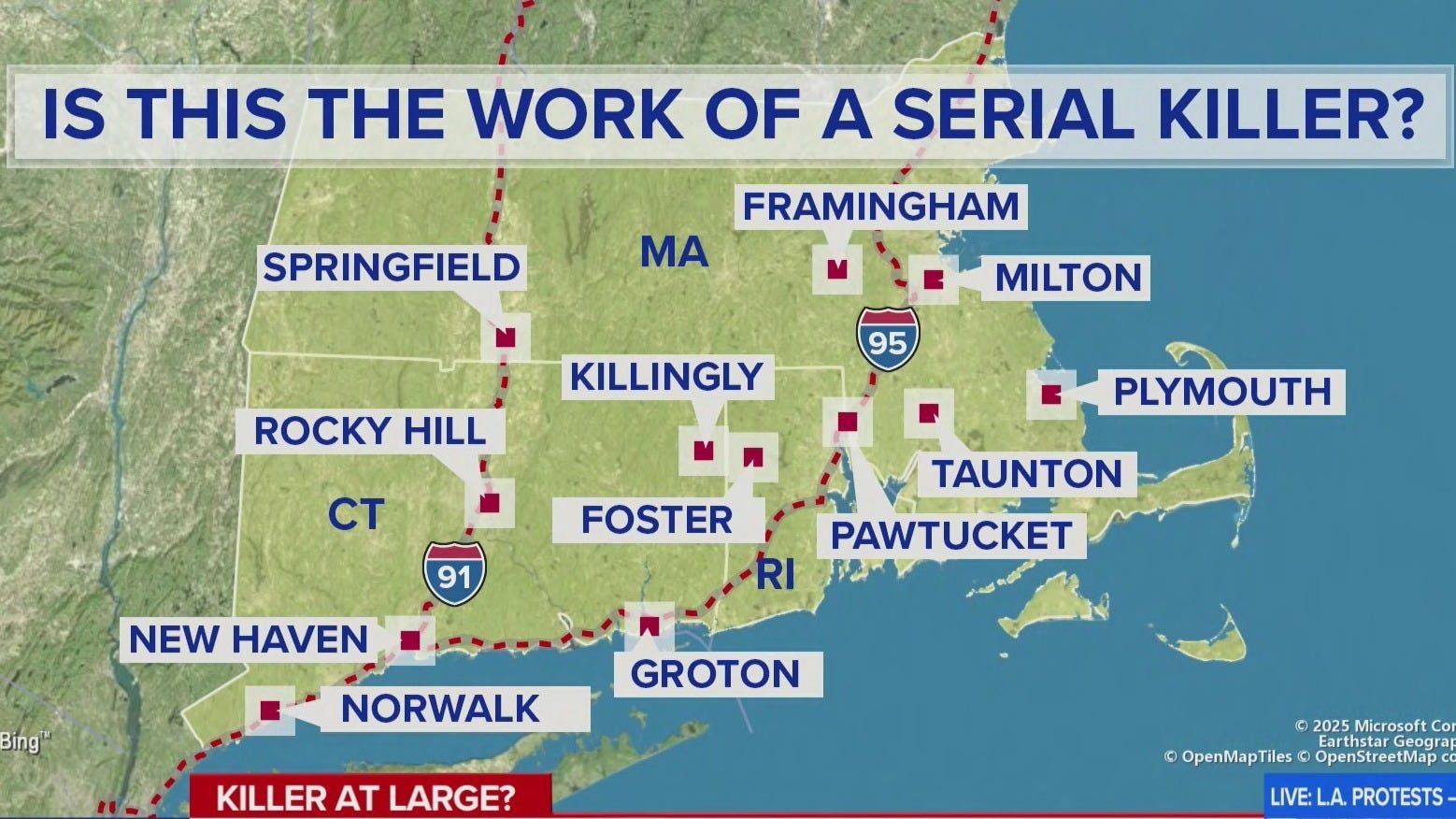
Online sleuths focused on the cases and joined Facebook groups that mushroomed in recent months, with one amassing more than 32,000 followers. The group that gave the panic its name “New England Serial Killer” was eventually renamed under pressure from Facebook’s content policies, but not before it had become the primary gathering place for a community of amateur investigators who were sharing locations, victim names, theories, and an escalating conviction that the authorities were either incompetent or actively covering something up.
The theories varied in their sophistication and their plausibility. Some pointed to geography most of the bodies had been found within a roughly seventy-mile radius, clustering around interstate corridors, near water, in wooded or semi-remote areas. The geographic proximity was real.
Whether it was meaningful was a different question. New England is a densely populated region with a relatively small total land area; bodies found anywhere in Massachusetts, Connecticut, and Rhode Island are going to be geographically proximate to each other almost by definition.
Some pointed to victimology most of the victims, it was noted, were women. This was partly true and partly an artifact of which cases received the most attention. The victims who drew the most sustained coverage were female, which is consistent with longstanding patterns in how missing persons cases and suspicious deaths are reported. But several of the cases in the cluster involved male victims or unidentified remains of indeterminate gender.
Some pointed to timing thirteen bodies in three months was, it was argued, statistically anomalous, a spike that demanded explanation. Here the argument was most superficially compelling and most fundamentally flawed, for a reason that forensic analysts would repeatedly explain and online investigators would repeatedly ignore: discovery dates are not kill dates. In multiple cases, individuals had been missing for months, pointing more to delayed recovery than to an escalating kill cycle.
A body found in April may have been in the ground since November. A body pulled from a river in April may have entered that river in January. The clustering of discoveries in the spring is partly a function of weather snow melts, vegetation thins, people return to outdoor spaces and of the increased activity of people in parks, rivers, and wooded areas that comes with warmer temperatures. Bodies that have been in place through a New England winter are found in spring.
What the Investigators Said
The response of law enforcement was consistent across jurisdictions, and consistently dismissed by the online community as either evasion or cover-up.
Authorities across Massachusetts, Connecticut, and Rhode Island, including Hampden District Attorney Anthony Gulluni and Connecticut State Police, consistently stated that the deaths were not linked. Each case was being investigated independently, with some explicitly ruled as not involving foul play.
Springfield police spokesperson Ryan Walsh told reporters that “internet rumors are just that.”
The forensic inconsistencies alone were striking. One victim was found dismembered in a suitcase. Others showed no visible trauma at all. Several deaths had been submerged in water coastal inlets, ponds, rivers making postmortem interval estimates difficult and obscuring potential findings. There was no public confirmation of consistent wound patterns, ligature marks, unusual toxins, or evidence of sexual assault across the cases.
One analyst writing in the Connecticut Examiner put it plainly: serial homicide is not chaotic by nature it is compulsive, methodical, and patterned. Killers develop preferences and rituals. They leave traces, even when they try not to. What was visible in the New England cases was not a pattern in any criminologically meaningful sense. It was a collection of unrelated tragedies that happened to be discovered in the same season, in the same region, in a media environment that had developed both the appetite and the infrastructure to connect unconnected things.
Former medical examiner Dr. Michelle DuPre told NewsNation the bodies could theoretically be connected, saying “Thirteen bodies in a relatively small area that’s too much of a coincidence,” but stressed that this doesn’t mean the individuals were all killed during the same time. They had simply been found in the same timeframe. The distinction matters enormously. It is the distinction between evidence and pattern-matching.
The Circumstances Varied Wildly
The detail that serious investigators found most convincing when arguing against a single perpetrator was not the geography or the timing but the sheer diversity of circumstances.
The victims differed in gender, age, background, and lifestyle. Some were transient, struggling with addiction or housing instability. Others had stable homes, families, and careers. There was no clear link between them, no shared demographic thread or social overlap.
The causes of death, where determined, varied from homicide to probable accident to undetermined. Some showed signs of violence; others showed no trauma whatsoever. One was found in a suitcase in a state of dismemberment; another was found sitting against a tree with no visible injuries. One was pulled from a river after weeks in the water; another was found in a park on a Sunday morning.
A serial killer does not produce this kind of variance. A serial killer produces a signature a method, a victim type, a geographic logic, a ritual. The New England cases produced almost nothing consistent across them except the fact of death and the season of discovery.
What they did produce was fear, and that fear was real regardless of whether its object was real.
The Actual Serial Killer
While the online community was constructing a phantom from the spring discoveries, an actual serial killer was being quietly identified in Massachusetts one who had nothing to do with any of the thirteen bodies that had triggered the panic.
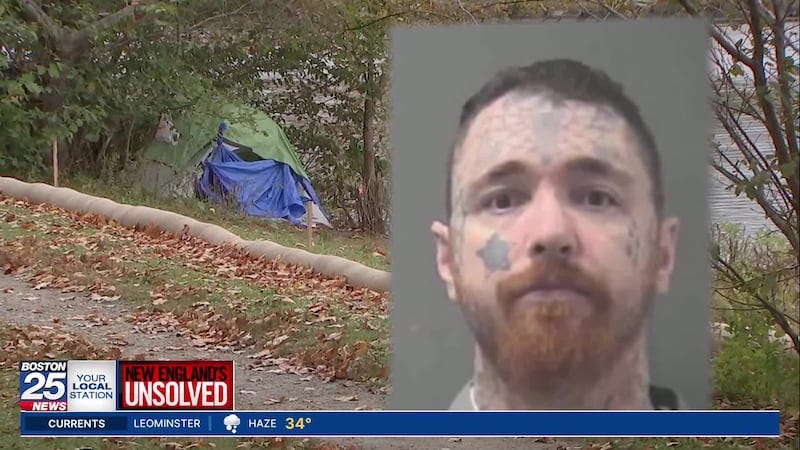
Kevin J. Lino, 38, of Lowell, Massachusetts, had been identified as a serial killer under the United States Department of Justice definition for committing two or more murders in separate events.
Lino had already been convicted of two murders: Normand Varieur, 61, shot multiple times in Charlestown, Boston in March 2012 in a drug-related dispute, for which Lino was convicted and sentenced to life without parole in 2013; and Jack Gilbert Berry, 27, beaten to death with a rock and a piece of lumber at a homeless encampment in Missoula, Montana in August 2014, for which Lino pleaded guilty in 2015 and received a fifty-year sentence.
On August 5, 2025, Lino was indicted on two additional counts of first-degree murder in Middlesex County, Massachusetts. The charges stemmed from the 2010 killing of Gary A. Melanson, 52, an unhoused man beaten to death with a metal baseball bat near the Rogers Street Bridge in Lowell, and the 2012 killing of Douglas Leon Clarke, 50, an unhoused man in Harvard Square, Cambridge, who died from a deliberate heroin overdose laced with a lethal dose after a confrontation with Lino.
Lino was arraigned on August 27, 2025, and pleaded not guilty. Police made clear they had no reason to believe Lino was behind any of the thirteen deaths that had generated the serial killer panic. His crimes were their own separate story a man who had killed unhoused and vulnerable people across multiple states over years, whose pattern had been assembled slowly through cold case investigation and DNA work rather than through a sudden cluster of visible discoveries.
Meggan Meredith and the Unsolved Cases
Of the thirteen cases at the center of the panic, several remain genuinely unresolved in ways that deserve continued attention regardless of whether they are connected.
Meggan Meredith, 45, found near a Springfield bike path, is still a homicide investigation. Her death was confirmed as suspicious. No arrests have been made. She is a real person who was killed by someone, and the public attention that briefly focused on her death as part of a pattern narrative moved on when the serial killer theory lost momentum, taking with it the pressure that public attention can generate on cold cases.
Jasmine Wilkes, 34, found in Edgewood Park in New Haven on May 30, 2025. Her death was under investigation. The circumstances were not publicly determined.
Adriana Suazo, 21, found in Milton on June 1. Her family wants to know the truth. That is a reasonable thing to want. Her cause of death had not been publicly confirmed at the time of writing.
These cases matter not because they are connected to each other but because they represent individual people whose deaths are unresolved. The serial killer narrative, paradoxically, may have made it harder rather than easier to focus on each of them as individuals subsuming them into a collective story that turned out to be fictional while their specific circumstances remained unaddressed.
The New England serial killer panic of 2025 is a case study in something that true crime culture has been slowly creating the conditions for across years of podcasts, documentary series, and online communities: a population that has learned to identify patterns in crime, that has developed genuine knowledge of serial killer methodology and victimology, and that is now applying that knowledge in conditions of incomplete information to produce confident narratives that may or may not correspond to anything real.
The people in those Facebook groups were not idiots or ghouls. They were, in many cases, people who genuinely cared about public safety, who lived in New England and were frightened, who had absorbed years of true crime content and believed they were applying its lessons usefully. Some of them were right that individual cases deserved more attention. Some of them correctly identified Meggan Meredith’s death as suspicious before the official homicide designation. The instinct to notice and to push back against institutional silence about vulnerable victims is not a bad instinct.
What went wrong was the leap from “these cases deserve attention” to “these cases are connected” to “there is a serial killer and the authorities are covering it up.” Each step in that chain required discarding evidence that didn’t fit and accepting inference as fact. The geographic proximity was real; its meaning was constructed. The timing was real; its explanation was seasonal. The fear was real; its object did not exist.
Meanwhile, Kevin Lino an actual serial killer who had killed actual people in Massachusetts and beyond was indicted quietly in August, identified through patient forensic work over years, connected to victims who were largely unhoused and therefore largely invisible to the communities that had been galvanised by the spring panic.


Leave a Reply