Georgia and Michigan, 1988–2022 a murdered teenager found on a highway who had no name for thirty-four years, a killer who burned to death at a racetrack, and the technology that identified both of them from the same crime scene in the same year
If you enjoy my true crime coverage, please help me continue my newsletter by upgrading here:
The northwest corner of Georgia is a particular kind of landscape Appalachian foothills, deep creek hollows, the kind of terrain where the roads cut through ridges and the valleys hold weather and the exits from the interstate appear without much warning and lead to small communities whose names only locals know.
Rising Fawn is one of those communities. It sits in Dade County, Georgia, barely twelve miles from the Alabama state line, close enough to the Tennessee border that the county occupies the northwest tip of the state like a pointed finger extended toward Chattanooga. Interstate 59 passes through, heading northeast toward Chattanooga or southwest toward Birmingham. It is a trucker’s road, a connector road, the kind of highway that sees a great deal of traffic moving between cities and very little of it stopping.
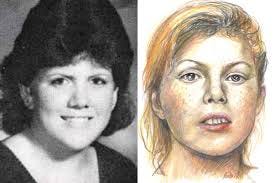
On December 16, 1988, a woman’s body was found on the side of Interstate 59 near Rising Fawn. She was young investigators estimated between fifteen and twenty-five years old, though the determination was uncertain. She was white. She had been strangled. She was wearing a blue and white plaid shirt and jeans. She had brown hair. She had no identification.
Dade County investigators and the Georgia Bureau of Investigation worked the case. They created clay renderings and composite sketches. They documented everything they had. They had no name for the woman on the roadside. They had no name for the man who had left her there.
They called her Rising Fawn Jane Doe, after the town nearest where she was found. And then, as the months turned into years, she remained Rising Fawn Jane Doe.
Norton Shores, Michigan, 1989
In January 1989, a month after the body was found in Georgia, a missing persons report was filed in Norton Shores, Michigan a small city on Lake Michigan near Muskegon. The report was for a nineteen-year-old woman named Stacey Lyn Chahorski.
Stacey had called her mother, Mary Beth Smith, in September 1988 months before her body was found to say she was traveling back home from the South. That was the last contact. In January, when she still hadn’t appeared, her mother went to the police.

The missing persons report existed in a Michigan database. The unidentified body existed in a Georgia database. There was no mechanism to connect them. This was 1989. DNA forensics was in its earliest stages. The internet did not yet exist in a form that would have allowed systematic cross-referencing of such cases. The FBI’s national databases were more developed than they had been a decade earlier but still limited in reach.
Rising Fawn Jane Doe and Stacey Lyn Chahorski were the same person. For thirty-four years, the investigative systems of two states did not know this.
Decades of Effort
The GBI did not close the case. This matters. Cold cases involving unidentified Jane Does in rural counties have a documented tendency to drift to accumulate the bureaucratic sediment of years, to be transferred between investigators, to reach a point where the trail is so old that sustaining active effort requires a kind of institutional commitment that is genuinely uncommon.
Dade County and the GBI maintained that commitment. They created new clay facial reconstructions as technology improved. They entered what evidence they had into national databases. They revisited the case repeatedly, looking for leads that had not surfaced.
In the mid-2000s, when the case was reassigned to a new investigator, additional evidence was located at the scene or in the archived physical evidence and sent to the FBI in Washington for further testing. A DNA profile of the victim was developed and entered into the Combined DNA Index System CODIS and the National Missing and Unidentified Persons System. No match came back.
In 2007, samples were submitted to the University of North Texas Center for Human Identification.
No match.
The case sat in this state actively maintained, technically open, connected to multiple databases for more than a decade more.
Then, in 2022, a GBI agent decided to try something different.
Othram
Othram Laboratories, based in The Woodlands, Texas, is one of several private laboratories that emerged in the late 2010s and early 2020s to offer a service that standard forensic labs could not provide: forensic genetic genealogy, the analysis of degraded DNA to produce a genealogical profile that can be traced through family trees to identify unknown individuals.
The technique had become publicly famous through its role in identifying the Golden State Killer in 2018. Applied to cold cases involving unidentified remains, it had opened cases that had been sealed for decades by the simple absence of a name.
In early 2022, the GBI worked with the University of Tennessee Anthropology Department to prepare a sample of the Rising Fawn Jane Doe’s remains for submission to Othram. The sample had to be carefully extracted from bone that was thirty-four years old. Othram’s laboratory processed it, building a DNA profile from the degraded material and running it through genealogical databases.
In June 2022, Othram produced a lead: a possible relative of the unidentified woman, living in Indiana.
A TBI intelligence analyst traced the lead to the Lafayette, Indiana, area the same area where the 1989 missing persons report for Stacey Lyn Chahorski had originated. Investigators contacted potential family members in Lafayette. The family confirmed: yes, they had a member who had disappeared from the area in 1978.
DNA samples collected with the help of the Lafayette Police Department from possible siblings of the missing woman were submitted and compared.
They matched.
On March 24, 2022, the GBI announced that Rising Fawn Jane Doe was Stacey Lyn Chahorski of Norton Shores, Michigan. She had been nineteen years old when she died. She had been lying in a Georgia grave, without a name, for thirty-four years.
Her mother Mary Beth Smith had waited thirty-four years for this. She expressed, through the GBI’s statement, gratitude to the investigators who had never given up.
The Same Technology, the Same Crime Scene, the Same Year
But identifying Stacey was only half of what the Othram analysis eventually produced.
The killer had left his own DNA at the crime scene. The GBI had known this for years biological material recovered at the scene that did not match the victim, a DNA profile of the unknown perpetrator that had been entered into CODIS without generating a match. This was not unusual. DNA databases in the 1980s and 1990s had not collected samples from many potential perpetrators whose criminal records predated mandatory DNA testing.
In June 2022, FBI genealogists took the killer’s DNA profile and ran it through the same genealogical process that had identified Stacey. They built a family tree from the genetic material. They traced leads. They identified a living family member who cooperated with the investigation and provided a DNA sample for comparison.
The confirmation DNA testing established a match: Henry Fredrick Wise, known as Hoss Wise.
Wise had been thirty-four years old at the time of Stacey Chahorski’s murder. He was a truck driver for Western Carolina Trucking Company, driving a regular route that ran through Chattanooga to Birmingham to Nashville a route that passed directly through Dade County, Georgia, on Interstate 59. He was also, improbably, a stunt driver who competed at regional speedways on weekends, the kind of secondary life that speaks to a man who existed in multiple registers simultaneously: working trucker, weekend daredevil.
He had a criminal history across three states theft, assault, obstruction of a police officer in Florida, Georgia, and North Carolina. His arrests predated mandatory DNA testing after felony conviction, which meant his profile had never entered CODIS. He had passed through the system repeatedly without being connected to anything.
In September 1999, at the Myrtle Beach Speedway in South Carolina, Wise’s stunt car caught fire during an event. He burned to death. He was forty-five years old.
A Historic First
On September 6, 2022, the GBI and FBI held a joint press conference at GBI headquarters in suburban Atlanta. FBI Special Agent in Charge of the Atlanta Field Office, Keri Farley, announced the identification of both Stacey Chahorski and her killer.
She noted the specific significance of what had been accomplished: “This case is key because it’s the first time that we know of that investigative genealogy was used to identify both the victim and the killer in the same case.”
The technique that had given Stacey back her name had also named the man who took it from her. Both identifications came from the same crime scene, thirty-four years later, using technology that had not existed when she died.
Farley added what needed to be said plainly: “We realize solving this horrific crime does not ease the pain for Stacey’s family, nothing can, but hopefully it will answer some questions.”
What Justice Looks Like Here
Henry Hoss Wise cannot be arrested. He cannot be charged, tried, or convicted. He burned to death at a racetrack in 1999, twenty-three years before anyone knew his name in connection with Stacey Chahorski’s murder.
His DNA is now in CODIS. Investigators have suggested that if he is connected to other unsolved murders and the circumstantial case for his involvement in the broader Redhead Murders series, detailed elsewhere, is substantial his profile may yet produce matches against other crime scenes. The highway route he drove regularly overlapped with the geographic corridor of multiple unsolved murders of young women in the 1980s and 1990s.
Whether those connections will ever be formally established is uncertain.
What is certain is that Stacey Lyn Chahorski, nineteen years old, called her mother in September 1988 to say she was on her way home from the South. Her mother waited. Her body was found two months later on a Georgia highway. Her name was not recovered for thirty-four years.
Her name is recovered now. The man who killed her has a name now too.
That is the form justice takes, sometimes, when a case lasts long enough for technology to catch up to what happened not prosecution, not a courtroom, not a sentence, but a name attached to the right person on each side of what was done.
It is not enough. It is what there is.
Stacey Lyn Chahorski was nineteen years old. She was from Norton Shores, Michigan. She called her mother and said she was coming home. Her mother is named Mary Beth Smith. She waited thirty-four years. She knows now.


Leave a comment