A thirty-seven-year-old Louisville mother who volunteered finding missing people vanished without a trace in the early hours of August 13, 2019, after a difficult night of arguments and lockouts, walking away from her sister’s house into a warm Kentucky dark leaving behind her phone, her bank accounts, her two sons, and six years of unanswered questions.
If you enjoy my true crime coverage, please help me continue my newsletter by upgrading here:
A Particular Cruelty
There is a particular cruelty in the disappearance of Andrea Knabel that goes beyond the ordinary tragedy of a missing person case.
Andrea spent significant time as a volunteer with Missing in America, an organization dedicated to finding people who had vanished from their lives. She helped search for them. She sat with the families. She learned how these cases worked how attention faded after the first weeks, how the machinery of official investigation slowed, how the people left behind aged around the absence and were never quite the same. She understood, better than almost anyone outside law enforcement, what it meant to be the family left searching when someone didn’t come home.
Then she became the person they were searching for.
Her case has every element that true crime readers recognize: a vulnerable woman going through a difficult period, an argument on the night of disappearance, family members under suspicion, a phone that went dark in the early hours, a neighbourhood canvassed imperfectly. What it does not have, six years on, is a resolution.
Who Andrea Was
Andrea Michelle Knabel was born on January 7, 1982, and grew up in Louisville, Kentucky. By the summer of 2019, she was thirty-seven years old and going through one of the harder patches of her adult life. She had recently been laid off from her job as an analyst.
Her car had been totaled in a hit-and-run accident. She had lost her apartment and was saving money to find a new place to live. She had moved into her mother’s home on Chickadee Road in the Audubon Park neighborhood a prosperous, tree-lined area of Louisville about five miles from downtown, the kind of neighborhood where nothing bad was supposed to happen.
She had two sons, aged six and eight. They were, by every account, the center of her life a woman who, even during the difficulty of that period, was described by family and friends as deeply devoted to her boys. She worked odd jobs. She looked after herself and her children as best she could. And she gave significant amounts of her time to Missing in America, the volunteer organization through which she had found a community and a purpose.
Her involvement with Missing in America gave her a specific window into the world of disappearance and loss that most people never have. She had worked cases. She had sat with families. She had been the person on the other end of the search. When she disappeared, some of those same families reached back to search for her.
The Night in Full
Understanding the night of August 12–13, 2019 requires following Andrea through several hours of ordinary chaos that became, in retrospect, the last documented hours of her life.
At around nine in the evening on August 12, Andrea’s mother left the Chickadee Road house to stay overnight with a friend. The house was under renovation her sister Sarah and Sarah’s fiancé Ethan Bates were staying there while doing repairs, and the bathrooms were temporarily out of service. The atmosphere in the house had been tense. Andrea and her family had been having the kind of arguments that accumulate when multiple adults share a small space during difficult financial circumstances. There had been a heated confrontation about her life choices about the financial hardship, about her mental health, about what the family wanted her to do about both.
After the argument, Andrea went to McDonald’s with Ethan Bates and a nephew. This is not a trivial detail it suggests that whatever the argument had been, the evening had not ended in complete rupture. She ate and then, because she had a skin infection or rash on her face that was bothering her, Ethan drove her to a hospital in the 3900 block of Dutchmans Lane to get treatment and medication.
At 11:22 p.m., she left the hospital by Lyft, heading back to Chickadee Road.
Nobody answered the door.
Whether Sarah and Ethan were in the house and chose not to answer, or were genuinely absent, or were asleep and didn’t hear her this question has never been satisfactorily resolved. What is documented is that Andrea stood at the door of the house where she was living, at roughly 11:30 at night, and could not get in.
At 12:15 a.m. on August 13, she walked more than a mile to her sister Erin’s house on Fincastle Road. Erin Knabel is Andrea’s closest sister, the one who would spend the next six years dedicating her life to finding her. That night, Andrea sat at Erin’s house and talked. She was upset. She vented about what had been happening. She asked to sleep there.
Erin drove her back to Chickadee Road and tried to help her get inside. Still no luck. Andrea walked back to Erin’s house again on foot.
Then Erin made a decision that she has had to live with every day since. She told Andrea to go home, and she could help sort things out. Andrea left Erin’s house at 1:38 a.m. From her window, Erin watched her sister walking away, scrolling on her phone, heading back in the direction of Chickadee Road.
That is the last confirmed sighting of Andrea Knabel. A woman walking down a street, phone in hand, heading home on a warm August night.
According to the Google Maps timeline reconstructed by investigators from her phone data, she arrived back at the Chickadee Road house at 1:54 a.m. sixteen minutes after leaving Erin’s. She did not appear to have gotten inside. And then, at some point in the dark hours between roughly 2 a.m. and 6:31 a.m when her phone briefly pinged active before going dark she was gone.
What Was and Wasn’t Found
When investigators and the family tried to reconstruct what had happened, the evidence was maddening in its incompleteness.
Andrea’s cell phone was briefly active at 6:31 a.m. several hours after she was last seen. The phone didn’t stay on long enough to register a location. Then it went straight to voicemail and has been there ever since. When police served a search warrant on the Chickadee Road house and searched for the phone, they didn’t find it. It has never been found.
Her credit and debit cards have not been used since the night of her disappearance. Her bank accounts have not been accessed. There has been no financial trace of her anywhere no withdrawals, no purchases, no transactions that would suggest a woman who chose to disappear and start over somewhere.
She was wearing a tank top, shorts, and tennis shoes. She had no bag, no wallet visible in surveillance or witness accounts, no coat on a summer night. She had nothing with her that suggested a prepared departure.
Her two sons were with their respective fathers that night. She was separated from both men. The detail matters because it removes the simplest explanation she couldn’t have simply gone to be with the boys without anyone knowing.
She did not contact her children. Six years have passed. She has not contacted her children
The Suspects
In the absence of evidence pointing clearly in any direction, the investigation circled through the people closest to Andrea on the night she disappeared.
Ethan Bates, Sarah’s fiancé the last person to have spent significant time with Andrea before she went to Erin’s house was interviewed by police for several hours. Investigators cleared him. Private investigator Tracy Leonard, who compiled the detailed pre-disappearance timeline for the family, told the Courier Journal: “We have no evidence that Ethan and Sarah had any wrongdoing in this at all.” There were rumours that Ethan and Andrea had been involved romantically, and that this may have complicated the relationships within the household. Investigators did not find evidence of this sufficient to change their assessment.
The docuseries Finding Andrea explored the wider social network around Andrea her associations through Missing in America, the possibility that she had been doing work as a private investigator for someone, the question of whether her involvement in cases had brought her into contact with dangerous people. These threads were followed. They did not produce a suspect or a charge.
The theory that lingered most with the family involved the possibility that Andrea, in a vulnerable state, had accepted a ride from someone she shouldn’t have trusted. She was known, when distressed, to call on a wider network of acquaintances than her immediate family. The family believes she may have reached out to someone after leaving Erin’s house someone who drove past, or someone she called, or someone she already knew. Whether that person did her harm or whether she walked into something else entirely is unknown.
The Stalking Car and the Strange Tips
Several months after Andrea’s disappearance, Erin and Mike Knabel noticed a gold Chevy Impala driving slowly past Erin’s home on Fincastle Road the street Andrea had last been seen walking away from. The car drove past multiple times, then stopped. The two occupants described as a thin white man and a thin white woman sat and watched the house.
Mike and Erin were unsettled. They noted the licence plate and had it run later. The car was stolen.
Whether this was connected to Andrea’s disappearance, or was a coincidence, or was something else entirely an opportunistic surveillance of a house that had been in the news was never established. Investigators were informed. The lead went nowhere.
Sightings were reported in the months that followed. Two came from Indiana Clarksville and Jeffersonville in October 2019, both describing a woman who matched Andrea’s description. Both were investigated. Both proved inconclusive.
A man in Indianapolis, nearly four and a half years after Andrea’s disappearance, called Mike Knabel to report having encountered a woman who looked like Andrea, called herself Andrea, and had been taken to a hospital. Mike contacted Louisville Metro Police, Indianapolis Police, and the Louisville Missing Persons Unit. By the time anyone could confirm, the woman could not be located for comparison.
Every tip leads somewhere and then stops. That has been the pattern for six years.
The Investigation’s Failures
Joe Fanciulli is a retired detective sergeant with fifty-two years in law enforcement, who came across Andrea’s case through a Facebook group for missing people in early 2021 and volunteered to help the family.
What he found, approaching the case from the beginning with fresh eyes, was not reassuring about how it had been handled.
Years after Andrea disappeared, Fanciulli conducted a neighbourhood canvas of the streets she had walked that night. He knocked on doors. He asked questions. And he discovered that some people in the immediate area people who might have seen something, heard something, known something had never been contacted by investigators at all. The original canvas had not been thorough. People who might have been able to place Andrea between the time she left Erin’s house and the time her phone went dark had never been asked.
“These are long shots and we fully understand that,” Mike Knabel said when this came to light. “But with any investigation you can’t neglect something like that.”
Keeping the Louisville Metro Police Department focused on the case has been, by the family’s account, a sustained struggle. LMPD has described the case as open and active, and says it investigates all credible leads. The family’s experience has been of a department that has its own plan, its own system, and does not communicate that plan to the people who are most invested in the outcome. Mike Knabel, in one of his more measured statements about the investigation, said: “I’d at least like some communication to talk to them about it. But I think they’ve got their own plan and maybe the distraught father of a daughter who’s been gone nineteen months isn’t part of that.”
The tension between the family and the police department has been a constant feature of the case’s public life. Both sides appear to believe they are working toward the same goal. Neither side appears satisfied with how the other is going about it.
The Gold Impala, the Docuseries, and the Reward
When Discovery+ aired Finding Andrea in October 2021, the family’s hope was specific: not just exposure, but the particular kind of pressure that public attention places on people who know something. “Any case like this that gets a great amount of exposure and publicity,” Fanciulli said, “people who were involved, people who have knowledge, or people who are just waiting for a question to be asked they come to a point where they can’t live with holding something inside anymore and will come forward with what we need.”
The docuseries generated tips. New people came forward who had previously been reluctant to talk. Fanciulli described receiving calls from people who had information about the night Andrea disappeared and who had been afraid to speak before the documentary aired.
Whether any of those calls have moved the investigation materially forward is unknown. No arrest has been made. No remains have been found. No charges have been filed against anyone.
A $10,000 reward remains available for information leading to Andrea’s whereabouts.
The family’s current tip line still rings
Erin
The most remarkable thing about the Knabel case beyond the disappearance itself may be what it produced in the people left behind.
Erin Knabel, the last person to see her sister alive, watched Andrea walk away from her window at 1:38 in the morning and has not stopped looking since. She has created three separate community pages for missing persons in the Louisville and Kentucky area, offering other families what she understands from the inside: a place to share their person, to keep the case visible, to find people who will care.
“It’s the closest I can get to getting answers for my sister,” Erin said.
She is doing what Andrea did finding the missing. She is doing it, in part, in the hope that someone will do the same for her.
What Remains
Six years after Andrea Knabel walked away from her sister’s house, the case has three possible explanations, none confirmed.
She is alive somewhere, having chosen to walk away from her life for reasons that her family cannot account for and that her two sons’ continued absence from her life make nearly impossible to accept.
She came to harm at the hands of someone she encountered or contacted in the hours after she left Erin’s house a stranger, an acquaintance, someone from the world she had been moving through in those difficult months of 2019. Her remains have not been found.
Something happened to her in the gap between 1:54 a.m., when her phone placed her at Chickadee Road, and the last phone ping at 6:31 a.m. something that left no financial trace, no physical evidence, no witness who has come forward to explain it.
Her father Mike walks her last known path every August 13. He carries a photograph of them together, holding an hourglass from a board game.
“It just shows you that with your loved ones, you really don’t know how much time you have with them,” he said.
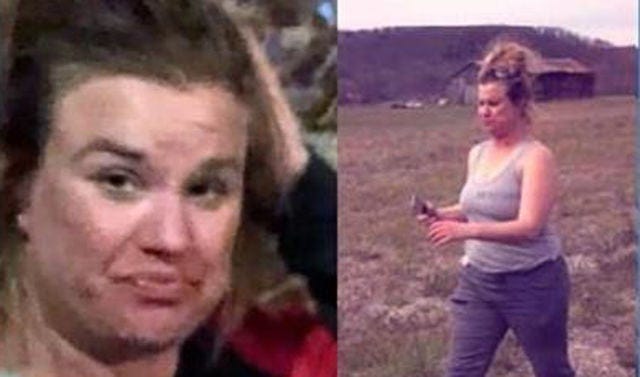
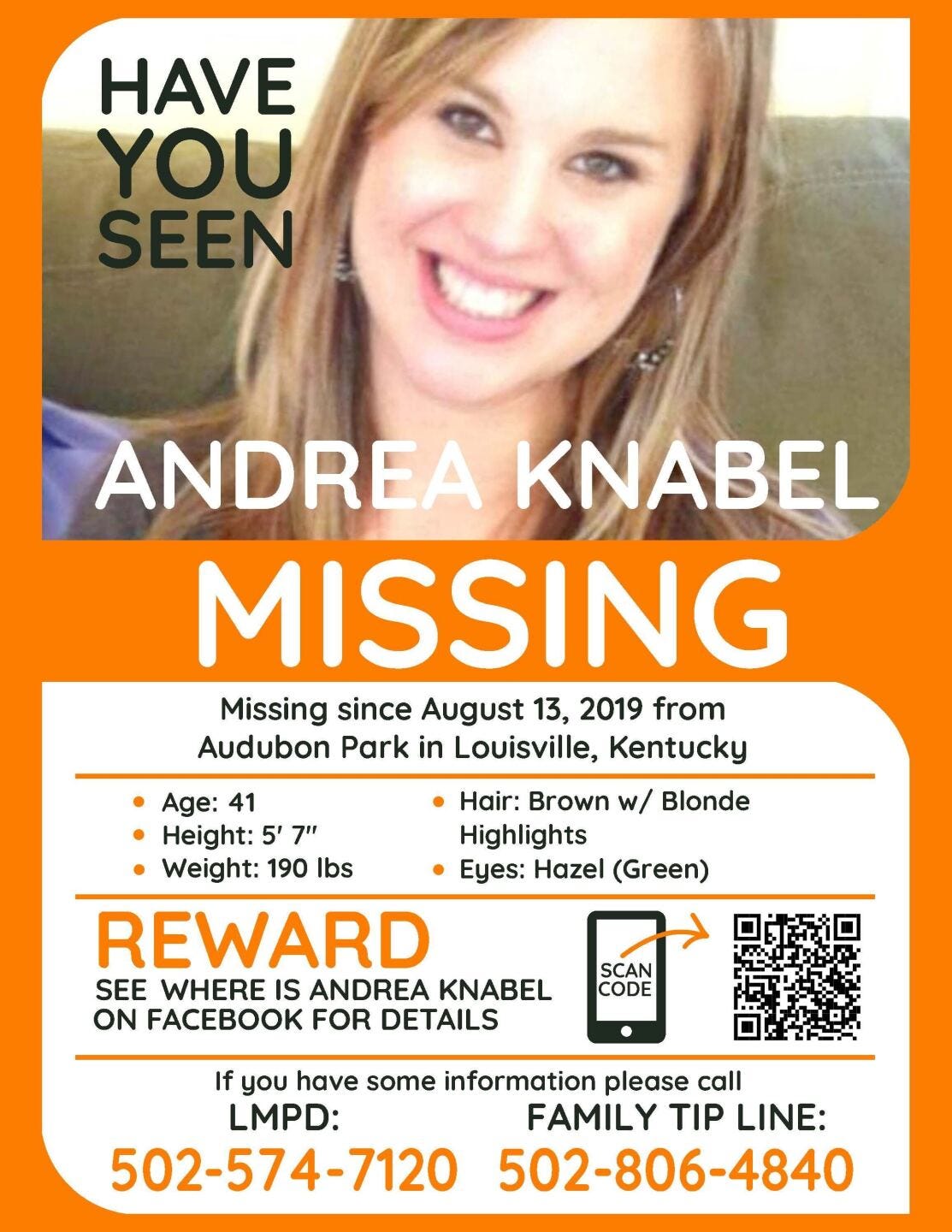
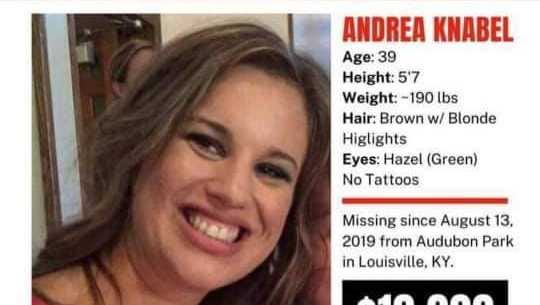
DESCRIPTION: Andrea Michelle Knabel white female, 5’7”, approximately 180–190 lbs, hazel/green eyes, brown hair often with blonde highlights. Last seen August 13, 2019, Audubon Park neighbourhood, Louisville, Kentucky. She was thirty-seven years old. She had two sons, aged six and eight.
REWARD: $10,000 for information leading to Andrea’s whereabouts.
TIPS: Family tip line: (502) 806-4840 Louisville Metro Police: (502) 574-7120 Anonymous line: (855) 746-0846


Leave a Reply