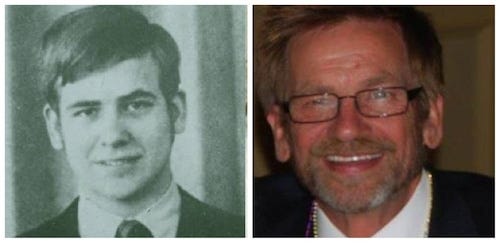
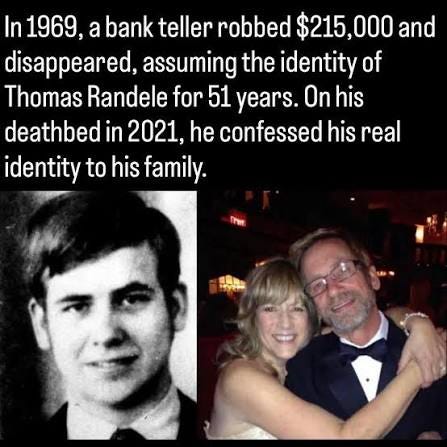
A twenty-year-old Cleveland bank teller watched The Thomas Crown Affair until he had Steve McQueen’s every move memorised, stuffed $215,000 into a paper bag on a Friday afternoon, walked out of Society National Bank into the summer heat, and then spent the next fifty-two years in a Boston suburb as a car salesman named Tom Randele dying with the secret on his lips, confessing only to his wife and daughter, weeks before investigators would have found him anyway.
If you enjoy my true crime coverage, please help me continue my newsletter by upgrading here:
Theodore John Conrad was born on July 10, 1949, in Denver, Colorado. His parents divorced while he was in elementary school, and he moved with his mother and sister to Lakewood, Ohio a west-side suburb of Cleveland sitting on the south shore of Lake Erie. He graduated from Lakewood High School in 1967 and enrolled in college briefly before dropping out. He was, by the accounts of those who knew him then, a personable kid easy company, a little directionless, the kind of young man who was searching for something without knowing what shape it took.
What it took, as it turned out, was a movie.
In 1968, The Thomas Crown Affair was released a caper film starring Steve McQueen as Thomas Crown, a bored Boston millionaire who organizes a bank robbery purely for the intellectual satisfaction of seeing whether he can get away with it. McQueen played Crown with a particular combination of cool intelligence and barely concealed contempt for the ordinary world, a man who had everything and still needed the game of it. The film was stylish and smart, and for a young man in Lakewood, Ohio who had not yet found his own game, it lodged somewhere deep and specific.
Conrad saw it more than half a dozen times. He talked about it to his friends. Not in the way people talk about films they enjoy, but with a fixated precision the mechanics of the robbery, the ease of it, the way Crown had simply walked into the bank and walked out. “He bragged to his friends about how easy it would be to take money from the bank,” investigators would later note, “and even told them he planned to do so.”
His friends didn’t believe him.
Society National Bank, 127 Public Square, Cleveland
In January 1969, Conrad began working at Society National Bank at its headquarters on Public Square in downtown Cleveland. The position was in the cash vault he packaged money to be delivered to bank branches around the city. It was, as the US Marshals Service later described it, “a position for a trusted employee.” He was given access to large quantities of cash because his character was not questioned and he seemed a model of responsibility.
What he was actually doing was making notes. The security was loose. There were no fingerprint records taken when he was hired. The vault had no camera. The cash wasn’t tracked in ways that would show a discrepancy between shifts. He had been telling his friends for months that it would be easy. Now he was confirming it from the inside.
On July 11, 1969 a Friday, the day after his twentieth birthday he made his decision final.
He bought a bottle of whiskey and a pack of cigarettes on his lunch break. Then he went back to the vault, filled a paper bag with $215,000 in cash, and at the end of his shift, walked out of the bank.
He did not run. He walked. He was carrying a paper bag. Nobody stopped him.
He didn’t go home that night. He didn’t say goodbye to anyone. He left his life in Cleveland behind as completely as if it had never existed.
When bank managers opened the vault on Monday morning, the money was gone. So was Ted Conrad. He had been given a two-day weekend head start by the simple fact that he had chosen a Friday.
The Letters
In the days after the robbery, two letters arrived for Conrad’s girlfriend in Cleveland postmarked Washington DC and Los Angeles. They said how much he loved her and missed her. They said he was sorry. He had, in a separate communication that investigators later learned about, written her a fuller confession, describing what he had done and expressing genuine regret for the impact on the people he cared about.
Then he stopped writing. He stopped calling. He had looked at the person he cared most about in Cleveland and had decided that what he was running toward mattered more than what he was leaving behind.
What he was running toward, specifically, was Boston.

Thomas Randele Is Born
In 1970, Conrad showed up at a Social Security office in Boston and told them he didn’t have a Social Security number he had just moved there. This was a different era. There was no database to check, no national system to cross-reference, no photograph matching to do. The office issued him a card.
At a stroke, Ted Conrad ceased to exist in any official sense, and Thomas Randele began.
His daughter Ashley later examined the name he chose and found what she believes is a deliberate structure within it. Thomas the first name of Thomas Crown, the character he had built his escape around. Randele potentially a combination of Randall and Randele, two character names associated with Steve McQueen: Josh Randall from the CBS western Wanted Dead or Alive, and Thomas Randele constructed to echo those names. Whether this was a twenty-year-old’s private joke with himself, or a coincidence, or Ashley’s projection onto her father’s choices, cannot be established.
What is established is that with a Social Security card and a new name, Thomas Randele could do almost anything. He couldn’t get a passport without a birth certificate, which limited some travel. But he could get a driver’s licence. He could get a bank account. He could get a job. He could build a credit history. He could become, over time, someone who had always been there.
He settled in Lynnfield, a suburb north of Boston. He had chosen, with what reads now as either extraordinary audacity or extraordinary sentiment, to live near the city where his favourite movie was set and filmed.
A Life in Lynnfield
Thomas Randele became a car salesman. He was very good at it. He worked at luxury car dealerships across the north Boston suburbs for decades, the kind of salesman that people remember attentive, knowledgeable, able to talk to anyone about anything without ever quite revealing much about himself. He drove fast cars and knew how to talk about them with genuine pleasure.
He played golf. This was another thing he was very good at. He was a scratch golfer the designation for someone who plays at exactly the par score and it became the activity around which much of his social life organized itself. He made friends at the course. Those friends knew him as Tom Randele, a genial, well-spoken guy who hit the ball beautifully and who had an easy manner about him that made people comfortable.
He got married. He and his wife Kathy had a daughter, Ashley, who became the person he was closest to in the world. He made her lunch every day. He drove her to school. He got out of work early to take pictures with her before her senior prom. He watched crime shows NCIS was a particular favourite, a detail that Ashley recounts with a complicated mix of humour and something harder.
His daughter once struggled with French homework and he didn’t offer to help. She later discovered he was fluent in French. He was also, over the years, friendly with an FBI agent in Boston. He donated to local police charities. He attended community events. He was, in all the ways that could be observed from the outside, a devoted family man and one of the nicest people anyone around him had ever known.
“He was never someone who seemed like they were looking over their shoulder, or someone who didn’t want his photo taken,” Ashley said. “Like, there were none of those signs. He never looked back.”
In the late 1990s and early 2000s, his face appeared on a television commercial for a car dealership. Ted Conrad, wanted fugitive, was on television in the Boston market. Nobody called it in.
The Elliots: A Family Mission
Back in Cleveland, John K. Elliott of the US Marshals Service had made Ted Conrad his mission.
Elliott was a man who took the personal dimension of the hunt seriously. He spent decades running down leads California, Hawaii, Texas, Oregon all false. He requested the Conrad case be featured on America’s Most Wanted and Unsolved Mysteries, hoping that someone somewhere would recognise that face and call it in. The wanted posters went up and came down and went up again. The face on them grew older in approximate renderings as years passed.
John Elliott never found Ted Conrad. He died in 2020, one year before Conrad himself died, having worked the case for longer than most careers last.
His son Peter J. Elliott had joined the US Marshals Service. He had grown up hearing about Ted Conrad the way some children hear bedtime stories a recurring character, an adversary, a problem that had no solution yet. “Conrad lived near us,” Peter Elliott said. “Conrad had the same doctor as my dad did. And Conrad worked at the local ice cream store where my father used to take us as kids.” That last detail is startling: Ted Conrad, wanted fugitive, had at some point worked in the same ice cream shop that John Elliott took his children to. The hunter and the hunted, circling in the same small geography of a suburb north of Boston, without one ever knowing how close he was to the other.

After John Elliott’s death in 2020, his son Peter inherited the case files, the old leads, and his father’s particular determination to close a loop that had remained open for fifty years.
The Deathbed Confession
In February 2021, Thomas Randele was diagnosed with aggressive lung cancer. He started chemotherapy. He was seventy-one years old.
That March, sitting in the living room watching NCIS with his wife Kathy and his daughter Ashley, he said something that came without warning or preamble.
“Ladies, I need to tell you something in case it ever comes up. When I moved here, I had to change my name. The authorities are probably still looking for me. I don’t want to talk about it, but I just want you to know in case something comes up.”
Ashley demanded he at least tell her his real name. He agreed, on the condition she would not look into it and would not tell anyone.
“He was cool as a cucumber, but he looked scared,” Ashley later said. “He said, ‘My name is Ted.’”
That night, after he had gone to bed, Ashley Googled it.
“It honestly felt like something out of a Lifetime movie. Who suspects that when they look up their parent’s birth name, they’re going to find headlines that say, ‘Vault Teller Steals Money Fugitive’?”
She told her mother. They sat with it. They made a pact: they would spend one year grieving Thomas Randele, the man they had known and loved, before telling anyone. They would notify police in June 2022.
Thomas Randele died on May 18, 2021. They never got to keep that pact.
The Obituary and the Knock at the Door
Someone, whose identity has not been publicly established, sent Thomas Randele’s obituary to a crime reporter in Ohio shortly after his death. The note suggested the deceased man might be Ted Conrad.
The obituary listed his date of birth as July 10, 1947 the same birthday as Conrad’s, but listed two years older. It listed his parents’ names, with Randele added. These were small discrepancies small enough that they might mean nothing, large enough that a careful investigator would want to check.
Peter Elliott was a careful investigator. He pulled the obituary. He cross-referenced it against what his father had compiled over decades. He found a 2014 bankruptcy filing by Thomas Randele in a Boston federal court. He pulled the handwriting from the filing and compared it to handwriting Conrad had produced on a 1967 college application.
They matched.
In November 2021, Peter Elliott and a team of investigators drove to Lynnfield, Massachusetts, to the house on Carter Road where Thomas Randele had lived. Ashley answered the door.
“I think you know why we’re here,” Elliott said.
She did.
The Closing of the Case
At the Carl B. Stokes US Courthouse in Cleveland, in December 2021, Peter Elliott held a press conference. On the table in front of him were items from the investigation: Thomas Randele’s driver’s licence, the original arrest warrant from 1969 signed by his father John Elliott.
Next to them was the official document closing the Conrad case, signed by Peter J. Elliott. At the bottom, in addition to the formal language of case closure, he had added one more line.
On behalf of John K. Elliott.
“I hope my father is resting a little easier today knowing his investigation and his United States Marshals Service brought closure to this decades-long mystery,” Elliott said.
Conrad had been living in Lynnfield for decades. His doctor was the same doctor John Elliott had seen. He had worked at the ice cream shop where John Elliott took his kids. He had been standing next to the people looking for him, in the most literal sense possible, and none of them had ever known it.
“Everything in real life doesn’t always end like in the movies,” Elliott said.
The Daughter
Ashley Randele has spent the years since her father’s death trying to understand who he was. She co-hosted a podcast Smoke Screen: My Fugitive Dad that traced his life from Cleveland to Lynnfield, revisited the robbery, and looked for the answer to the question that no amount of investigation can definitively answer: why.
“We find out more in the investigation,” she said. “It was less about the money itself, but using the money to get away from the life he had and start over.”
She also had a discovery that upset her more than the robbery itself something in his past that the podcast revealed, which she has not disclosed in detail, but which she has described as the secret that affected her more deeply than finding out her father was a fugitive.
She visited the vault at Society National Bank. She sat in the building her father had walked out of on a Friday afternoon in 1969 with a paper bag full of cash. She tried to find the overlap between the man who did that and the man who made her lunch every day.
“I was not going to let the world forget who my dad was,” she said, “because my dad is the guy who made my lunch every day and drove me to school and made sure that he got out of work early enough to take pictures with me before my senior prom. Everybody in the world is so much more than their worst day.”
His worst day was July 11, 1969. He was twenty years old. He had a paper bag and a movie in his head and a future he was improvising from scratch.
The Final Accounting
The $215,000 Ted Conrad took from the vault in 1969 is worth approximately $1.89 million today. What became of it in the first years of his new life is unknown presumably it funded the period between Cleveland and the point at which Thomas Randele had built sufficient ordinary income to sustain himself. By the time he was a middle-aged car salesman in Lynnfield with a mortgage and a wife and a daughter’s school fees, the 1969 money was long gone.
He built a life. He raised a family. He was, by all the measures available to the people around him, a good man reliable, present, warm. He donated to police charities and befriended an FBI agent and watched NCIS on Tuesday nights.
He was also, technically, one of America’s most wanted fugitives a face on a poster, a name in a database, a case that a father and son had made their collective life’s work to close.
He managed to be both things completely and simultaneously, for fifty-two years, in the same suburb north of Boston.
The case is closed. Conrad is dead. The money is gone. The statute of limitations on the original charges had long expired before investigators identified him. There will be no prosecution, no sentencing, no formal accounting.
What there is instead is a daughter who is trying to understand her father, a US Marshal who closed the case his father died pursuing, and the original arrest warrant from 1969 sitting under glass at the Carl B. Stokes courthouse in Cleveland, next to its counterpart from 2021.
Signed, at the bottom of the second document, on behalf of John K. Elliott.


Leave a Reply