Oak Level, Virginia, August 2002 a couple shot in their sleep, a nine-year-old girl taken from her bed, twenty-three years of investigation, and a case that remains the longest-running active homicide investigation in Henry County history
Oak Level
Henry County, Virginia sits in the southwestern corner of the state Piedmont country, tobacco and textile country historically, a landscape of rolling red clay hills and woodlands where small communities have existed for generations with the particular insularity of rural places that know their own well and take time with strangers.
If you enjoy my true crime coverage, please help me continue my newsletter by upgrading here:
Oak Level is one of those communities. It sits along Route 220, a main road running roughly north-south through the county, and it is the kind of place where everybody knows whose truck that is parked in whose driveway and who normally sleeps where. It is a community where violent death was not supposed to happen, and where, when it did happen on the night of August 14–15, 2002, it produced a shock that the county has never fully absorbed partly because the people who did it were never identified, and partly because what they did was so far outside the ordinary grammar of comprehensible violence.
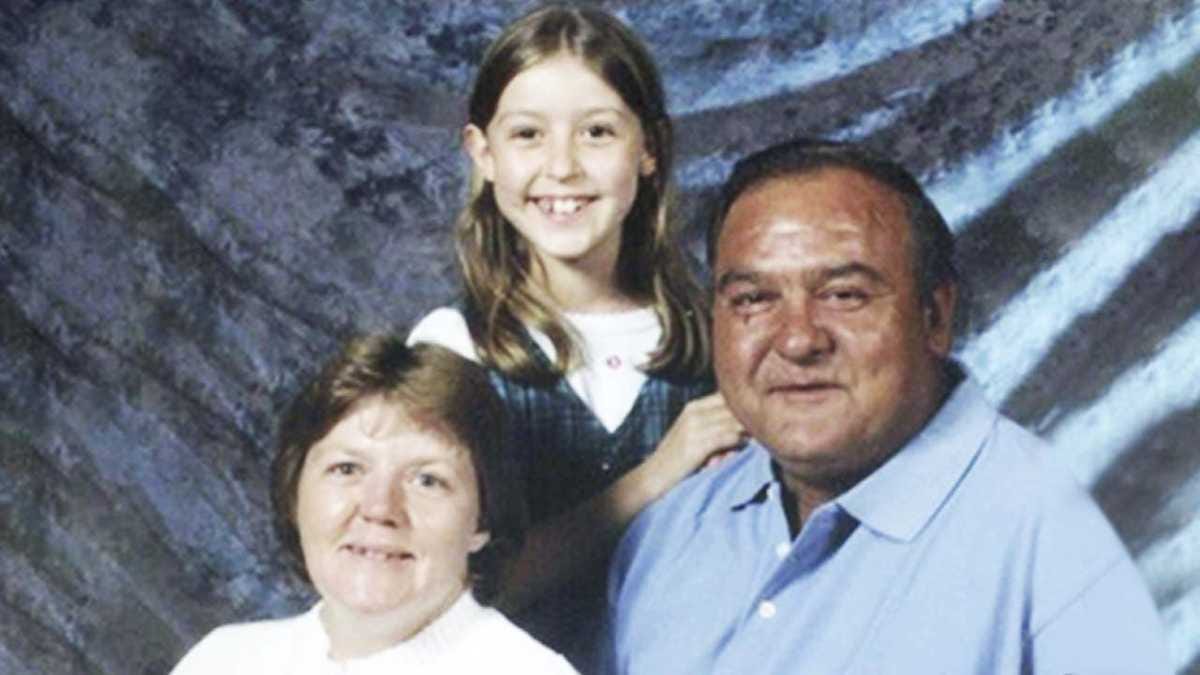
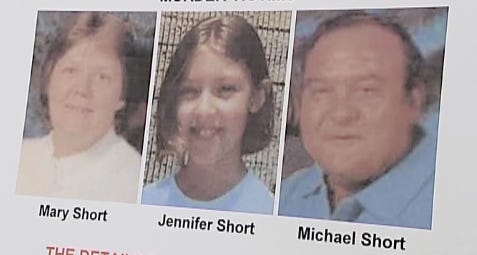
Michael Wayne Short was fifty years old. He had grown up in Henry County, the son of Billie and Annie Short, with a brother and two sisters. He had built himself a life in the county: he owned and operated M.S. Mobile Home Movers, a business that transported and set up mobile homes across the region.
It was physical, demanding work that required local knowledge, a network of contacts, and the kind of reliability that builds a business through word of mouth. Michael was known as a hard worker, a man who showed up and got the job done. He had three adult sons from a previous marriage, with whom the family maintained a good relationship.
Mary Frances Short, née Hall, was thirty-six years old fourteen years younger than her husband. She had worked factory jobs and had spent time as a seamstress at the Pluma Inc. plant in the Bowles Industrial Park in Martinsville, a textile operation that would close in 1999. She was remembered at the plant years later by her coworkers as “Little Mary” small, quiet, pleasant, the kind of person who accumulated nicknames from affection rather than any distinguishing characteristic.
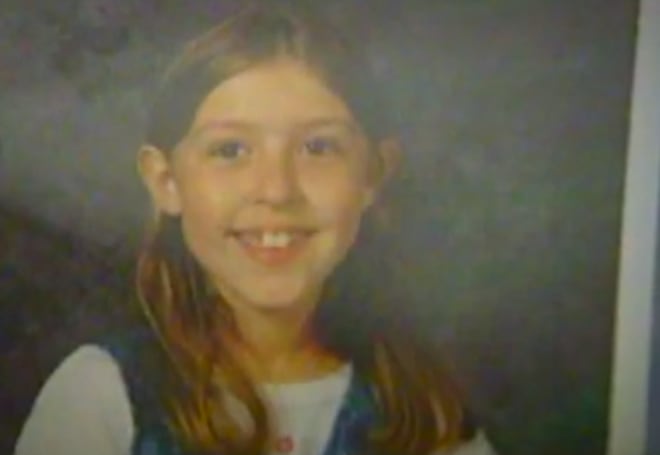
Together, Michael and Mary had one daughter: Jennifer Short, born July 1993, who was nine years old in August 2002 and was about to begin fourth grade at Figsboro Elementary School in Martinsville. Jennifer was a child who her parents kept close the Shorts were described by neighbours and community members as a family that largely kept to themselves, private in the way of many rural families, not unfriendly but not particularly outward-facing either. Jennifer spent her time with her parents. She was their only child together, and by all accounts the centre of their lives.
The house sat on Route 220. It was, at the time of the murders, on the market. The Shorts had decided to move to South Carolina, and Michael had made several trips to the coastal parts of that state Bennettsville, Conway, Florence, Myrtle Beach in the spring and summer of 2002, scouting possible locations for the family and the business. The house was being shown to potential buyers. People had walked through it during open houses in the weeks before the murders.
That detail the open houses, the strangers who had been through the rooms would become one of the threads investigators would pull on for years.
August 14, 2002
The last confirmed sighting of the Short family alive was at a fast food restaurant drive-through near their home, at approximately 11 p.m. on the night of August 14. Michael, Mary, and Jennifer had gone out to pick up a late dinner. A security camera or witness placed them there. They drove home.
That evening, Chris Thompson one of Michael’s employees had been at the Short property working with Michael on a vehicle in the family’s garage. Thompson later told investigators that when he left late that night, the entire Short family was alive and well. Jennifer had already gone to bed. Michael and Chris had been working together on the truck, and the evening had been ordinary in every way Thompson could describe.
Chris Thompson was supposed to return the next morning. He and Michael had plans to drive together to Christiansburg to pick up another truck for the business. He arrived the following morning at the house on Route 220 and found the garage door open which was not in itself unusual. Michael sometimes slept on a couch in the garage, watching television, in the way of men who snore and prefer not to disturb their wives.
Michael was on the couch. He was not sleeping.
He had been shot once in the head with a small-calibre weapon. He was dead.
Thompson called 911. Officers arrived and entered the house. In the bedroom, they found Mary Short. She was in her bed. She had been shot once in the head with the same weapon. Her mattress had been moved approximately two inches from its normal position. Her pillow was on the floor.
Both of them had apparently been killed in their sleep. There was no sign of struggle anywhere in the house. No furniture overturned, no defensive wounds documented, no indication that either Michael or Mary had woken before they were shot. Someone had entered the house, moved through it in darkness, located Michael on his garage couch and Mary in the bedroom, and killed each of them with a single shot to the head.
Two .22 calibre shell casings were found one near Michael’s body, one near Mary’s.
Investigators also made a discovery that confirmed this was not an opportunistic break-in or a robbery gone wrong: $600 in cash was sitting on the kitchen counter. Blank cheques were nearby. Whatever the killer or killers had come for, it was not money.
And then investigators looked for Jennifer.
She was not there.
The Absence
Jennifer Short’s bedroom showed the only physical disturbance in the house beyond the two murders. Her mattress had been moved two inches. Her pillow was on the floor the same positioning as her mother’s. Whether this represented a struggle, a search, or the killer moving through the room methodically is a question that investigators have considered from every angle.
She was not hiding in the house. She was not in the surrounding woods, which were searched immediately. She was not at a neighbour’s. She was nowhere that any of the initial searches could find her.
The working assumption in the first days was that Jennifer had somehow escaped the attack that she had woken, understood what was happening, and run. This was the hope that sustained the search through the first weeks. An Amber Alert was issued. A massive search of the surrounding area was organised, involving law enforcement, volunteers, and the community.
Henry County Sheriff Frank Cassell described the case in terms that conveyed how unusual the scene was even for an experienced law enforcement officer. “Being able to get that close would surprise me,” he said of the killer’s approach to two sleeping people in different parts of the house. “This is a very unusual, bizarre case.”
Investigators also discovered, upon arriving at the scene, that the phone line to the house had been cut. This was not the work of someone who had arrived at the house and improvised. Whoever had come to the Short home had cut the phones first had prepared, had planned, had taken the step that would prevent anyone inside from calling for help even if they had the time and presence of mind to do so.
The phone line. The single shots. The cash left on the counter. The missing child. These were the elements of a crime that said, clearly and from the beginning, that whoever had done it had come with a specific purpose.
Six Weeks
The search for Jennifer lasted six weeks. In its scale and intensity, it was unlike anything Henry County had previously organised. The community turned out. Volunteers covered ground. Law enforcement from multiple agencies coordinated. The case received national attention.
On September 25, 2002 forty-one days after the murders residents on private property in Stoneville, North Carolina, in Rockingham County, made a discovery.
The Albert family, who lived on the property, first noticed that their dog had gotten hold of something in the driveway something the dog seemed to believe was a turtle shell. It was not a turtle shell. It was part of a child’s skull.
The family found teeth in their driveway. They found remains scattered around a creek on the property.
Officials collected samples and sent them for identification. On October 4, 2002, the remains were confirmed to be Jennifer Short. She was nine years old.
She had also been shot once in the head with a small-calibre weapon.
The location where she was found was approximately thirty to thirty-five miles from the Short family home forty-five minutes by road. She had been transported there, held there, and killed there. How long she had been alive after her abduction from her bedroom on the night of August 14 cannot be definitively established from what remains were found.
The discovery of Jennifer’s remains transformed the case. It had been a double murder and a child abduction. It was now a triple murder. And the question of motive which had always been murky became murkier still. The parents had been shot in their sleep, which suggested the killer wanted them dead quickly and quietly and without drama. The child had been taken rather than killed at the scene, which suggested the killer had wanted her alive for some purpose. She had then been transported thirty miles and killed and left in a creek bed.
“Although investigators were never able to definitively say if Jennifer was sexually assaulted, many have speculated that she was the primary target of the murders,” investigators told reporters years later.
The implication that the parents had been killed as obstacles, as people who would resist and raise an alarm, so that their daughter could be taken is one that has haunted the case ever since.
Garrison Bowman and the Wasted Years
The early investigation produced a primary suspect almost immediately, and spent years pursuing him without result years that, in retrospect, represented a significant drain on the investigation’s momentum.
Garrison “Gary” Bowman was a sixty-six-year-old carpenter from Madison, North Carolina. He came to the attention of investigators through a combination of factors: he had allegedly hired Michael Short’s mobile home moving company to relocate a mobile home, the job had not been completed satisfactorily, and there were reports that Bowman had made threats related to the dispute. According to his landlord, Bowman had once said he might “have to kill” a Virginia man who had failed to move his mobile home. When investigators confirmed that Michael Short’s company was involved in such a job, Bowman became the focus of intense scrutiny.
The day after the murders were discovered, Bowman left for Canada. This departure however legitimate his reasons appeared, in the context of a fresh murder investigation, extremely suspicious. By October, Canadian authorities had located him in Yellowknife, Northwest Territories, holding him on charges of drunk driving and violating immigration laws. He was extradited and appeared before a grand jury in Virginia.
No indictment was forthcoming.
What followed was an investigative dead end that consumed years of work and produced nothing useful and worse, produced something actively damaging. Three men, seeking to collect the reward being offered in connection with the Short case, fabricated statements claiming to have seen Bowman near the Short residence. Two of them claimed to have seen him leaving the property with a young girl.
These fabrications drove police attention further toward Bowman and away from whatever the actual perpetrator or perpetrators were doing in the interim. When the fabrications were eventually uncovered, all three men were convicted of crimes including perjury and providing false information to law enforcement. They were sentenced to prison terms for it. By 2005, police attention had begun to shift away from Bowman. In 2007, five years after the murders, South Yorkshire Police officially stated that Bowman was no longer a suspect. He had never been charged with anything connected to the Short family.
Bowman denied involvement throughout. In statements to reporters in 2004, he said: “This will hang over me for the rest of my life, unless they find the person who did it.” He was a man with a possible grudge and the wrong timing, who became the subject of fabricated witness testimony from men motivated by reward money, and whose investigation consumed enormous resources that might otherwise have been directed differently.
Thousands of hours. Gone.
Mary’s Stalker and the Open Houses
With Bowman eliminated, investigators returned to the evidence and the history of the Short family for alternative angles.
Two threads emerged as persistent areas of interest.
The first concerned Mary Short’s history at the Pluma Inc. textile plant in Martinsville. In the early 1990s approximately a decade before her murder Mary had experienced what coworkers and plant management described as harassment from a man who came to the facility asking for her. On at least one occasion, in 1992, this man had physically entered the plant before being asked to leave. Security had been involved. Mary’s coworkers remembered the incidents clearly enough to describe them ten years later to investigators.
No restraining order had been filed. No formal police record of the harassment appears to have existed. The man’s identity was never officially established. Whether his obsession with Mary a decade-old pattern of unwanted attention that had been significant enough for plant management to physically remove him was connected to her murder is a question that cannot be answered without knowing who he was.
The second thread concerned the open houses. The Short home was on the market in the weeks before the murders. Potential buyers had walked through the rooms. They had seen the layout where the bedrooms were, how the garage attached to the house, how the rooms related to each other. Investigators pulled real estate records and tried to identify everyone who had toured the property.
Whether any of those individuals was the killer, or whether any of them provided information that enabled the killer to move through the house with the confident quiet that the crime scene suggested, was never established. The thread was followed. It did not close.
The White Truck
In 2009, the FBI released a composite sketch of a person of interest in the case. The sketch showed a man who had been seen sitting in a white flatbed truck near the Short family home during the early morning hours of August 15, 2002 the early hours in which Michael and Mary were killed and Jennifer was taken.
A white flatbed truck. Near the house on Route 220. In the small hours of the morning.
The sketch was widely distributed. The tip line received calls. None of the calls confirmed the man’s identity.
The truck, and the man in it, remain unidentified.
Jennifer’s Yearbook
Among the 138 pieces of evidence investigators collected from the Short home was Jennifer’s 2002 yearbook from Figsboro Elementary School. She was about to begin fourth grade. She had attended Figsboro for her school years up to that point, which meant her face, her class, and her teachers were documented in that yearbook.
The yearbook’s seizure reflected one of the investigative theories that was never publicly confirmed but was widely discussed among people close to the case: that Jennifer had been the primary target, that someone had chosen her specifically, and that the mechanism of that choice might have involved access to information about her where she lived, what she looked like, what her schedule was.
A child predator who had somehow identified Jennifer Short as a target, who had come to the house with the specific purpose of taking her and had killed her parents because they were in the way this is one of the most disturbing frameworks for understanding the crime, and also one of the most consistent with the evidence as it exists. The execution-style shootings. The $600 left on the counter. The child taken rather than killed at the scene. The phone line cut in advance.
Captain Wayne Davis of the Henry County Sheriff’s Office the investigator who has most recently taken personal ownership of the case has acknowledged that the investigation into the Short family murders has led to the arrest and imprisonment of multiple child predators who surfaced during the inquiry. “We have put numerous other child predators in jail,” he said in 2025. “Those individuals came to investigators’ attention during the Short investigation.” He was careful to add that none of those individuals had been charged with the Short family murders.
The implication that the investigation has moved through a world populated by people capable of what was done to Jennifer, even if it has not yet identified the specific person who did it is one that investigators have carried for twenty-three years.
The Task Force, the DNA, and 2025
In 2023, Henry County Sheriff’s Office announced the formation of a new dedicated task force to reexamine the Short case. The task force includes two Henry County Sheriff’s investigators, special agents from the Virginia State Police, and members of the FBI office out of Lynchburg. They were given the complete case file everything accumulated since August 2002 and asked to start from the beginning.
“I believe we can solve the case,” Rockingham County Sheriff Sam Page said.
The task force has, according to Davis, “made substantial progress over the last two years.” In 2025, Davis announced that evidence collected in 2002 was being processed at DNA Labs International using technology that did not exist when the evidence was first gathered. A grant from the US Department of Justice Sexual Assault Kit Initiative has enabled additional testing of evidence that had not previously been analysed with modern techniques.
“If I had just one goal I could achieve during my career,” Davis said in 2025, “it would be to solve the Short family case and bring justice to the family. Nothing would be more gratifying to me than to bring those responsible to justice. I am passionate about the Short case.”
In 2019, the house on Route 220 burned down. Investigators were unable to determine whether the fire was arson. It was assessed as probably unconnected to the murders.
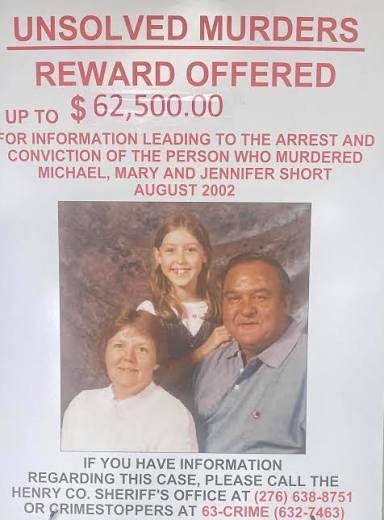
A reward of more than $62,500 is currently offered for information leading to the arrest and conviction of those responsible.
What the Evidence Says
Taken together, the physical evidence of the Short case the cut phone line, the single shots, the cash untouched on the counter, the specific positioning of Jennifer’s bedding, the distance at which her remains were found tells a story of premeditation and purpose. This was not a robbery. It was not a spontaneous act of violence. It was planned in advance by someone who had thought about how to do it without being stopped, who cut the phones before anything else, who moved through the house with enough knowledge of its layout to find two sleeping people in different rooms and kill them both without waking anyone.
The $600 on the counter. In twenty-three years, no investigator has proposed a credible theory in which that $600 makes sense for a robbery. It makes sense only if the person or people who entered the house that night were not there for money.
They were there for Jennifer.
If that reading is correct, then everything else follows: the advance preparation, the execution of the parents, the transport of the child to a remote location in another state, the specific manner of disposal. And if that reading is correct, it raises the question that has defined the investigation for twenty-three years: who had identified Jennifer Short as a target, and how?
The answer may be in the DNA evidence currently being processed at DNA Labs International. The technology available in 2025 is categorically different from what existed in 2002. Forensic genealogy the technique that identified the Golden State Killer, that named Stacey Chahorski’s killer, that gave Tracy Sue Walker back her name after thirty-seven years can work from biological material that would have produced no result in 2002. If the killer left biological material at the scene or at the location where Jennifer was found, it may now be possible to identify them.
The Family
Michael Short’s adult sons from his previous marriage have lived with the knowledge of what happened to their father, their stepmother, and their half-sister for twenty-three years. The community of Oak Level has lived with it too the particular weight of a violent crime that was never solved, that left no one arrested and no explanation, that sits in the local memory as a wound that has not closed.
The investigation has been, by the accounting of Henry County Sheriff’s Office, the longest-running active homicide investigation in the county’s history. Active is the key word. The file has not been closed. The case has not been retired. The investigators who have worked it over the years have expressed, consistently and over decades, a personal commitment to resolution that goes beyond professional obligation.
“We have not forgotten,” Davis said in 2025, on the twenty-third anniversary. “We will not forget.”
The Questions That Remain
Who cut the phone line?
Who moved through the Short house in darkness and found Michael on his garage couch and Mary in her bed and killed each of them with a single shot without either waking before they died?
Who took Jennifer from her bed, transported her thirty miles into North Carolina, and left her in a creek on the Albert property in Rockingham County?
Who was the man in the white flatbed truck seen near the Short home on the morning of August 15, 2002?
Who had been watching Mary Short at the Pluma plant in the early 1990s, asking for her, being removed from the premises?
Who had walked through the Short house during the open houses in the weeks before the murders, mapping the rooms?
These questions have existed for twenty-three years. Some of them may be answered by the DNA testing now underway. Some of them may require someone, somewhere, to decide they can no longer carry what they know. Some of them may never be answered.
The house on Route 220 burned to the ground in 2019. The tree under which Jennifer played as a child still stands somewhere in Henry County. The file at the sheriff’s office runs to thousands of pages, and a task force of investigators is working through it again with fresh eyes and new tools.
Michael Short was fifty years old. Mary Short was thirty-six. Jennifer Short was nine, and about to start fourth grade, and had her whole life in front of her.
Someone came to their house in the dark and took all three of them.
That someone has not been found.
Michael Wayne Short was fifty years old. Mary Frances Short was thirty-six. Jennifer Short was nine years old, born July 1993. She would have been thirty-two years old today. Their killer or killers have never been charged. The reward stands at $62,500.
If you have any information:
Henry County Sheriff’s Office (276) 638-8751.
Crime Stoppers 63-CRIME (632-7463).
FBI Tip Line 1-800-225-5324.


Leave a Reply