Doncaster to London, September 14, 2007 a fourteen-year-old left home as if heading to school, bought a one-way ticket to London, walked out of King’s Cross Station, and has not been seen since
Balby, Doncaster
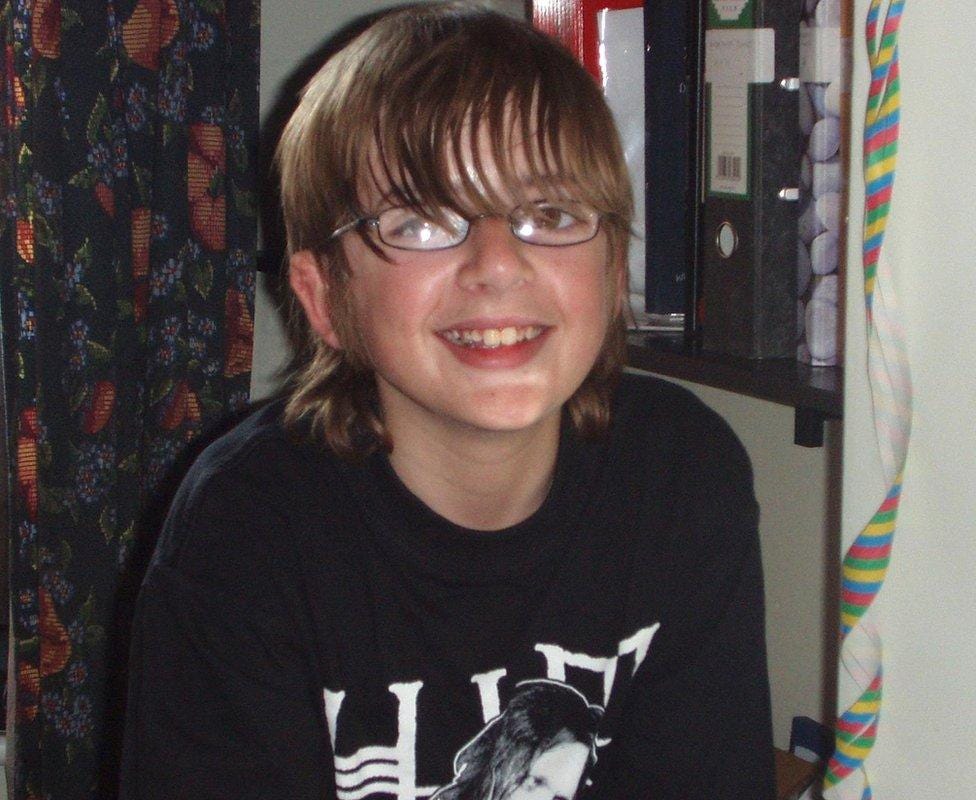
Andrew Paul Gosden was born on July 10, 1993, in Doncaster, South Yorkshire a post-industrial city in the north of England, once defined by coal mining and steel production, by the time of Andrew’s birth adapting to whatever came after those things. He grew up in Balby, a suburb to the south of the city centre, with his parents Kevin and Glenys and his older sister Charlotte. Kevin and Glenys were committed Anglican Christians who had, in a decision that spoke to their respect for their children’s autonomy, not baptised either child, believing it was not their place to impose their faith on their family.
What emerged in Andrew, by the time he was fourteen, was a young man of striking intellectual gifts and a personality that he guarded with care.
He attended Macaulay Catholic High School, where teachers noted his academic ability, particularly in mathematics, and where his attendance record was described as outstanding. He was enrolled in the gifted and talented programme. He was, by the accounts of those who knew him, genuinely exceptional in the way that certain young people are not performing intelligence but inhabited by it, working through problems in ways that were qualitatively different from his peers.
If you enjoy my true crime coverage, please help me continue my newsletter by upgrading here:
Outside school, he was a homebody. He was not someone who went out without telling his parents where he was going this was specifically noted as a characteristic of his behavior, a child who kept his family informed because he was considerate and because he had no particular reason to hide his movements. He had a small group of friends at school. He was not known to be bullied. He had interests that ran toward music he loved heavy metal, particularly bands like Slipknot, whose imagery appeared on his clothing and his messenger bag. He played on a PlayStation Portable, a PSP, which was his primary entertainment device. He did not have a mobile phone at the time of his disappearance: he had owned one previously, had lost it, and had never asked his parents for a replacement.
He did not have an email address. He had no social media presence, no online accounts linked to any device. For a fourteen-year-old in 2007, this was already somewhat unusual. For the investigation that would follow his disappearance, it would become one of the central facts the absence of a digital trail that might otherwise have explained what was in his mind.
True Crime Weekly is a reader-supported publication. To receive new posts and support my work, consider becoming a free or paid subscriber.
Friday, September 14, 2007
It was eight days into the new school year.
On the morning of Friday, September 14, 2007, Andrew dressed in his school uniform, said “see you later” to his family, and left the house as if heading to school. He walked in the direction of his bus stop and then did not get on the bus.
Instead, he went to Westfield Park, a small park nearby. A family friend later recalled seeing him there at approximately 8:20 in the morning, sitting alone on a bench. He sat there in his school uniform, alone, on a bench in a park until he was confident his family had left the house.
Then he went home.
At home, he changed out of his school uniform and into casual clothes: a black Slipknot T-shirt, black jeans, and Vans trainers. He took a messenger bag and added to it his bank card, his PSP, and an unknown number of other possessions. The bag had patches on it relating to his favourite bands. He had, in some sense, dressed himself for something specific for a version of himself that was different from the schoolboy in uniform who had said goodbye to his parents.
He left the house again. He walked to a cash machine and withdrew £200 the entirety of his bank account balance. He then walked to Doncaster railway station, arriving at 9:22 in the morning.
At the ticket window, he asked for a ticket to London King’s Cross. The vendor told him that for less than £1 extra, he could buy a return ticket. Andrew declined. He bought a one-way ticket for £31.40 and walked to the platform.
He boarded the 9:35 train to London. Another passenger later recalled seeing him sitting alone in his seat, playing on his PSP for the duration of the journey. He didn’t speak to anyone. He was calm. He was a fourteen-year-old boy riding a train to London in a Slipknot T-shirt, and nothing about him appeared distressed or frightened or in need of help.
The train arrived at King’s Cross Station at 11:20 a.m. slightly ahead of schedule because of service variations. Andrew disembarked.
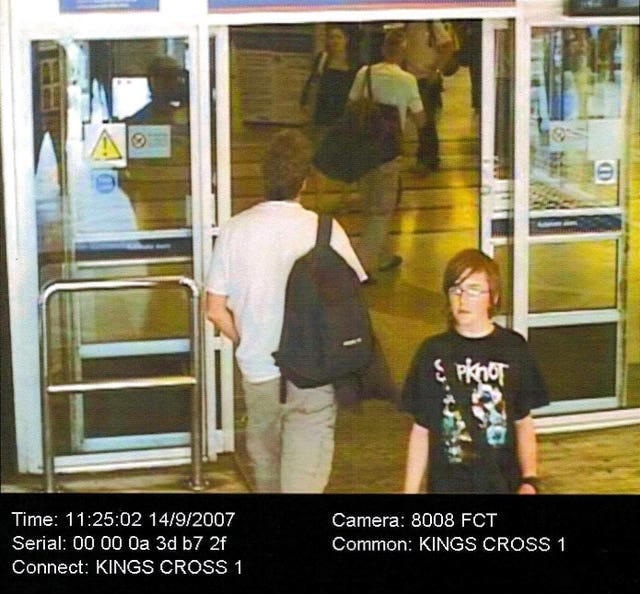
At 11:25 a.m., CCTV cameras inside King’s Cross Station captured him exiting toward Euston Road.
That is the last confirmed sighting of Andrew Paul Gosden anywhere in the world.
The Evening
Kevin Gosden was the first to know something was wrong.
That evening, when Andrew had not come home from school, Kevin began making calls. He contacted friends, he contacted the school, he worked through the list of people Andrew might conceivably be with. Nobody had seen him. Andrew had not been at school. Nobody knew where he was.
Kevin reported his son missing that night. What followed was the beginning of a search that would last years, generate hundreds of leads, involve two major arrests, and never produce a confirmed sighting after 11:25 a.m. on September 14.
The investigation fell to South Yorkshire Police, with involvement from the Metropolitan Police Service given that Andrew’s last known location was in London. In the early weeks, investigators obtained the CCTV footage from King’s Cross and established the confirmed timeline. They established the Doncaster withdrawal, the one-way ticket, the park, the change of clothes. They established that the morning had involved a degree of planning waiting in the park until the family left, returning home to change, withdrawing the full account balance that indicated Andrew had made a considered decision to go somewhere and had taken steps to ensure he had time before his family noticed he was gone.
What they could not establish was where he went from King’s Cross, or why he had gone there, or who if anyone had known he was coming.
What Was in His Mind
The investigation of Andrew Gosden’s disappearance has been shaped from the beginning by a fundamental question that has never been answered: what was he intending to do in London?
The absence of digital evidence no email, no social media, no online chat logs, no accounts of any kind on his devices means there is no record of any communication he might have had in the weeks or months before he disappeared. If he was corresponding with someone, there is no surviving record of it. If he was making plans, he made them in ways that left no trace.
The theories investigators and the family have explored over the years are extensive.
The simplest explanation that Andrew had decided independently to go to London for reasons of his own, sightseeing or attending an event was the first thing the family themselves proposed. He had enjoyed London visits with his family. He liked museums. He had, perhaps, simply wanted to go to the capital and explore. His sister Charlotte had, at fourteen, independently traveled to London to hand out CVs for work experience; Kevin Gosden speculated that Andrew might have been doing something similar.
Various events in London around that date were examined as possible draws. Investigators looked at whether Andrew had any interest in a SikTh concert being held in the area, or in a HIM promotional signing at the HMV on Oxford Street on September 17. Investigators explored the possibility that he had attended a YouTube gathering being held in London around that time but could find no evidence he had any interest in or awareness of YouTube. A music signing by the band HIM was investigated with the band’s cooperation, but the evidence trail went cold.
The possibility that Andrew had arranged to meet someone was taken seriously from early in the investigation, and has grown more serious over time. He had no phone and no documented internet presence, but there are avenues through which a fourteen-year-old in 2007 could have arranged a meeting that would not leave a paper trail through a friend’s device, through a school computer, through a library terminal. None of these were fully ruled out.
The nature of who he might have been meeting, and why, became the axis around which the most disturbing investigative theories rotated.
The Sightings
In the year following his disappearance, 122 potential sightings of Andrew were reported from across the United Kingdom 45 from London alone, 11 from Brighton. Every one was investigated. Every one proved inconclusive.
The family identified several sightings as more credible than others, based partly on the specificity of witness descriptions and partly on reported details of how the young man they had seen had spoken.
The most plausible, in Kevin Gosden’s assessment, placed Andrew at the Pizza Hut restaurant on Oxford Street on the afternoon of September 14 approximately 2.6 miles from King’s Cross, about an hour’s walk. The family has stated that this lead was not properly investigated by police at the time. Whether this represents an investigative failure or a reasonable prioritisation of limited resources in the early days of a complex missing person case is a question that has never been satisfactorily answered.
Additional sightings on Oxford Street on September 17 three days after his disappearance were reported. The following day, Andrew was reportedly seen sleeping in a park in Southwark. On September 19, five days after he vanished, a report was made of a young man matching his description getting off a train at Mortlake station in southwest London.
None of these were confirmed. None led to a finding.
The Online Lead
Among the most tantalising threads in the case emerged through an online conversation that investigators were able to trace.
An individual using an internet platform made contact with another user in what appeared to be a casual online discussion. During the exchange, this individual mentioned having “left home when they were 14” and noted that they did not have a bank account. When the other person offered to send them money, this claim was made as an explanation.
The language matched Andrew’s circumstances fourteen, left home, no functional bank account after the withdrawal. Investigators traced the lead. The person communicating could not be identified. Whether this was Andrew whether at some point after his disappearance he had access to an internet-connected device and used it is unknown. Whether it was someone else who happened to fit the description is equally unknown.
The lead was investigated. It produced nothing conclusive. It remains in the file, neither confirmed nor eliminated.
The Arrests
For fourteen years, the investigation produced no arrests. Then, on December 8, 2021, South Yorkshire Police detectives working with the Metropolitan Police arrested two men in London.
A 45-year-old man was arrested on suspicion of kidnap, human trafficking, and possession of indecent images of children. A 38-year-old man was arrested on suspicion of kidnap and human trafficking.
The family was informed. For the Gosdens, the arrests however cautiously they had to be received represented the first significant development in years. They also represented the first public indication that police were actively pursuing the theory that Andrew had been a victim of organised criminal exploitation rather than a young man who had chosen to go missing.
The two men were released under investigation while enquiries continued. Detectives interviewed them, seized items from their properties, and spent nineteen months building their case or finding that no case existed.
On September 20, 2023, South Yorkshire Police announced that both men had been eliminated from their inquiries.
Detective Chief Inspector Andy Knowles, leading the investigation, said: “We’re confident the two men arrested played no part in Andrew’s disappearance and have been eliminated from our inquiries. However, the investigation remains open and active and we would urge anyone with information to come forward.”
Kevin and Glenys Gosden released a statement that was, under the circumstances, extraordinarily composed. They thanked the investigative team for its thoroughness. They expressed sympathy for the two men who had spent nearly two years under investigation for something they had not done. They described the preceding months as “a period of additional difficulty for our family, intensifying our sense of living in limbo.”
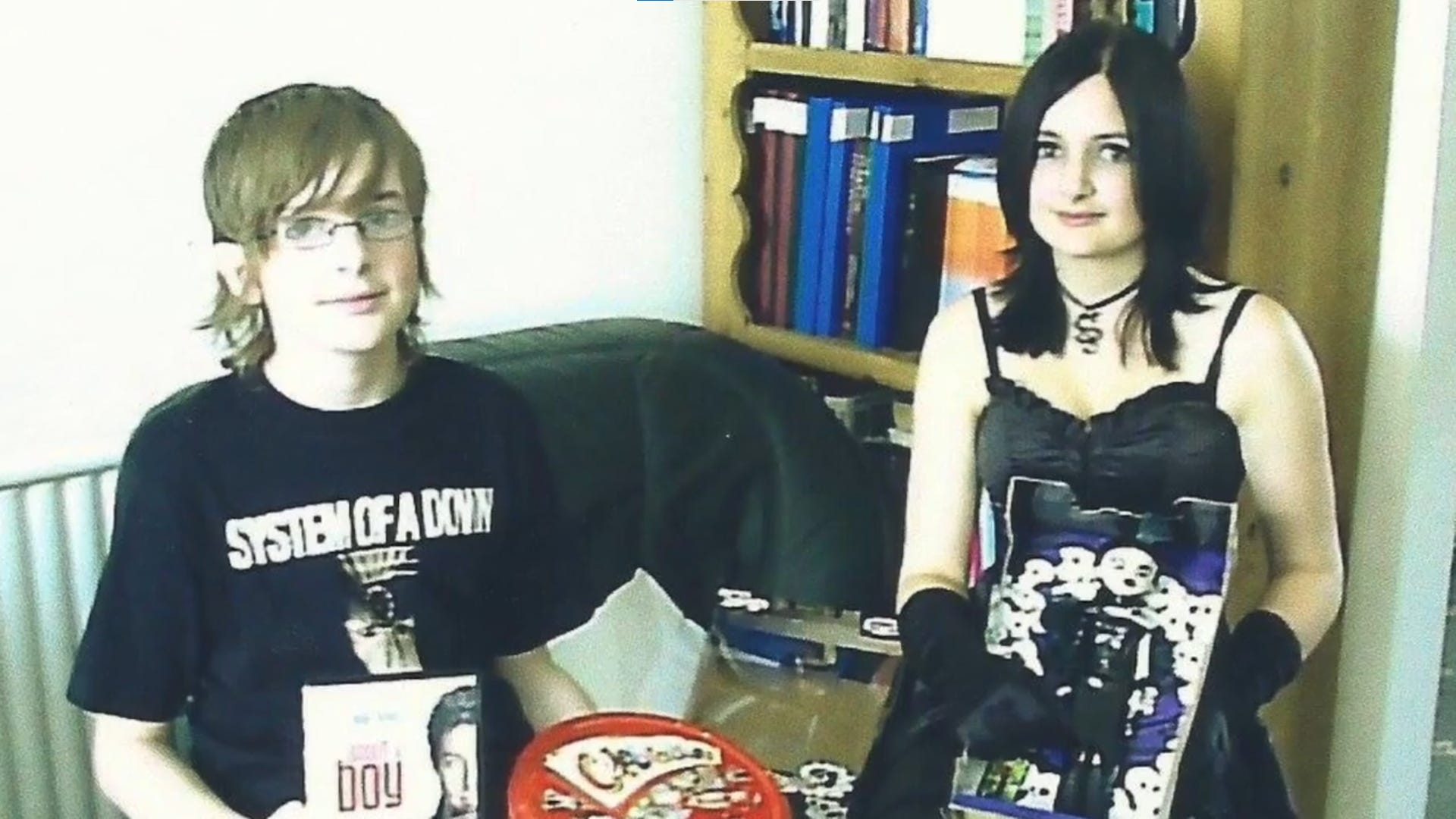
Physical Details and the Ear
Andrew’s distinctive physical features have been central to every appeal for information across eighteen years. Beyond his height approximately 5’3” at the time of disappearance and his typical clothing, investigators have focused on two specific characteristics.
He is deaf in his left ear. This is a significant and unusual characteristic, and one that would likely have become apparent to anyone who spent any time with him the way he positioned himself in conversation, the side on which he needed people to speak to him. For anyone who has known or lived with Andrew since 2007, this would be a feature of daily life.
He has poor eyesight. He would require strong glasses or contact lenses to see clearly. Without them, his ability to navigate would be significantly affected. The question of how he has managed this, if he is alive, is one of the small practical details that investigators believe could eventually surface as a lead.
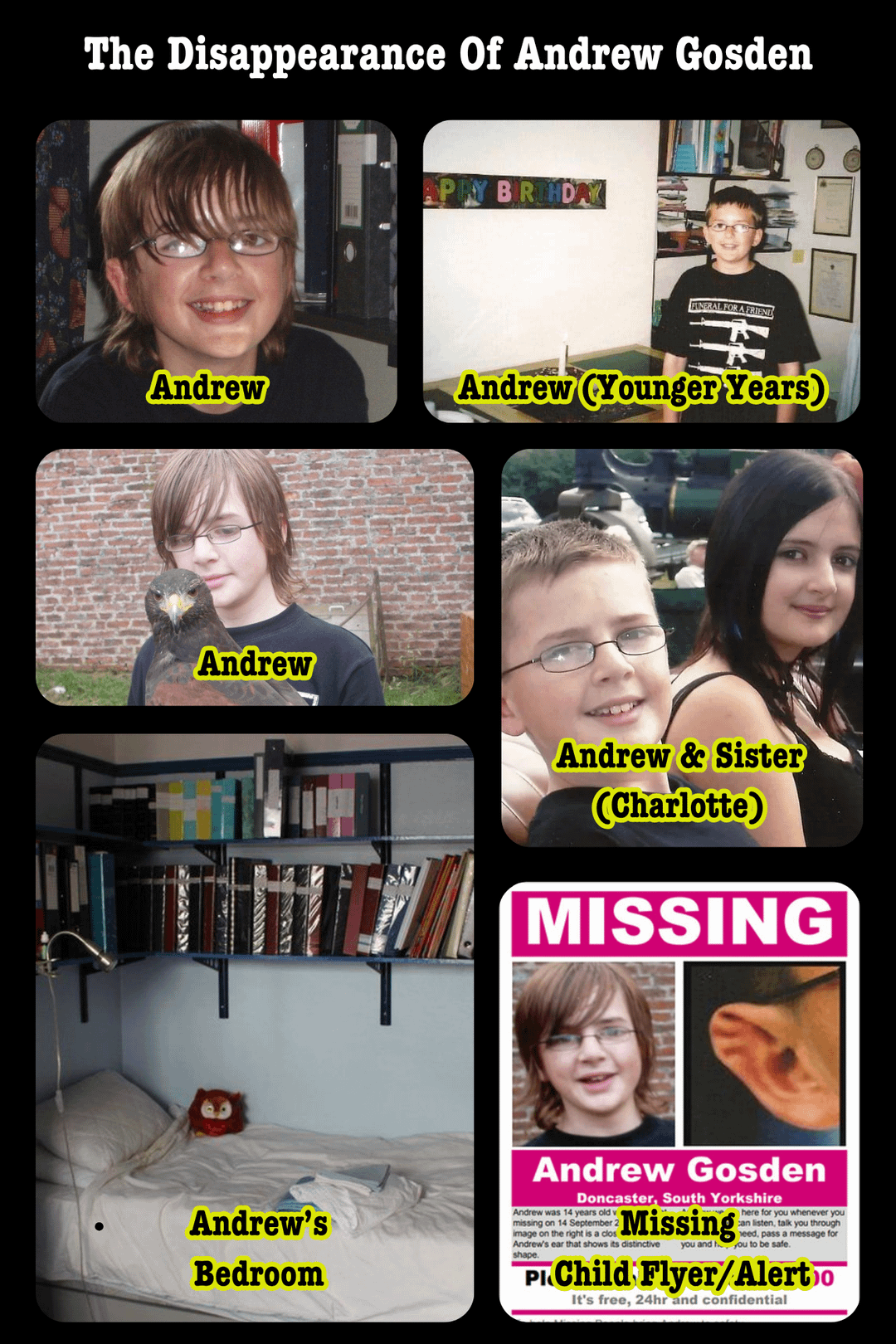
Most distinctively: Andrew has a double ridge on his right ear a physical feature, present from birth, that cannot be altered or concealed and that appears in every appeal issued by South Yorkshire Police. The ear photographs have been shared on missing persons posters, on social media appeals, on the campaign website run by the family. The double ridge is, in the language of investigators, the feature most likely to trigger recognition in someone who knows him. The question in every appeal is the same: do you know someone with this ear?
The Family’s Search
Kevin and Glenys Gosden have not changed the locks on their house. Andrew left with his key. If he came back, he could get in.
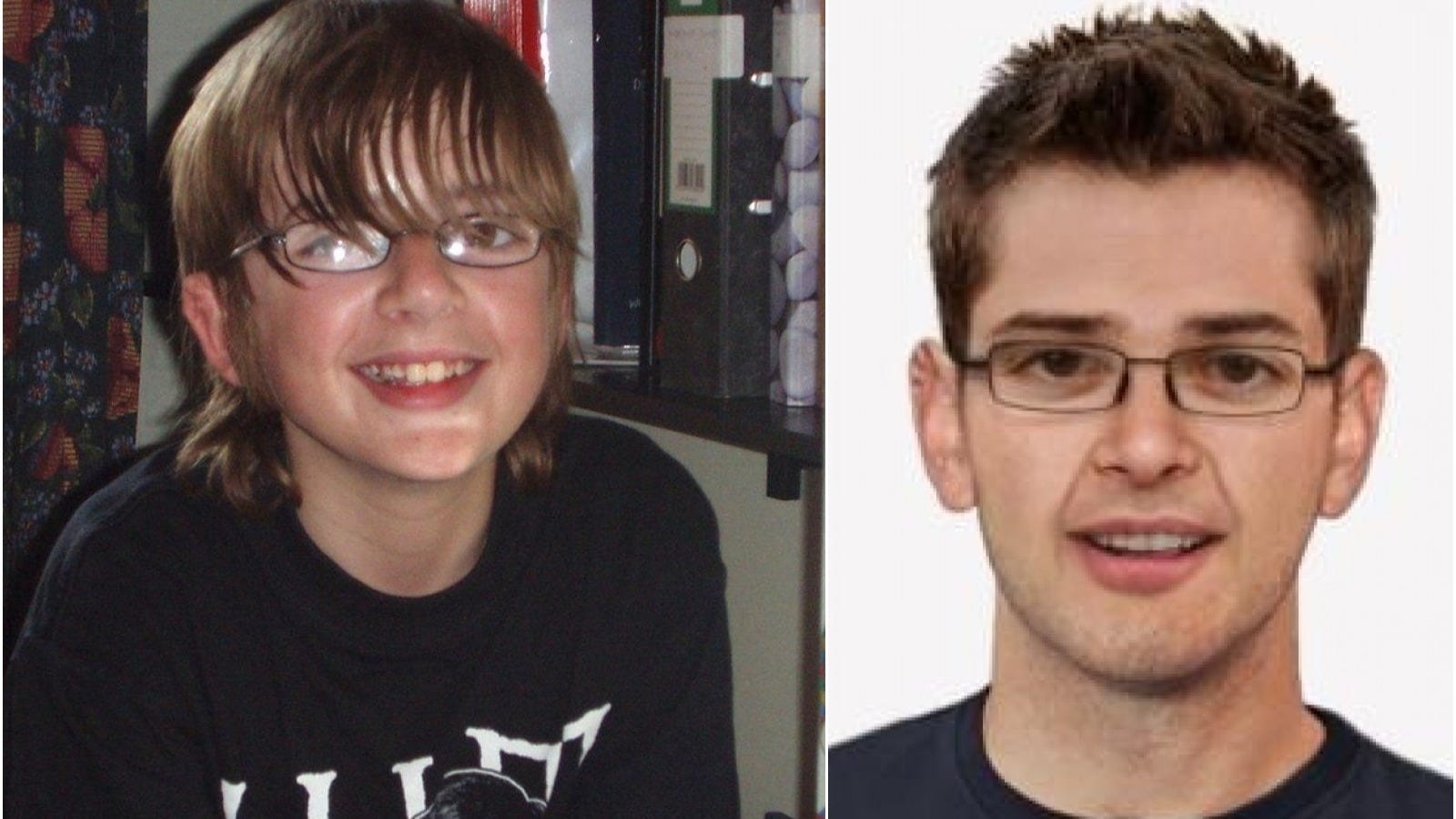
The family’s campaign has evolved over the nearly two decades since he disappeared. In July 2018, on what would have been Andrew’s twenty-fifth birthday, two age-progression photographs were released showing what he might look like as a young adult. The rock band Muse whose music Andrew had enjoyed agreed to help publicise the campaign. In October 2019, a further age-progression image was released.
In September 2025, on the eighteenth anniversary of his disappearance, South Yorkshire Police issued a fresh appeal. Andrew would now be thirty-two years old. The investigative team has changed several times over the years, but the case has remained formally open and active throughout.
In one of the most quietly heartbreaking details of the case’s long aftermath, Kevin and Glenys recently announced that they had finally decided to renovate Andrew’s bedroom seventeen years after he disappeared. They had left it as it was. For seventeen years. The decision to change it was not giving up; it was the rearrangement of grief into something more liveable.
“A missing loved one is not something that can be moved on from,” Kevin wrote. “We simply find ourselves another year on, with no clue where or why he went off that day, let alone where he could be now, even if he is alive.”
Why It Haunts
The Andrew Gosden case haunts people who encounter it for reasons that go beyond the ordinary distress of a missing child though that distress is real and present and has not diminished in eighteen years.
It haunts because of the methodical preparation. He did not disappear impulsively. He waited in a park in his school uniform until his family left the house. He went home and changed. He withdrew his entire bank account. He bought a one-way ticket and declined the return. Every decision made that morning suggested a young man who had thought about what he was doing and had made choices, and yet the reason for those choices remains completely invisible no note, no communication, no digital record, no confided plans, no one who has come forward to say he told them he was going.
It haunts because of what he took and what he left. He took his PSP, his bank card, and whatever else fit in the messenger bag. He left everything else. He left his home. He left his family who in the accounts of everyone who knew them had done nothing wrong and provided him no discernible reason to flee.
It haunts because of the one-way ticket. The vendor told him the return cost less than a pound more. Andrew declined. He was going somewhere and not planning to come back by train. Whether he was planning to come back at all is the question that has not been answered.
What Is Known, and What Isn’t
What is certain: Andrew Gosden left his home in Doncaster on the morning of September 14, 2007, with a plan that involved going to London and not returning in the way he had come. He was last seen at King’s Cross at 11:25 a.m. His bank account has never been used again. No confirmed sightings have been established since that moment.
What is unknown: everything else. Why he went. Who if anyone he was going to meet. What happened between 11:25 a.m. on September 14 and whatever came after it. Whether he is alive. If he is, where he is and under what circumstances. If he is not, what happened to him and where his remains are.
The investigation has, over eighteen years, pursued two broad categories of explanation. The first: Andrew made a choice to leave his life for reasons of his own reasons that were internal, possibly related to his mental state or to something in his life that he had not shared with his family, and that he carried out with the quiet purposefulness of someone who had decided. The second: he was lured to London, or was planning to meet someone who exploited or harmed him, and what happened to him after King’s Cross was not something he chose.
The arrests in 2021 suggested investigators had moved toward the second category with enough confidence to act on it. The elimination of both men in 2023 moved the case back toward the open territory between the two explanations, where it remains.
The Ear
South Yorkshire Police’s most recent appeals include, as they always have, the photograph of Andrew’s right ear. The double ridge. The feature he cannot disguise, cannot change, cannot hide.
The appeal is always the same: do you know someone with this ear? Is there someone in your life, on your street, in your community, who might be Andrew? Someone with gaps in their life history. Someone who has never quite explained where they came from. Someone who is deaf in one ear, who wears strong glasses, who would have been fourteen years old in 2007 and is thirty-two years old now.
Kevin and Glenys Gosden have lived for eighteen years with the particular condition of not knowing a condition that has no medical name and no established treatment, that does not resolve with time but only accumulates more of it. They did not change the locks. They kept his room as it was for seventeen years. They are still looking, in the ways available to them, for a son who sat on a bench in a park one Friday morning, waited until the house was empty, and then caught a train south.
Andrew Paul Gosden was fourteen years old on September 14, 2007. He would be thirty-two years old today. He has a double ridge on his right ear, is deaf in his left ear, and requires strong glasses or contact lenses. His bank account has not been used since the morning he disappeared. His family has never changed the locks.
If you have any information:
South Yorkshire Police 101, or anonymously through Missing People at 116 000.


Leave a Reply