Mascotte, Florida, May 11, 1987 an eleven-year-old girl walked to a convenience store for a pencil and never came home. Thirty-nine years later, with an execution warrant signed and a DNA result called inconclusive, the case of James Duckett still has no settled answer

Mascotte
Mascotte is a small city in Lake County, Florida, sitting in the flat citrus country west of Orlando the kind of place that is defined less by what it is than by its proximity to things that are not it.
Interstate 75 runs nearby and Orlando is forty-five minutes east. But Mascotte itself is quiet and small and largely invisible to anyone who doesn’t live there, the kind of community where everybody knows whose patrol car that is and who is on duty on a given night, because there is only one patrol car and only one officer on duty at any given time.
If you enjoy my true crime coverage, please help me continue my newsletter by upgrading here for only $5 a month:
On the night of May 11, 1987, the officer on duty was James Aren Duckett twenty-nine years old, a rookie, one year into the job. And on that same night, Teresa McAbee left her mother Dorothy McAbee’s home in Mascotte, walking alone to a nearby Circle K convenience store to buy a pencil.
Teresa was eleven years old. She was in fifth grade at Mascotte Elementary School. She needed a pencil to finish her homework. The Circle K was close by. She had walked it before. It was the kind of errand that eleven-year-olds run in small towns without anyone thinking twice about it.
But she never came home…
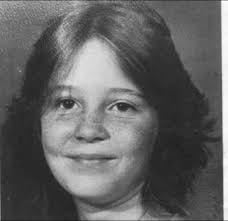
The Last Sighting
On the night of May 11, 1987, James Aren Duckett was on patrol duty throughout the city of Mascotte when he first encountered eleven-year-old Teresa McAbee, who was walking out of a convenience store with a sixteen-year-old Mexican teenage boy.
What happened next is the pivot on which the entire case turns, and it has been disputed since the moment investigators began asking questions about it.
Duckett inquired of the convenience store clerk about the girl’s age before he approached both McAbee and the boy, questioning them before he instructed McAbee to go back home.
This much is essentially undisputed Duckett himself has acknowledged encountering Teresa at the Circle K and telling her to go home. What he disputes is everything that followed.
The prosecution’s account, built over thirty-eight years and affirmed by multiple courts: Duckett did not let Teresa simply walk home. After speaking to the store clerk about her age, after asking questions about the girl at the counter in a way that struck the clerk as odd, he placed Teresa in the front seat of his patrol car.
He drove her to a dirt road near Knight Lake, less than a mile from where he had encountered her. There, he raped her and strangled her. He threw her body into the water.
Duckett’s account: he spoke to Teresa and the sixteen-year-old boy, told her to go home, and that was the last time he saw her.
One of them is lying. Determining which one has consumed nearly four decades of investigation, trial, appeal, and most recently a last-minute DNA battle that took the case to the brink of execution and then, at least temporarily, pulled it back.

The Body in Knight Lake
The next day, Jim Clark, while fishing, found the body of Teresa, reportedly raped, choked, and drowned. He informed Mascotte Police Chief Mike Brady, who then notified the Lake County Sheriff’s Office.
An autopsy showed she had been raped, strangled, and thrown into the water.
The location where her body was found was significant from the beginning: Knight Lake was less than a mile from the Circle K. The timeline Teresa alive at the convenience store, her body in the lake discovered the next morning meant she had died within a short distance of where she was last seen, within a short window of time after she was last seen.
Investigators moved to the area near the lake and found something on the dirt road leading to the water. Investigators found tire tracks along that road near the body. The tracks matched the pattern of police cars driven by the Mascotte Police Department, including Officer Duckett.
This was the first piece of physical evidence pointing at Duckett, and it is the kind of evidence that looks damning and is simultaneously less definitive than it sounds. Mascotte had a small police force with a small fleet of vehicles. The tire pattern matching police department vehicles did not mean Duckett’s specific car it meant cars of that type, which in Mascotte’s case included every vehicle in the department.
The second piece of physical evidence was more specific. One lone pubic hair was found inside Teresa’s underwear and would later be evaluated and confirmed by FBI expert Michael Malone as being consistent with Duckett’s pubic hair.
The third piece was perhaps the most significant in terms of placing Teresa in contact with Duckett’s specific vehicle.
Circumstantial evidence linking Duckett to the scene included tire tracks matching his patrol vehicle and commingled fingerprints from both Duckett and McAbee found on the hood of the car
The fingerprints of both Duckett and Teresa McAbee on the hood of Duckett’s patrol car a placement consistent, investigators argued, with Teresa sitting on the hood, or being placed there was the physical link between victim and suspect that the prosecution would build its case around.
Then there was the witness.
A woman named Gwen Gurley, who was herself in custody at the time, told investigators she had been at the Circle K on the night of May 11 and had seen a police officer leave with a passenger a young girl in the front seat of his patrol car.
Her identification of Duckett as the officer, and of the girl as Teresa McAbee, was among the most significant testimonial evidence in the case.
Gwen Gurley later recanted her testimony, claiming that she was told to say she saw Duckett with Teresa by the case’s investigators and that she received favourable prison treatment because of her testimony.
She then recanted the recantation, walking back her claims about investigative pressure while maintaining certain elements of what she had originally said. When eventually called for Duckett’s evidentiary hearing, Gurley invoked the fifth amendment and clarified that she would not testify at any new trial Duckett might be given.

A witness who testified at trial, then recanted claiming coercion, then recanted the recantation, then refused to testify further Gwen Gurley’s testimony exists in a permanent state of productive uncertainty, useful to both prosecution and defence and definitive to neither.
The prosecution additionally presented testimony from three teenage girls who said Duckett had made sexual advances toward them in the six months before Teresa’s murder. This evidence was introduced under Florida’s Williams Rule, which allows prior bad acts to be admitted under certain circumstances, and was considered by defence attorneys and subsequent reviewers to be among the more prejudicial elements of the prosecution’s case.
The Trial and the Death Sentence
On October 27, 1987, James Aren Duckett was indicted for the sexual battery and murder of Teresa McAbee. He was tried in 1988.
A jury recommended the death penalty by an eight-to-four vote, which the trial court accepted after finding multiple aggravating factors. Duckett was convicted of first-degree murder and sexual battery on May 10, 1988, and sentenced to death on June 30, 1988.
He has maintained his innocence since the moment of his arrest, through his conviction, through every appeal, through every evidentiary hearing, through thirty-eight years on Florida’s death row. He has never changed his account of what happened on the night of May 11, 1987: he told Teresa McAbee to go home, and she walked away, and that was the last time he saw her.
He has been on death row longer than Teresa McAbee was alive when she was killed.
The Problems With the Evidence
The case against James Duckett is built almost entirely on circumstantial evidence, and the specific pieces of that evidence have each, at various points, been subjected to scrutiny that complicated rather than resolved the picture.
The FBI hair analysis that identified the pubic hair in Teresa’s underwear as “consistent with” Duckett’s was conducted by Michael Malone, an FBI forensic examiner whose testimony would later become one of the most significant examples of junk science in American legal history.
A former homicide investigator named Marshall Frank, while researching a crime novel, began corresponding with Duckett and initially concluded that the prosecution had misjudged the fingerprint evidence, mishandled both the tire cast and pubic hair identification, and failed to pay attention to things that might have been in Duckett’s favor
Frank subsequently changed his position after reviewing the full case file, coming to believe Duckett was responsible. His reversal and the reasoning behind it has itself been scrutinized by Duckett’s advocates as an example of how the weight of institutional belief can shape an investigator’s conclusions.
The FBI, in a sweeping review of Malone’s work conducted in the late 1990s, found that he had provided inaccurate and scientifically unsupportable testimony in multiple cases.
Hair analysis of the type Malone performed microscopic comparison without DNA confirmation has since been largely discredited as forensic science. The finding that the pubic hair was “consistent with” Duckett’s hair would not, under modern standards, constitute meaningful evidence of identification.
The fingerprint evidence both Duckett’s and Teresa’s prints on the hood of the patrol car has been offered by Duckett’s advocates as a red herring. Duckett’s prints were on his own car because it was his car. Teresa’s prints, under Duckett’s account, could have gotten there when he approached her and the sixteen-year-old outside the Circle K, if she had touched the vehicle during their interaction.
Under the prosecution’s account, they got there because Teresa sat on the hood before being put inside the car.
Neither explanation is impossible. Neither is definitive.
The Suspect in Other Crimes
One dimension of the Duckett case that has received less attention than the evidence questions is what investigators found when they looked beyond the McAbee murder.
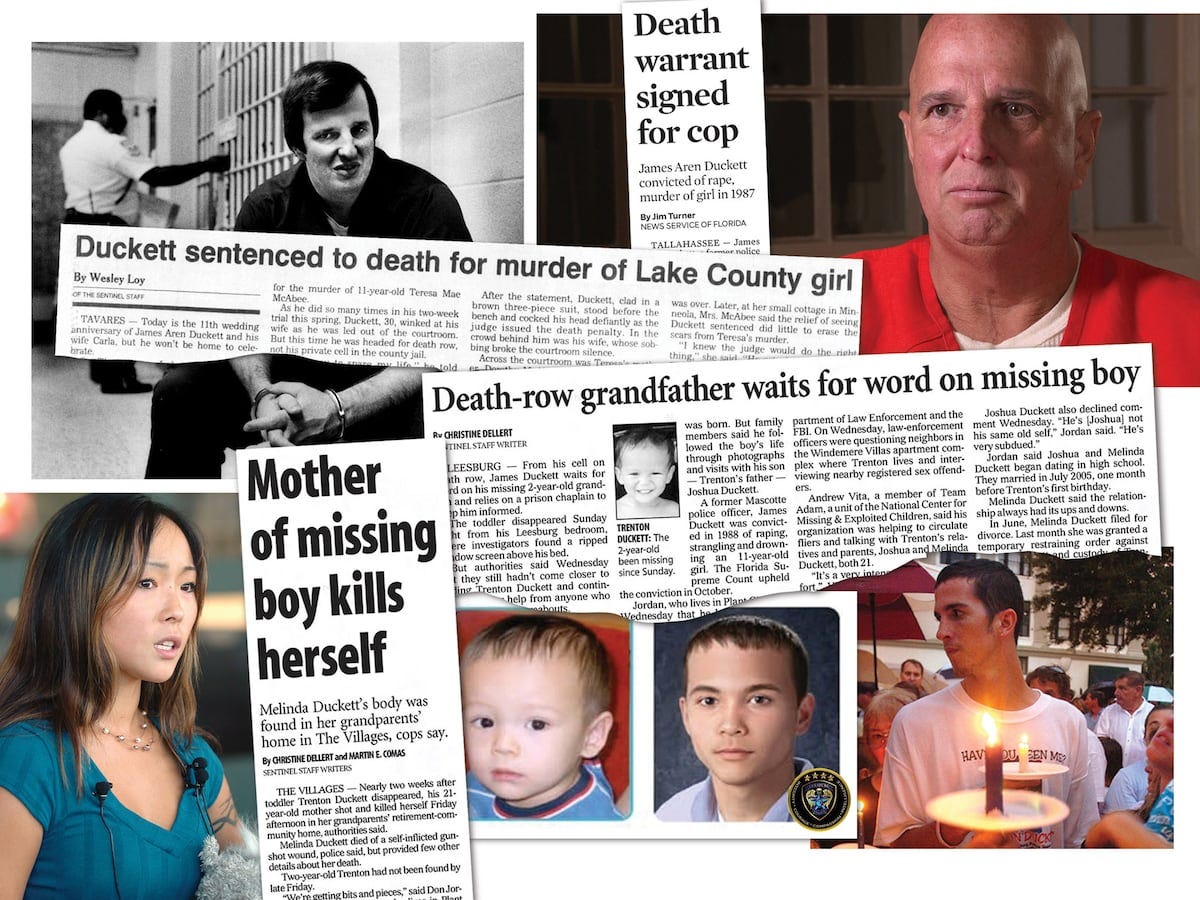
Apart from McAbee’s murder, Duckett is also a suspect behind the 1987 unsolved murder of fourteen-year-old Jeanifer Shyan Weldon and a third unsolved murder of an unidentified woman in 1986.
If Duckett is guilty of the McAbee murder, the pattern a police officer using his badge and his patrol car as instruments of predation, operating in the small community where he served is both coherent and deeply disturbing. If he is not guilty, then these three cases involving young women in the same area in the same period represent crimes by an unknown perpetrator who has never been identified or charged.
Investigators who worked the case maintained, consistently and across decades of appeals, that Duckett was their man. The circumstantial case, when assembled whole, pointed in one direction.
Whether the whole is more than the sum of its parts whether the tire tracks plus the hair plus the fingerprints plus the witness plus the prior bad acts testimony adds up to proof beyond reasonable doubt, or adds up to a persuasive story built around questionable science is the question that has divided lawyers, journalists, investigators, and advocates for nearly four decades.
February 2026: The Execution Warrant
Governor Ron DeSantis signed Duckett’s death warrant on February 27, 2026, scheduling his execution for March 31 at 6:00 p.m. at Florida State Prison in Raiford.
This was the fifth scheduled execution in Florida that year. Florida put to death a record 19 people in 2025, nearly half of all executions in the U.S.
Duckett’s attorneys, aware that the execution date was approaching, made a last-ditch legal argument: there was biological material from the crime scene semen found on Teresa’s jeans that had never been subjected to modern DNA testing. In 1987 and 1988, the technology to extract a usable profile from such material did not exist. In 2026, it does. The defence argued that testing the sample could, in principle, either confirm Duckett’s guilt or exonerate him. Either way, justice would be served by knowing.
A Florida circuit court judge declined to issue a stay, indicating he believed the testing could be completed before the filing deadline. Duckett’s attorneys appealed.
On March 26, the Florida Supreme Court issued a rare stay of execution pending the results of the DNA testing.
The DNA Results and the Inconclusive Finding
The testing was rushed through in the days immediately preceding the scheduled execution date. On March 27, 2026, the State filed its report.
The results were inconclusive.
The defenses own expert concluded that the dataset lacked sufficient information to support a reliable conclusion, stating: “I cannot state, to a reasonable degree of scientific certainty, that James Duckett either is or is not a contributor to the evidentiary DNA mixture. The available data are insufficient to support either an inclusion or an exclusion.”
Inconclusive is not exculpatory. It is also not confirmatory. It is simply nothing. Thirty-nine years of a case, and the DNA test that was supposed to resolve it produced the single most frustrating possible answer.
The State immediately moved to lift the stay of execution, arguing that since the testing was complete and had not exonerated Duckett, the stay’s purpose was fulfilled. Duckett’s attorneys argued that their expert needed access to the raw data underlying the inconclusive finding that a qualified bioinformaticist, given the full dataset, might be able to extract more specific conclusions from what had been characterised as inconclusive.
The Florida Supreme Court ordered further analysis of the DNA testing results, continuing the stay.
Then, after that analysis was completed, the Supreme Court ruled that Duckett failed to meet the legal threshold required for a newly discovered evidence claim, noting the results would not probably produce an acquittal on retrial. The court also rejected Duckett’s constitutional arguments regarding the speed of the death warrant process.
The Florida Supreme Court denied James Aren Duckett’s request for a stay of execution, allowing the state to move forward with his scheduled execution
As of July 2026, James Duckett faces execution with the DNA question unresolved not exonerated, not confirmed, simply in the permanent uncertainty of an inconclusive result from degraded biological material that has been sitting in an evidence bag for thirty-nine years.
What Teresa McAbee’s Family Wants
Teresa’s mother Dorothy McAbee has lived for thirty-nine years without a complete and settled answer about what happened to her daughter on the night of May 11, 1987. The conviction gave her a name. The appeals gave her decades of renewed uncertainty. The DNA test that might have closed the case permanently produced a result that resolved nothing.
Whatever she feels about the pending execution whatever closure it might or might not provide the fundamental circumstances of her daughter’s death remain, in some sense, exactly where they were in 1988: a jury’s verdict based largely on circumstantial evidence, a convicted man who has never stopped saying he is innocent, and a night in Mascotte that nobody has been able to fully reconstruct.
Teresa McAbee walked to the Circle K for a pencil. She was eleven years old. Someone killed her raped her, strangled her, threw her body in a lake a mile from where she had been alive and buying school supplies. Whether that someone was James Duckett has been the legal question for thirty-nine years.
The DNA result, when it finally came back, said: we cannot tell you.
The Broader Question
The case of James Duckett sits at an uncomfortable intersection of several unresolved debates in American criminal justice.
It is a case involving a conviction built largely on forensic science hair comparison, tire track analysis that has since been substantially discredited. It is a case where the primary witness recanted and then recanted her recantation. It is a case where the defendant is a former police officer, which cuts in both directions: he is someone for whom the jury may have had particular expectations of trustworthiness, and simultaneously someone for whom the evidence of predatory behavior using his patrol car and badge as tools of access to a child is uniquely coherent if he is guilty.
It is also a case involving a child. Teresa McAbee was eleven years old, and the desire for her death to be accounted for for someone to have paid for what was done to her is understandable and human and not easily separated from the question of whether the right person is the one paying.
If James Duckett is guilty and a jury found that he was, and multiple appellate courts have sustained that finding then his execution is the conclusion of a process that took thirty-nine years but ultimately delivered accountability for what was done to Teresa McAbee.
If he is not guilty if the hair analyst who identified that pubic hair was wrong, if the tire tracks proved nothing, if the fingerprints meant what he said they meant, if Gwen Gurley’s original testimony was coerced then the state of Florida is about to execute a man who has spent thirty-nine years on death row for a crime he did not commit, and the person who raped and drowned Teresa McAbee has spent those same thirty-nine years free.
The DNA test that might have told us which of those things is true came back inconclusive.
Teresa Mae McAbee was born in July 1975. She was murdered on May 11, 1987, in Mascotte, Florida. She was eleven years old and in fifth grade at Mascotte Elementary School. James Aren Duckett has been on Florida’s death row since 1988. DNA testing of evidence from the crime scene in 2026 produced inconclusive results. His execution is pending.
 True Crime Weekly
Leave a comment