Knoxville, Tennessee, January 12, 1995 a nineteen-year-old was lured from a Job Corps dormitory and tortured to death over the course of an hour by a peer who brought back a piece of her skull as a souvenir, ate breakfast with it in her pocket, and cried in court at her death sentence before writing a letter that evening calling it unfair

Orange Park
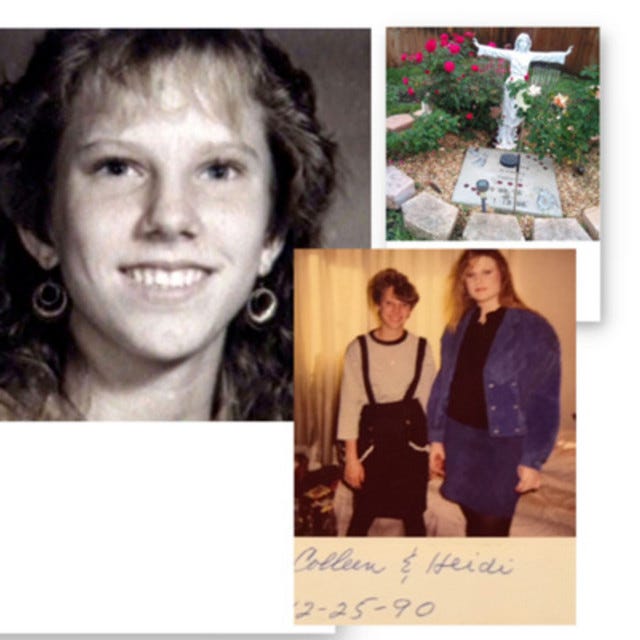
Colleen Anne Slemmer was born on September 20, 1975, in Orange Park, Florida a suburb of Jacksonville, the kind of quiet community where people know their neighbours and children play outside until the streetlights come on. She grew up there with her mother May Martinez, her stepfather, and her younger sister, and she was, by every account that survives her, exactly what she appeared to be: a kind and quiet young woman with a genuine instinct for helping people. She had volunteered with the Special Olympics programme. A teacher who knew her described her as “a very sweet, quiet, mild-mannered young lady.”
If you enjoy my true crime coverage, please help me continue my newsletter and keep it free for others, by upgrading here for only $5 a month:
She was nineteen years old when she left home. She had enrolled in Job Corps a federal vocational training programme for young adults to study a six-month computing course. Florida had no Job Corps centre with the programme she wanted, so she enrolled at the centre in Knoxville, Tennessee. Her mother had tried to talk her out of going. She was far from home, May said, and she wanted her close by. Colleen had always been independent. She made her own decision.
She left on October 31, 1994. It was the last time her family saw her alive.
The Job Corps Center
The Job Corps Center in Knoxville was a residential facility students lived and studied on site, in the close, sometimes claustrophobic proximity of dormitory life. Colleen had been there for approximately two and a half months when the trouble began.
Her mother would later tell investigators that Colleen had mentioned problems at the centre a few people who had been going into her room, stealing her jewellery, taking her clothes. She named two girls and a guy: Christa Pike, Shadolla Peterson, and Tadaryl Shipp, who was Pike’s boyfriend.
Christa Pike was seventeen years old. She and Colleen had developed a strained relationship, with Pike accusing Colleen of trying to steal her boyfriend and spreading rumours about her around the facility. Kim Iloilo, Pike’s closest friend, told investigators that at some point before Pike arrived at the centre, Shipp had shown an interest in Colleen. Once Pike came on the scene, his attention had shifted entirely to her. There was, in other words, no real threat Colleen was not pursuing Shipp, and Shipp was not pursuing Colleen. Pike’s grievance was constructed from a situation that had already resolved itself.
It didn’t matter. Pike had decided how she felt about Colleen Slemmer, and she had decided what she intended to do about it.
True Crime Weekly is a reader-supported publication. To receive new posts and support my work, consider becoming a free or paid subscriber.
On January 11, 1995 the day before the murder Pike told Kim Iloilo directly that she intended to kill Colleen. When Iloilo asked why, Pike said she had just felt mean that day.

January 12
At approximately eight in the evening on January 12, 1995, Iloilo watched Pike leave the Job Corps centre with Colleen, Shadolla Peterson, and Tadaryl Shipp. They were heading in the direction of 17th Street.
What happened over the next two hours is documented in exhaustive and harrowing detail in Pike’s own confession to police, in her statements to friends that same night, and in the medical examiner’s report produced at autopsy the following day.
Pike had told Colleen she wanted to walk to the Blockbuster Music Store. On the way, she mentioned a bag of marijuana hidden in Tyson Park, steering the group toward the University of Tennessee’s agricultural campus. When they reached the steam plant area on the UT campus, Pike and Colleen exchanged words.
Then Pike began hitting her.
She hit Colleen. She banged her head against her knee. She threw her to the ground and kicked her repeatedly, in the face and in the side. As she slammed Colleen’s head against concrete, Colleen asked, again and again: “Why are you doing this to me?”
When Colleen threatened to report Pike to Job Corps management which would result in Pike being terminated from the program Pike kicked her harder, in the face and the side. Colleen lay on the ground and cried. Then she tried to run.
Someone else in the group caught her and pushed her back to the ground. Pike and this other person whom Pike referred to in her confession only as “he,” declining to name him, though Tadaryl Shipp was later convicted for his role held Colleen down until she stopped struggling, then dragged her to another area of the campus. There, Pike cut Colleen’s stomach with a box cutter she had brought with her.
Colleen screamed.
Pike would later tell police that she began hearing voices at this point voices telling her that she had to prevent Colleen from talking, from reporting her, from sending her to prison. She stood watching Colleen bleed. When Colleen rolled over, got to her feet, and tried to run again, Pike cut her across the back a long, deep cut that the medical examiner would later measure and catalogue.
Colleen kept trying to get up. Pike kept cutting. Colleen bargained for her life: if Pike would just let her go, she said, she would walk back to Florida without collecting a single belonging from the dormitory. She would disappear. She would never come back.
Pike told her to shut up. She told her it was harder to hurt someone who was talking.
The more Colleen talked, the more Pike kicked her in the face.
Pike cut her throat. Once. Then again. Then again. Colleen was still talking, still trying to sit up, still begging, even as her throat was being cut. Colleen’s throat was cut six times in total across the attack. Each time she spoke, Pike cut again. The box cutter worked in combination with a miniature meat cleaver Pike had borrowed before leaving the dormitory a weapon she had deliberately carried to the scene.
Colleen tried to run one more time. Pike threw a rock at her, hitting her in the back of the head. The other person threw a rock too. Colleen fell.
Pike hit her. She hit her and kept hitting her. She found a large piece of asphalt and used that. She could hear Colleen “breathing blood in and out,” could see her body jerking with each impact, and she kept hitting. She asked Colleen, somewhere near the end: “Colleen, do you know who’s doing this to you?”
Colleen’s only response was a groan.
The attack lasted between thirty minutes and an hour. When it was over, Pike and the others dragged Colleen by her feet to a pile of debris near some trees and left her there. They scattered her clothes in the surrounding bushes. They walked back to the Job Corps centre and arrived at approximately 10:15 in the evening.
Colleen was not with them.
True Crime Weekly is a reader-supported publication. To receive new posts and support my work, consider becoming a free or paid subscriber.
The Skull
Later that night, Pike went to Kim Iloilo’s room.
She told her she had just killed Colleen. She told her she had brought something back. She opened her hand and showed Iloilo a piece of Colleen’s skull broken off during the asphalt blows, pocketed before she left the scene
She was dancing. She was singing. “La, la, la,” she sang, moving in a circle, smiling, as she described in detail what she had done: the throat cut six times, the beating, the asphalt, the pentagram carved into Colleen’s chest and forehead.
The next morning at breakfast, Iloilo asked her what she had done with the piece of skull.
Pike said it was in her pocket. Then she said: “And, yes, I’m eating breakfast with it.”
Later that morning, in class, she approached another student, Stephanie Wilson, and pointed at her shoes. Brown spots, she said that’s not mud. Pike pulled a napkin from her pocket and showed Wilson the piece of bone. She told her she had slashed Colleen’s throat six times and beaten her in the head with a rock. She said Colleen’s blood and brains had been pouring out. She said she had taken the piece of skull when she left.
The Body
On the morning of January 13, a University of Tennessee groundskeeper discovered the body near the greenhouses on the agricultural campus. He would testify at trial that it was so severely beaten he had initially thought he was looking at a dead animal. When he got closer, he saw clothing, a bare breast, and understood what he was actually looking at.
He called law enforcement.
Officers who arrived found the body face down on debris, nude from the waist up, covered in blood and dirt. The head had been bludgeoned. Cuts and slashes covered the torso. Officer John Terry Johnson testified that he thought he was looking at the victim’s face, but he couldn’t be sure it was, in his words, extremely mutilated. As additional officers arrived and the investigation expanded, the crime scene grew to cover an area 100 feet long and 60 feet wide. Trampled bushes, hand and knee prints in the mud, drag marks, and a large pool of blood approximately 30 feet from the body documented the extended geography of what had happened.
When the body was turned over, investigators saw the throat. A bloody rag was tied around the neck. A detective who accompanied the body to the morgue and observed it after it had been cleaned saw the pentagram carved into the victim’s chest.
The victim was identified by dental records as Colleen Slemmer, nineteen years old, Job Corps student, from Orange Park, Florida.
The Autopsy
Dr. Sandra Elkins, the Knox County Medical Examiner, performed the autopsy. What she found was so extensive that she abandoned her standard approach of cataloguing every wound by assigning each one a letter of the alphabet. There were too many. She testified that to document every wound, she would have needed to cycle through the alphabet more than once and remain in the morgue for three days. She eventually classified the most serious wounds and recorded the rest simply as “more superficial slash wounds on the back, arms and chest.”
Among the major wounds she documented: a six-inch gaping wound across the middle of the neck that had penetrated the fat and muscle tissue; ten additional slash wounds on the throat; slash wounds on the face; the carved pentagram on the chest.
The cause of death was blunt force injuries to the head. Colleen had sustained a minimum of four significant blows to the skull. The right frontal area of her skull had been fractured. The bridge of her nose was fractured. The most catastrophic wound labelled simply as injury “W” involved most of the left side of her head. Delivered while the right side of her skull was in contact with a firm surface, this blow fractured the right side of the skull and drove a portion of the skull into the brain itself. Small pieces of black asphalt were embedded in the skull fractures particles from the chunk of asphalt Pike had used to administer the blows.
The medical examiner noted that the area around each wound was red and inflamed meaning Colleen’s heart had been beating when every wound was inflicted. None of the stab or slash wounds would have rendered her unconscious. Blood in her sinus cavity confirmed she had been alive, and probably conscious, throughout.
She had been alive and aware for the duration of what was done to her.
The Investigation
Police connected Pike to the crime quickly. She had been talking about it openly since the night of the murder to Iloilo, to Wilson, to anyone who would listen, showing the piece of skull around the dormitory.
On January 14, 1995 two days after the murder Pike was interviewed by police. She waived her Miranda rights and gave a full statement. She claimed she hadn’t planned to kill Colleen, only to fight her. She described having taken the box cutter and the meat cleaver with her as a precaution. She described the entire sequence of events in the clinical, detached manner that investigators would later cite as one of the most disturbing elements of the interview.
She declined to name the other participants by name, referring throughout to “he” or “the other person.”
On the day after the murder, before she had been arrested, Pike had returned to the crime scene with three to five other girls from the dormitory. A university police officer named Harold Underwood was securing the area. Pike approached him and asked why the area was cordoned off, what the identity of the victim was, whether police had any suspects. While the other girls said nothing, Pike moved around, appeared amused, and giggled. Underwood noticed her pentagram necklace. When he learned the next day that the victim had a pentagram carved on her chest, he reported Pike’s behaviour to his superiors.
The investigation found satanic material in both Pike’s and Shipp’s rooms at the Job Corps dormitory a satanic altar in Shipp’s room, literature in both. Pike had “Lil Devil” tattooed on her left chest. Both were photographed at the police station on the day of Pike’s statement wearing pentagram necklaces.
The Trial
The State of Tennessee prosecuted Pike for first-degree murder.
The defence presented extensive testimony about Pike’s background and upbringing in mitigation. It was not a comfortable portrait. She had grown up in instability shuttled between parents who could not manage her, raised initially by a paternal grandmother who died in 1988, then passed between her mother and father. Her father had kicked her out twice; she had been removed from his home the second time in 1989 after an allegation that she had sexually abused his two-year-old daughter from a second marriage. Her mother admitted to smoking marijuana with Pike to “establish a friendship” and acknowledged that Pike had been out of control since she was eight years old. Pike had grown marijuana in pots at home at age nine, threatened to live on the street, been allowed a live-in boyfriend at fourteen, wielded a butcher’s knife against an abusive boyfriend, stolen repeatedly from her own family, dropped out of high school, and attempted suicide by overdose after her grandmother’s death.
Pike’s aunt, called as a defence witness, described her niece as a “pathological liar” and admitted she had been afraid to let Pike near her own children.
The defence’s own witnesses painted a picture of a young woman who had been failed repeatedly by every adult who should have protected her. They also painted a picture of someone who had been, by consistent testimony, entirely and fundamentally unmanageable since early childhood.
The jury considered all of it. They found two aggravating circumstances: that the murder had been especially heinous, atrocious, and cruel, involving torture and serious physical abuse beyond what was necessary to cause death; and that the murder had been committed to prevent Colleen from reporting Pike and having her removed from the programme.
They sentenced Christa Pike to death by electrocution.
The Letter
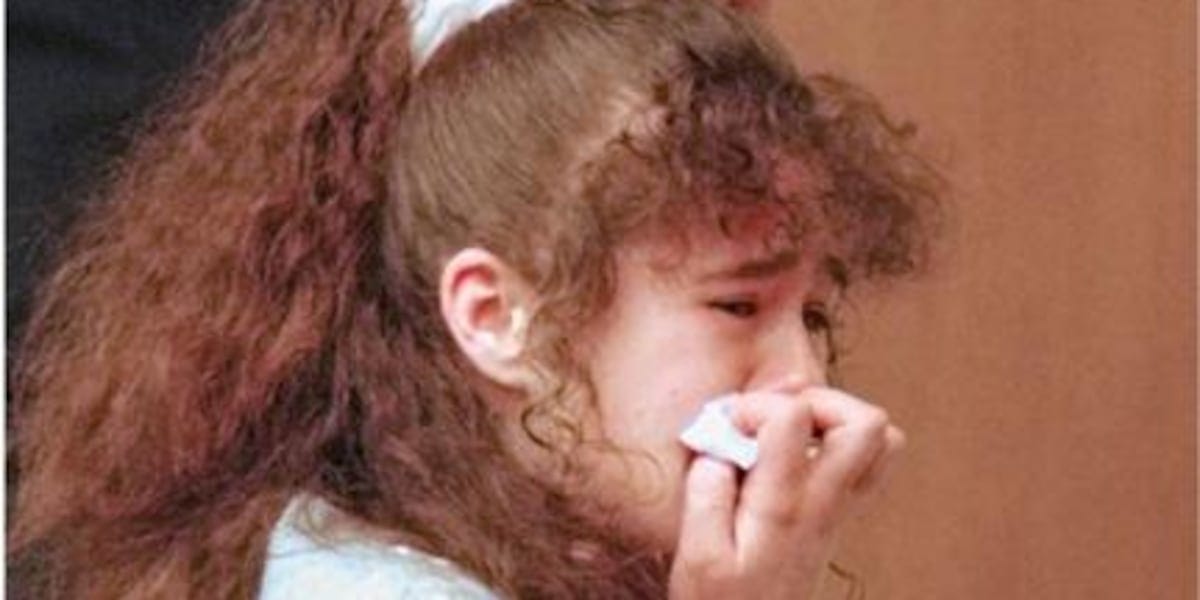
In the courtroom, when the sentence was read, Pike wept. She broke down visibly, in the way that tends to produce in observers at least a flicker of conflicted feeling the instinct toward sympathy, toward the possibility that grief and fear are evidence of something redeemable.
That evening, Pike wrote a letter to Tadaryl Shipp.
It read: “Ya see what I get for tryin’ to be nice to the hoe? I went ahead and bashed her brains out so she’d die quickly instead of letting her bleed to death and suffer more, and they f—— fry me! Ain’t dat some s—?”
She signed it: Lil Devil.
Since Incarceration
Christa Pike has not been a model prisoner.
In August 2001, six years into her sentence, she attacked a fellow inmate named Patricia Jones at the Tennessee Department of Correction facility. Jones had reportedly taken a dislike to Pike’s rumoured romantic partner, a woman named Natasha Cornett. Pike resolved the situation by wrapping a shoestring around Jones’s neck and attempting to strangle her. In a recorded phone call with her mother, Pike described the incident without apparent remorse:
“She was passed out on the ground, Mama, twitching, foaming at the mouth. Her eyeballs were bugged out so far her eyelids were flipped up. If I had 30 more seconds, we would have a little chalk outline out there in our rec pen, and that btch would be gone somewhere.”*
In March 2012, prison authorities uncovered and disrupted an escape plot. Pike had been coordinating with outside accomplices including a former prison guard to break out of death row. She faced additional criminal charges in connection with the conspiracy.
A 2024 documentary revealed she had been responsible for the dismissal of two prison guards, reportedly having been in a sexual relationship with both.
The Others
Tadaryl Shipp, who was seventeen at the time of the crime and tried as a minor, received a life sentence for his role in Colleen’s murder. He was up for parole in 2025. The Tennessee Board of Parole denied his release.
Shadolla Peterson, also seventeen and tried as a minor, pleaded guilty to being an accessory after the fact. She received a six-year probationary sentence.
The Mother
May Martinez Colleen’s mother, the woman who had tried to talk her daughter out of going to Knoxville, who had never imagined this was a conversation she would need to have has lived for over thirty years with the knowledge of what happened to her child.
She sat through the trial. She watched Colleen’s skull being passed among the jurors pieces of it falling away, dropping onto the courtroom floor as it was examined. She saw photographs of her daughter’s body. She heard the medical examiner describe the wounds methodically, the alphabet that ran out before the wounds did.
She has experienced nightmares since the trial that have never fully stopped. She has required medication to sleep. She has waited more than thirty years for the sentence handed down in that courtroom to be carried out.
The Execution
Christa Pike is the only woman currently on Tennessee’s death row. She is held at the Debra K. Johnson Rehabilitation Center in Nashville.
Her execution is scheduled for September 30, 2026. If carried out, it will be the first execution of a woman in Tennessee in over two hundred years.
Her defence has mounted a challenge to the lethal injection protocol, arguing that her specific medical history and blood condition make the standard procedure unconstitutional in her case. They have raised additional concerns about religious accommodations and psychological trauma related to the execution team’s procedures. A special master Senior Judge Mark Ward was appointed by the Tennessee Supreme Court to oversee evidentiary hearings on these claims, which were held from August 11 to 14, 2026.
Whether the execution will proceed as scheduled remains, at the time of writing, an open legal question.
What Was Done to Colleen
Colleen Slemmer went to Knoxville because she wanted to study computing and build something for herself. She was nineteen years old and independent and determined, and her mother had tried to keep her close and she had made her own choice, as nineteen-year-olds do.
She spent two and a half months at the Job Corps center. She made an enemy she had not sought and did not deserve, through no action of her own because a boy had noticed her before noticing someone else, and then moved on, and that was enough.
She was lured to a university campus with a story about marijuana and a music store. She was beaten and cut and had her throat slashed and was beaten again, for between thirty minutes and an hour, on a cold January night in Tennessee. She begged. She bargained. She tried to run, repeatedly, with a cut throat and asphalt fragments in her skull, and she was caught and beaten again each time. She was conscious throughout. She was asking why.
A piece of her skull was carried back to the dormitory in the pocket of the person who killed her. It was shown to other students over breakfast the following morning. It was held up in class.
Colleen’s mother has been waiting for over thirty years.
Colleen deserved better than what was done to her. She deserved better than what her case became. She deserved the computing course and the independence and whatever she was going to build for herself in the years she should have had.
May she rest in peace.
Colleen Anne Slemmer was born September 20, 1975. She was murdered on January 12, 1995, in Knoxville, Tennessee. She was nineteen years old. Christa Pike’s execution is scheduled for September 30, 2026.


Leave a comment