Jennings, Louisiana, 2005–2009 eight women found dead in swamps and canals over four years, a pimp with connections everywhere, investigators who may have been complicit, witnesses who kept dying, and twenty years of zero convictions in a town where everyone seems to know what happened and nobody will say
Jennings
Jefferson Davis Parish sits in the flat southwestern corner of Louisiana crawfish country, oil field country, the kind of landscape where the land barely rises above the surrounding waterways and where the heat in summer is the kind you feel in your lungs. Jennings is the parish seat, a town of approximately ten thousand people built around the I-10 corridor between Baton Rouge and Houston, and it has the particular character of communities that sit along commercial highways a motel strip, a few bars, a truck stop economy, and the industries that accumulate around all of those.
The Boudreaux Inn sat on Martin Luther King Drive in Jennings. It was not a place where you would choose to stay if you had options. It was a no-tell motel of the specific southern variety cheap rooms, thin walls, a clientele defined by transience and desperation and it was the hub around which the world of the Jeff Davis 8 revolved. The women worked there, or they had worked there. They used drugs there. They knew each other through that world, and through each other, and through the man who was at the centre of it.
That man’s name was Frankie Richard.
If you enjoy my true crime coverage, please help me continue my newsletter and keep it free for others, by upgrading here for only $5 a month:
The Eight
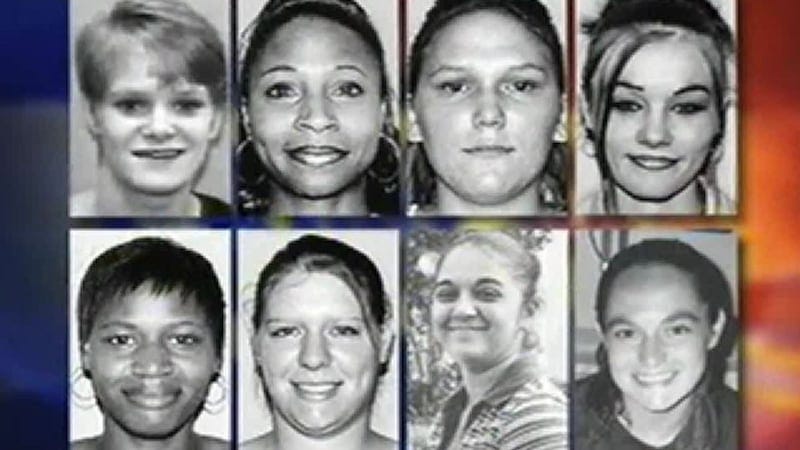
Between May 2005 and August 2009, eight women were pulled from canals, swamps, and roadways in and around Jennings. All of them were connected to the world of sex work and addiction that ran along the South Jennings corridor. Most of them were connected to each other. Most of them were connected to Frankie Richard. And every one of them, investigators would later discover, had been a police informant.
Loretta Lynn Chaisson Lewis, twenty-eight years old, was found floating in a canal on May 20, 2005. Her death was initially classified as undetermined. Rumours of a serial killer began to circulate in Jennings almost immediately the community knew who these women were, and something about the first death felt like a beginning rather than an isolated event.
It was.
Ernestine Marie Daniels Patterson, thirty years old, was found in a canal off a highway south of Jennings on June 18, 2005 less than a month later. Two men, Byron Chad Jones and Lawrence Nixon, were arrested on second-degree murder charges. The charges were later dropped. Evidence problems. The first evaporation of a case that would happen again and again.
Kristen Gary Lopez, twenty-one years old, was found in a canal on March 18, 2007. Frankie Richard and his niece Hannah Conner were arrested. Richard was the last person known to have seen Kristen alive. Both were released again, due to a lack of conclusive evidence. A detective sergeant on the case would later allege that a lead investigator had sold a truck that may have been connected to Kristen’s murder, generating internal conflict inside the sheriff’s office that was eventually reported to the state attorney.
The truck was gone. The evidence was gone. Richard was gone.
Whitnei Dubois, twenty-six years old, found in May 2007.
Laconia “Muggy” Brown, twenty-three years old, found in August 2007.
Crystal Shay Benoit Zeno, twenty-four years old, found in January 2008.
Brittney Gary, seventeen years old, found in May 2008. Seventeen. The youngest. The daughter of a Jennings family, connected to the same tight world of South Jennings that had already produced four bodies.
Necole Guillory, twenty-six years old, found near Interstate 10 in Acadia Parish in August 2009. The last confirmed victim. Her body was found off the highway, just outside the parish line, as if the killer or killers had made a small geographic adjustment.
Most of the bodies were decomposed when found the Louisiana heat and humidity and water worked quickly, and the combination made determining cause of death difficult. The medical examiner concluded that most deaths were consistent with asphyxiation, though the evidence was often insufficient to establish this definitively. Cause of death was listed as undetermined in several cases. This was not simply a limitation of forensic science. It was a gift to whoever had killed them.
True Crime Weekly is a reader-supported publication. To receive new posts and support my work, consider becoming a free or paid subscriber.
The Connections
Ethan Brown is a journalist and author who spent years investigating the Jeff Davis 8 and published his findings first in a Medium article and then in the book Murder in the Bayou in 2016. His investigation produced a picture of the case that was fundamentally different from the serial killer framework that local law enforcement had publicly pursued.
The women, Brown documented, were not strangers to each other who happened to share a demographic profile. They knew each other intimately. Kristen Gary Lopez and Brittney Gary were cousins. Brittney Gary and Crystal Benoit Zeno had been roommates. They had all worked at the Boudreaux Inn. They had all moved through the same constrained social world of sex work and crack addiction in South Jennings.
And every one of them had been a police informant.
This last detail is the one that restructures everything else. In the world of small-town drug enforcement, informants are both assets and liabilities. They know things. They tell things. And when the people they inform on are the same people who supply law enforcement, or who have relationships with law enforcement that go beyond the professional, informants become problems. The FBI’s own Behavioral Analysis Unit, according to Brown’s investigation, had noted that the women all knew each other a pattern inconsistent with the serial killer framework, in which victims typically have no prior relationship with each other or the killer.
Brown’s working theory developed carefully and without formal accusation against any individual was that at least four of the women were probably killed by or at the behest of Frankie Richard, and that at least two others were probably killed by people connected to law enforcement who were protecting their interests in the drug trade and the sex work economy that ran through South Jennings.
Frankie Richard
Frankie Richard was, in Jennings, something like a local institution a white man who called himself “Cajun Country’s John Gotti,” who ran a strip club and was widely known as a drug dealer, who had sexual relationships with six of the eight women, who was the last known person to have seen at least two of them alive, and who walked through repeated investigations and charges with a freedom that, to outside observers, suggested either extraordinary good fortune or extraordinary protection.
He had been arrested in connection with the Lopez killing. Released. His niece had been arrested alongside him. Released. He was charged at one point with threatening a victim a rape victim who came forward against him reportedly received the message: “If you tell anyone, bitch, you will end up like the others.” He was not convicted of that rape.
He spoke to Ethan Brown openly during the investigation, something that Brown described as puzzling and, on reflection, illuminating. A man who knows he will not be touched can afford to be candid. Richard admitted freely that he knew all the girls, that he had sexual relationships with most of them, that he was close to the world that had produced eight bodies. He denied killing anyone.
The striking moment came not in his denials but in the timestamp around his arrests. He was arrested on suspicion of overdose on the day a Showtime documentary about the Jeff Davis 8 was premiering a coincidence that the families of the victims noted with bitter precision.
No charges in connection with any of the eight murders have ever been sustained against Frankie Richard.
The Sheriff’s Office and the Task Force
The Jefferson Davis Parish Sheriff’s Office was not merely failing to solve the murders. According to multiple sources documented by Brown and reported by journalists covering the case, the office was actively implicated in the conditions that produced them.
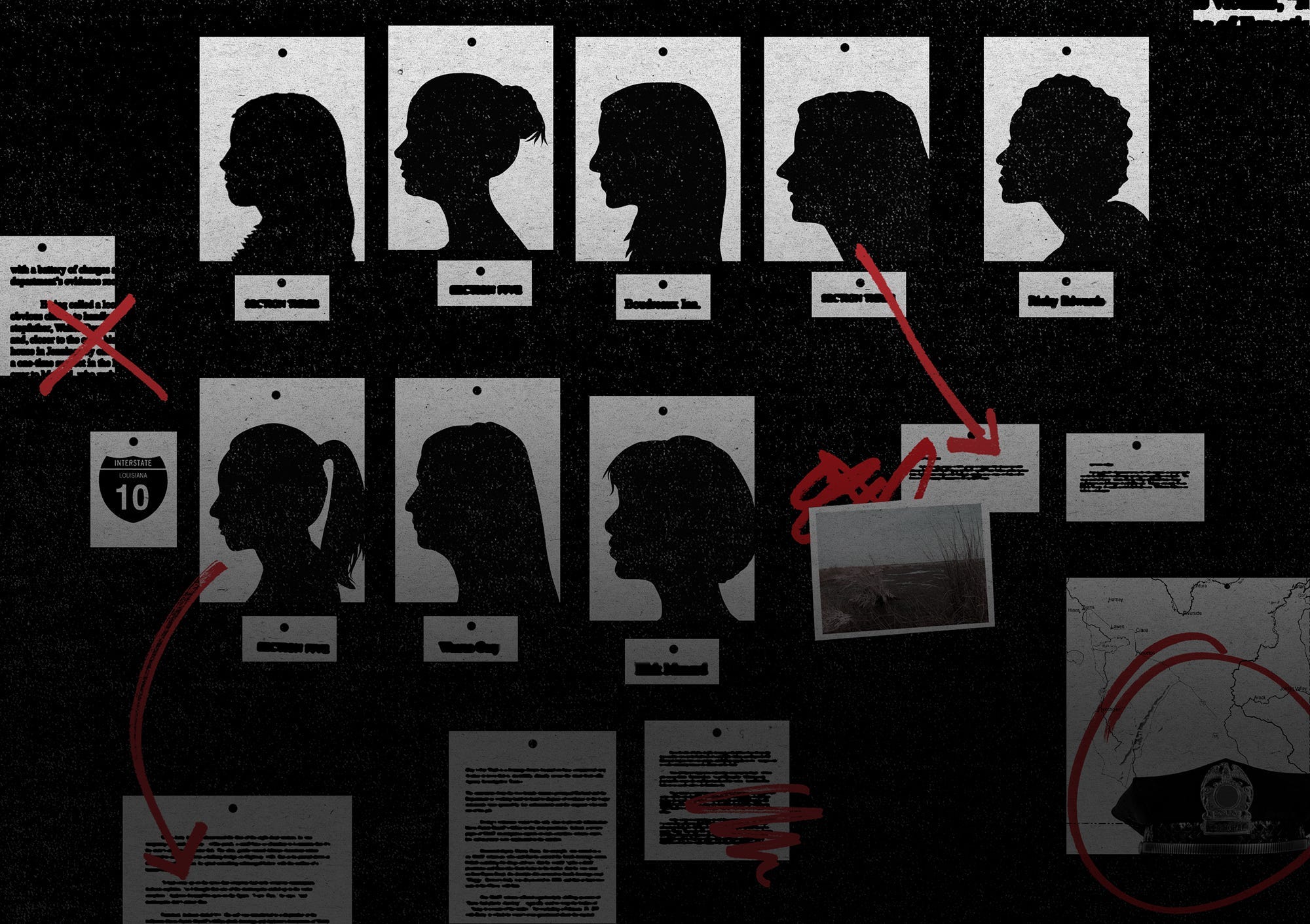
Accusations against the office included the sale of seized drugs, the harassment of sex workers in South Jennings, and the destruction of evidence in connection with at least one of the killings. A police sergeant reported unethical behaviour by a lead investigator who had sold a truck potentially connected to Kristen Lopez’s murder. Two female inmates alleged that evidence in the Lopez case had been disposed of at Frankie Richard’s behest, and that the disposal had been facilitated by members of the sheriff’s office.
In 2009, facing public pressure that had become impossible to dismiss, Sheriff Ricky Edwards announced the formation of a multi-agency task force that would eventually include fourteen federal, state, and local agencies. He also ordered that every investigator working the case submit to DNA testing an acknowledgment, implicit but unmistakable, that investigators themselves were among those under suspicion. The results of that DNA testing were not publicly disclosed.
Witnesses who came forward with information about the case had a troubling tendency to become unavailable to change their stories, to recant, to develop the kind of amnesia that tends to follow threats, or in some cases to die. The pattern of witness intimidation was documented but not prosecuted. Multiple witnesses stated, in task force interviews, that local law enforcement had somehow been involved in the murders. Those statements were not made public until Brown reported on them.
The journalist who reported the case most thoroughly received communications suggesting that if he continued his work, he would not be able to get his book published. When a contact told him that people in Jennings had said he would “never get that book out” and that he could “take that however you want to,” Brown stayed out of Jennings for months while he completed the manuscript.
The book came out.
The sheriff called him an author of fiction stories.
The Congressman
In the course of his investigation, Brown learned that Louisiana Congressman Charles Boustany had allegedly had sexual contact with three of the Jeff Davis 8 victims at the Boudreaux Inn the motel where the women worked and through which so much of the case’s social geography ran. A field representative for Boustany was later found to own the hotel.
Boustany denied any impropriety and filed a defamation suit against Brown. He withdrew the suit after losing his congressional seat.
The connection between a sitting congressman’s office and the motel where eight murder victims had worked was not, as far as the public record shows, investigated by any law enforcement body in a manner that produced charges or findings.
The Murders Stop And Why That Matters
One of the most significant details in the Jeff Davis 8 case is the timing of when the killings stopped.
The murders began in 2005 and continued through 2009. In 2009, the multi-agency task force was formed, investigators were required to submit to DNA testing, and the scrutiny on the case reached its highest level. The killings stopped.
If a single serial killer had been preying on women in Jefferson Davis Parish, the formation of a task force which in itself would not have made the area physically safer or made victims less accessible would be an unlikely reason to stop. Serial killers typically continue until they are caught or incapacitated.
The more compelling explanation, and the one that Brown and other investigators have argued, is that the murders were not primarily the work of a single unconnected predator but rather the work of people embedded in the community people who understood that the level of scrutiny had changed and that continuing to kill would be foolish. People who could read the situation and make a decision.
People who knew that the women were informants and had decided that silence was more important than their lives, and who stopped once the cost of that silence had risen to a level that exceeded its perceived value.
Twenty Years, Zero Convictions
The Jeff Davis 8 case entered its twentieth year in 2025. Over those two decades, the case has generated a fourteen-agency federal task force, a New York Times bestselling book, a Showtime documentary, a Crime Junkie podcast episode, and sustained journalistic scrutiny. It has produced four arrests. Zero convictions. Not one person has served a day in prison for the murders of Loretta Chaisson Lewis, Ernestine Patterson, Kristen Lopez, Whitnei Dubois, Laconia Brown, Crystal Zeno, Brittney Gary, or Necole Guillory.
Frankie Richard is still alive. He has never been convicted of any crime connected to the eight murders.
The DNA submitted by investigators in 2009 was never publicly matched to any victim.
The truck that may have been connected to Kristen Lopez’s murder was sold and is presumably gone.
The witnesses who might have said something more than they said are older now, or dead, or still afraid.
Jefferson Davis Parish has the highest per-capita unsolved homicide rate in Louisiana nearly twenty unsolved murders in a jurisdiction of ten thousand people, a ratio that speaks either to extraordinary bad luck or to something systemic in how violent death is investigated and adjudicated there.
Ethan Brown’s conclusion, after years of investigation, was direct: the women were killed because they knew too much. They were informants in a drug trade that was entangled with law enforcement. They were killed to silence them, and the investigation into their murders was compromised from within by the same institutions that had the most to lose from their testimony.
He makes clear that he cannot prove this in a court of law. The evidence, as he documented it, does not rise to criminal proof. It rises to something else to a picture of institutional rot so complete that the apparatus designed to deliver justice was the same apparatus that had a stake in preventing it.
Brittney Gary was seventeen years old.
Nobody has been convicted of her murder.
Loretta Lynn Chaisson Lewis, 28. Ernestine Marie Daniels Patterson, 30. Kristen Gary Lopez, 21. Whitnei Dubois, 26. Laconia “Muggy” Brown, 23. Crystal Shay Benoit Zeno, 24. Brittney Gary, 17. Necole Guillory, 26. Eight women. Found in canals and swamps in and around Jennings, Louisiana, between 2005 and 2009. Zero convictions. If you have information, contact the Jefferson Davis Parish Sheriff’s Office or the FBI.


Leave a Reply