Healy, Alaska, December 31, 2025 a twenty-four-year-old PhD student from India, living in Houston, Texas, flew alone to Fairbanks ten days before the new year, took a Lyft to a remote lodge near Denali National Park, spent eight days there without telling anyone why he had come, checked out on the morning of December 30, was last seen on camera leaving on foot the following day, and has not been heard from since. Nine months later, there is no body, no confirmed sighting, no foul play announced, and no explanation for why he went.
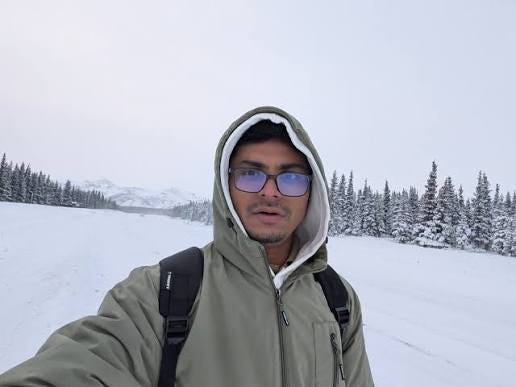
Guntur to Houston
Karasani Hari Krishna Reddy was born on March 15, 2001, in the Guntur region of Andhra Pradesh, India a southern state known for its agricultural heartland, its Telugu-speaking population, and for producing significant numbers of students who pursue postgraduate degrees in the United States. The pipeline from Andhra Pradesh to American universities is well-established and well-travelled, driven by families who invest heavily in education and by students who come to the US with specific academic goals and a clear sense of what they are building.
Hari came to Houston to pursue a PhD through Trine University a private university based in Angola, Indiana, with a satellite program in Houston that serves a significant population of international students, particularly from India. He was living in Houston with roommates, most of them also Telugu-speaking students from Andhra Pradesh, navigating the specific combination of academic pressure, cultural distance, and communal support that characterises the lives of international students pursuing advanced degrees in American cities.
His roommate Surya Teja described him as quiet, studious, and not adventurous emphatically not the kind of person who went on solo trips. “He never had any trips or he never went anywhere,” Teja told KTUU. “I would never imagine that he would travel to Alaska, to be honest.”
If you enjoy my true crime coverage, please help me continue my newsletter and keep it free for others, by upgrading here for only $5 a month:
KP Sompally, an international coordinator for the Telugu Association of North America who became the primary community liaison after Hari disappeared, confirmed this assessment. “He never revealed why he’s going to Alaska,” Sompally said. “The roommates came to know only after their parents called back from India.”
The parents calling from India, the roommates learning about the trip from the family rather than from Hari. These details point to a young man who had decided to do something and had chosen not to tell the people closest to him about it not even his roommates who shared his daily life in Houston, who would have had to be aware of his absence.
Why he went to Alaska is the first question. Everything else about the case is downstream of that answer, and that answer has never come.
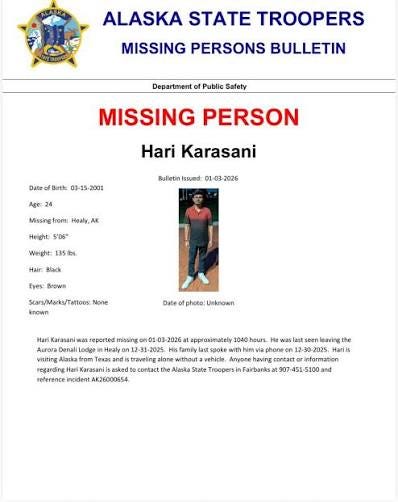
The Trip: December 22 to December 30
On December 22, 2025, Hari Karasani flew from Houston to Fairbanks, Alaska. He had told his roommates and his family back in India that he was going on vacation and would return around January 4 or 5. He told them he was going to the Denali region. He did not tell them why.
He could not drive and he had no vehicle. He was entirely dependent on public transportation and rideshare services to move through Alaska a state where, outside Anchorage and a handful of other cities, the distances between things are measured in hours rather than minutes, and where the infrastructure for carless travel is essentially non-existent.
From Fairbanks, he took a Lyft south along the George Parks Highway the main road connecting Fairbanks to Anchorage, running directly through the wilderness landscape of interior Alaska to the Aurora Denali Lodge in Healy, arriving on the morning of December 23. Healy is a small community of approximately a thousand residents, sitting at the northern entrance to Denali National Park, approximately 110 miles south of Fairbanks. In late December, it is cold in a way that most places in the contiguous United States never are. The temperatures in the area around the time of Hari’s disappearance reportedly dropped to minus forty-two degrees Fahrenheit.
The Aurora Denali Lodge is a modest accommodation the kind of highway lodge that serves travelers passing through, workers at the coal mine nearby, and the occasional winter visitor to Denali. It sits at mile marker 249.5 on the George Parks Highway. For eight days, from December 23 to December 30, Hari stayed there.
What he did during those eight days is not fully documented in the public record. He was seen in the area around the lodge and a nearby gas station video he apparently posted to Google confirmed he had walked the immediate vicinity. He had at least one call with his family and friends during this period: his family last spoke with him on December 29, and his friend Ravindra Atla spoke with him by phone on the morning of December 30.
At 10:00 a.m. on December 30, Hari checked out of the Aurora Denali Lodge.
He spoke with friends one more time that evening, around 8:30 p.m, Then nothing.
His phone was switched off on December 31 switched off, or dead, or broken, or taken. His phone signal was last traced to the Denali area on that date. From December 31 onward, there has been no confirmed contact, no financial activity, no sighting confirmed by investigators.
According to Alaska State Troopers, he was last seen leaving the Aurora Denali Lodge on December 31. The Troopers noted that he was believed to be on foot.
True Crime Weekly is a reader-supported publication. To receive new posts and support my work, consider becoming a free or paid subscriber.
The Lyft Transaction
Among the details that have generated the most speculation in the communities following Hari’s case on Reddit’s r/UnresolvedMysteries, on Websleuths, in the Indian-American community groups that have tracked the case across its nine months is a detail that investigators have not fully explained.
There was a Lyft transaction linked to Hari’s credit card that was later disputed.
The specifics of this transaction when it was made, where the requested pickup was, what the circumstances of the dispute were have not been released by investigators. What is known is that the transaction exists in the record, that it was disputed, and that it has fuelled public speculation about what happened after Hari checked out of the lodge on December 30.
A disputed Lyft transaction could mean many things. It could mean a charge for a ride he never took. It could mean a charge for a ride that was requested but cancelled. It could mean a charge for a ride that was taken but that the requester or a third party later disputed. It could mean something else entirely. Without the specifics, the transaction sits in the case’s public record as a question mark a financial anomaly that might point toward something, or might be exactly the kind of mundane billing dispute that happens to ordinary people every day.
What it cannot be is ignored. When a person is missing and there is an anomalous financial transaction connected to their accounts at approximately the time of their disappearance, that transaction is evidence of something. Investigators know this. What that something is has not been shared with the public.
One Hundred and Ten Miles
The Alaska State Troopers’ public notice stated that Hari may have been heading toward Fairbanks. The distance from the Aurora Denali Lodge to Fairbanks is approximately 110 miles.
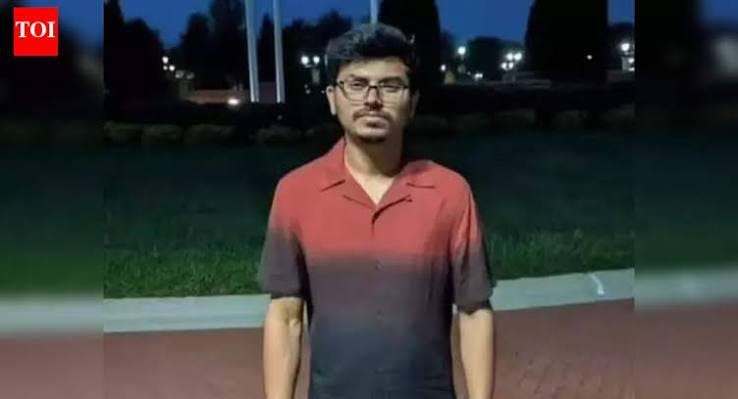
This detail has occupied a significant portion of the public discussion around Hari’s disappearance. Why would a person without a vehicle, in temperatures of minus forty degrees Fahrenheit, believe they could travel 110 miles toward Fairbanks on foot? The George Parks Highway is a major road with vehicle traffic, but hitchhiking in those conditions, in that cold, at that time of year, carries extraordinary risk. The distances between services, the weather, the darkness of Alaskan December all of these things make the scenario of someone attempting to walk or hitchhike from Healy to Fairbanks profoundly dangerous.
There are counterarguments. He may have been attempting to reach a point along the highway where he could reliably get a ride-share pickup a gas station, a roadside stop, somewhere with enough infrastructure that a Lyft driver would actually come. He may have been intending to hitchhike only a short distance. He may have had arrangements, known to him but not to anyone who has spoken publicly about the case, for transportation he had already arranged.
What the Alaska Department of Public Safety Information Officer said in the early days of the investigation is notable: there was “no indication of any suspicious circumstances regarding Mr. Karasani’s disappearance.” This is not a determination that nothing suspicious occurred. It is an early-stage assessment of what was visible in the immediate evidence. It means investigators had not, at that point, found evidence of a crime scene, a struggle, a weapon, a witness to violence.
The Search
When Hari’s roommates and community became fully alarmed when it became clear in the first days of January 2026 that he had not come home and had not been in contact and that something was genuinely wrong they contacted the Alaska State Troopers and the Telugu Association of North America simultaneously. The case number assigned by AST was AK26000654. The tip line was 907-451-5100.
The search that followed was constrained by the geography and the season. Interior Alaska in early January is not a forgiving environment for ground search. The temperatures that had been recorded in the Healy area approaching minus forty limited what search teams could do and for how long. The George Parks Highway corridor is vast, the terrain surrounding it is dense and difficult, and a person who had walked off the road could be invisible to aerial search under the right conditions of snow cover and terrain.
A Change.org petition was filed, signed by community members, requesting that the governors and attorneys general of both Texas and Alaska take personal interest in the case and coordinate expanded resources. The petition argued that the interstate nature of the case a Texas resident missing in Alaska and the extreme weather conditions warranted elevated governmental involvement beyond the standard missing person framework.
As of the most recent reporting more than three hundred days after Hari was last seen no trace of him has been found. No remains, no clothing, no personal effects, no confirmed sighting in the 110-mile corridor between Healy and Fairbanks, no confirmed sighting anywhere else.
The NRI Pulse, a publication serving the Indian diaspora community in the United States, published a report in late July 2026 marking the two-hundred-day threshold of Hari’s disappearance. The report noted that the case had “puzzled investigators and those who knew him” and that it remained one of the most perplexing missing persons cases involving an Indian national in the United States.
The puzzlement is genuine and specific. It is not the puzzlement of a case with too little information. It is the puzzlement of a case with the right information to ask good questions and no information to answer them.
Why did Hari go to Alaska? He told nobody. He had never gone anywhere before. He booked a trip to one of the most remote and climatically extreme places accessible from the continental United States, in the dead of winter, alone, unable to drive, and told his roommates only that he was going on vacation.
What did he do at the lodge for eight days? He watched the landscape the videos posted to Google show a young man looking at a cold, white, empty Alaskan winter through a phone camera. He made calls and he checked out on the morning of December 30.
What happened between the checkout and the switched-off phone on December 31? This is the gap that the entire investigation lives inside. Fourteen hours, approximately, between 10:00 a.m. on December 30 and the phone going dark sometime on December 31. What a person does in fourteen hours in Healy, Alaska in winter, without a car, with a disputed Lyft transaction on their credit card, with friends saying goodbye at 8:30 the previous evening this is the question that has not been answered in nine months.
Where is he? This is the question beneath all the other questions. It has no public answer.
His Parents in India
Hari’s parents are in India. They learned about the trip to Alaska the way everyone else learned from the calls that came after he was already gone, from the explanation that had to be given, from the worry that had to be translated into something comprehensible to people in Andhra Pradesh who had no frame of reference for what Alaska was or how cold it got.
Surya Teja described the moment they had to explain it to the family. “Initially when this thing happened, they don’t have any idea about Alaska, how bad the weather would be,” he said. “So we had to explain them by sending and asking them to see some videos and understand how the weather would be. That, in fact, made them worried a little bit more.”
The image of a family in India watching videos of an Alaskan winter, trying to understand what the landscape looks like where their son was last seen, is the human centre of this case. They did not know he was going. They did not know why. They could not have stopped him. And now they watch videos to try to understand a place where he might be, or where he might no longer be.
Hari Krishna Reddy Karasani was born March 15, 2001, in Guntur, Andhra Pradesh, India. He was twenty-four years old when he disappeared. He was last seen leaving the Aurora Denali Lodge in Healy, Alaska, on December 31, 2025. He was 5’7”, 130 lbs, with black hair and black eyes, and wore glasses. He cannot drive. His bank accounts have shown no activity since his disappearance. Alaska State Trooper case number: AK26000654.
If you have information: Alaska State Troopers — (907) 451-5100.


Leave a comment