On a February morning in 2002, a Lancaster County, Pennsylvania mother dropped her two children at school, drove to a park, sat down on a bench, and made a decision that would destroy her family, devastate her children, and turn her husband into a murder suspect for eleven years. She was not dead. She was not taken. She had simply left and would not come back until 2013, when she walked into a Florida sheriff’s office and told the deputy she was tired of running.
Lititz, Pennsylvania
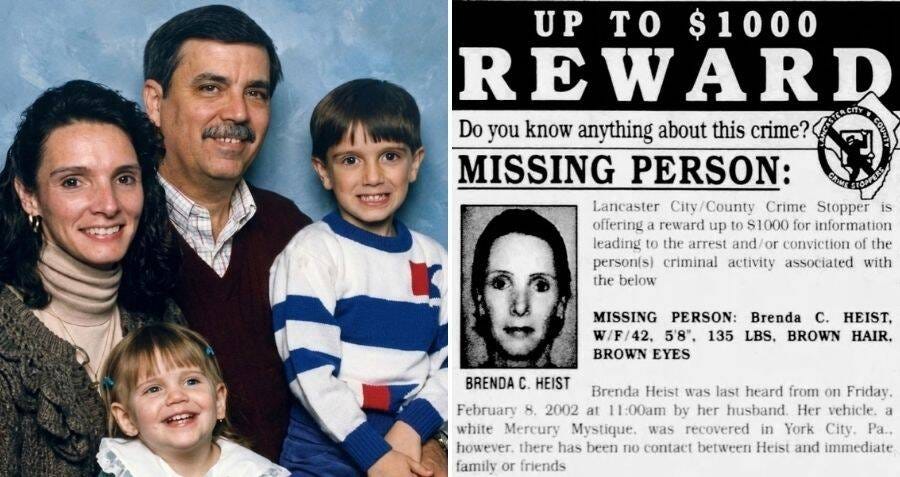
Brenda Heist was thirty-four years old in 2002, living with her husband Lee and their two children in Lititz, a small borough in Lancaster County, Pennsylvania the kind of community where people know each other, where a missing person generates real community attention, where a husband who cannot account for his wife quickly becomes the subject of uncomfortable questions. She had a twelve-year-old son and an eight-year-old daughter. She worked. She was going through a divorce. The marriage to Lee Heist had deteriorated, and by the winter of 2002 the proceedings were underway which meant lawyers, court dates, custody arrangements, the slow and grinding redistribution of a shared life into two separate ones. There was financial stress. There was whatever emotional weight a dissolving marriage places on the person carrying it. On the morning of February 8, 2002, Brenda Heist drove her children to school and dropped them off as she did every weekday. Then she went to a park. What happened next is the part of the story that Brenda herself would eventually explain, and the explanation, when it finally came eleven years later, would be both simple and staggering. She sat on a bench in the park and cried.
If you enjoy my true crime coverage, please help me continue my newsletter and keep it free for others, by upgrading here for only $5 a month:
The Disappearance
When the children came home from school that afternoon, the house was empty. Dinner had been set out to defrost on the counter. The laundry was half done mid-cycle, paused by a person who had intended to come back and finish it, or by a person who had left in such a hurry, or such a dissociation, that the ordinary afternoon tasks had simply stopped where they were. The children called their father. Lee Heist called the police. Four days later, investigators located Brenda’s car in a parking lot near a bus station in a neighbouring county. The car was intact. There was no sign of violence. She had driven there and left the car which meant she had gone somewhere, on foot or by bus or by some other arrangement, under her own power.
The investigation that followed took the shape that investigations into missing wives always take: it focused on the husband. Lee Heist was questioned. He submitted to a polygraph examination. He passed it. He was not charged. But in the way that suspicion works in small communities, the absence of charges did not fully restore his standing. People pulled away. His children grew up under the shadow of a story that implied, even without saying it directly, that their father might have made their mother disappear. He had not. She had made herself disappear. But nobody knew that yet.
Eleven Years
What Brenda Heist told police in 2013 was this: she had gone to the park that February morning in a state of emotional collapse. The divorce, the finances, the accumulated weight of a life she felt she could not carry it had brought her to a bench in a park in Lancaster County, Pennsylvania, where she sat and wept. Three strangers approached her. Two women and a man, she said. They talked with her. They were heading to South Florida. They invited her to come.
She got in their car and went. It is the kind of decision that is almost impossible to fully explain to people who have not been in the specific darkness that produces it the moment when the life you have built feels so completely impossible that the offer of a different road, any road, however strange, feels like the only available exit. She left her children. She left her car. She left the laundry half done on a winter afternoon, and she drove south with strangers and did not look back for eleven years. The life she built in those eleven years was not a life of comfort or reinvention. There was no new identity carefully constructed, no secret savings account, no plan. She lived on the streets of South Florida. She slept under bridges. She stayed in shelters. For a period she lived in a camper in Key West with a man she had met during her years on the road. She worked odd jobs cleaning houses, whatever could be found under the assumed name Kelsie Smith. She had no driver’s license in that name, no formal employment record, no paper trail of any substance. She was not hiding from the police. She was, as she would later describe it, hiding from herself from the life she had walked away from, from the decision she had made, from the knowledge of what her disappearance had done to the people she left behind.
What Happened at Home
In Lancaster County, Lee Heist raised the children alone. His daughter grew up and enrolled at West Chester University. His son grew up and went into law enforcement a choice that carries its own particular weight, given what his childhood had been. Lee had Brenda declared legally dead in 2011, three years before she actually reappeared, which was the practical step a widower takes when he needs to manage the legal and financial architecture of a life that has been left in permanent suspension. The community stigma, as Lee later described it, never fully lifted. People who had been his friends kept a certain distance during the years when he was technically a suspect in his wife’s disappearance. His children grew up as the children of the woman who had vanished which in a community like Lititz meant growing up as the children of a mystery, with all the curiosity and pity and occasional cruelty that attaches to that. They built their lives anyway. They did not know their mother was sleeping under a bridge in Key West. They did not know she had chosen strangers on a park bench over the half-done laundry and the defrosting dinner.
The Return
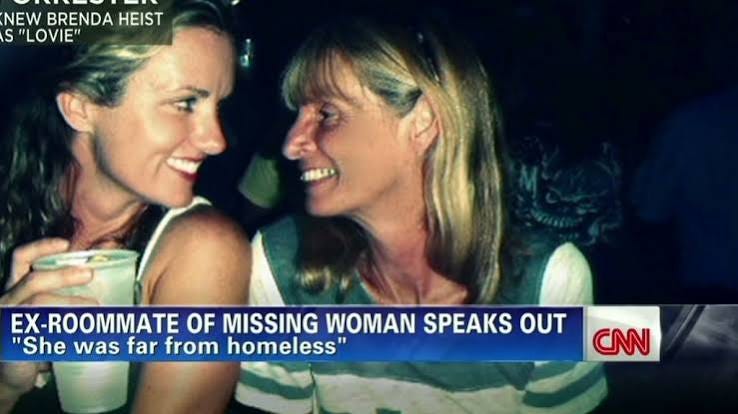
In April 2013, Brenda Heist walked into the Monroe County Sheriff’s Office in Key Largo, Florida. She was forty-five years old. She had been living in a homeless shelter for the final two years of her eleven-year absence, scavenging for food, surviving at the margin of the visible world. She told the deputy on duty that she was a missing person. She said she was tired of running.

There were outstanding warrants minor charges accumulated during the years on the road. She turned herself in on those warrants and told them who she was. The news broke across national media within hours. A Pennsylvania woman, declared legally dead two years earlier, had appeared in a Florida sheriff’s office and identified herself. Her husband had been a suspect. Her children were adults. She had been living under a bridge. Detective John Schofield, who handled her intake, told reporters that Brenda had said she was “at the end of her rope.” She was tired. The running whatever it had been a flight from, whatever it had become was over.
True Crime Weekly is a reader-supported publication. To receive new posts and support my work, consider becoming a free or paid subscriber.
The Question That Has No Clean Answer
What Brenda Heist did is not a crime in the ordinary sense. She was an adult. She was free to leave. No law requires a person to stay in a life that has become unbearable, and the dissolution of a marriage, the financial stress, the emotional collapse in the park none of that is incomprehensible. What makes her case one of the most-discussed disappearance stories on Reddit’s true crime forums is precisely the question it refuses to answer cleanly: how does a mother leave her eight-year-old daughter and twelve-year-old son and not come back for eleven years?
There are answers that invoke mental health, trauma, dissociation the way extreme psychological distress can produce behavior that looks, from the outside, like a choice and feels, from the inside, like the only possible movement. There are people who have studied cases like Brenda’s and argue that what happened in the park that morning was less a decision than a break a moment in which the ordinary mechanisms of attachment and obligation simply stopped working, and she moved in the only direction that felt possible. There are also her children, who by 2013 were adults who had built lives in the absence of a mother who was, as it turned out, alive and reachable and had chosen not to reach back.
When Lee Heist was told his wife had reappeared, he reportedly said their children had no interest in making contact. Whether that has changed in the years since is not part of the public record.
The park bench is still there. The house where the laundry was left half done has had other occupants since. The children of Brenda and Lee Heist are in their thirties now, living the adult lives they built while their mother lived under bridges in Florida. Brenda Heist did not leave because someone took her. She did not leave because she was in danger. She left because on a cold February morning in 2002 she sat on a park bench and cried, and three strangers offered her a ride, and she took it.
What happened inside that decision what it costs to make it and what it costs to live with it for eleven years, and what it costs to the people who stay behind is the question that sits at the center of this story, unanswered and unanswerable from the outside.
Brenda Heist disappeared from Lititz, Pennsylvania on February 8, 2002. She was thirty-four years old. She turned herself in to the Monroe County Sheriff’s Office in Key Largo, Florida in April 2013, after eleven years living on the streets of South Florida under the alias Kelsie Smith. Her children were adults by the time she returned. No criminal charges were filed in connection with her disappearance.


Leave a comment