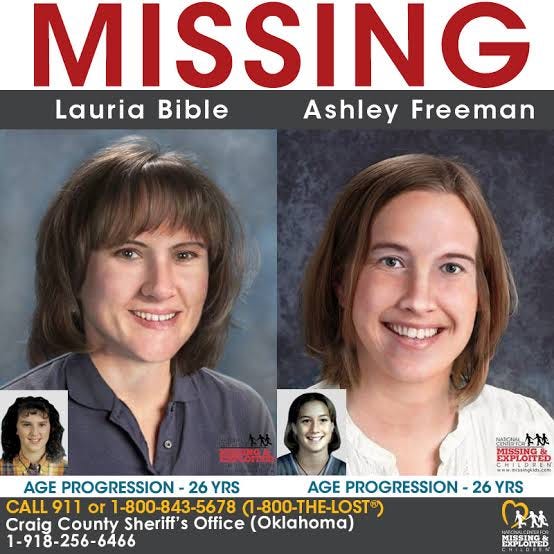
On Ashley Freeman’s sixteenth birthday, her parents were murdered and she and her best friend Lauria Bible vanished. Twenty-five years later, three men are believed responsible two of them died free and the girls have never been found.
On the morning of December 30, 1999, a passing motorist noticed flames rising from a mobile home on the outskirts of Welch, Oklahoma. By the time firefighters arrived, the structure was already gutted. Inside the ruins, they found the body of Kathy Freeman. Her husband Danny’s body would not be recovered until the following day, after Lauria Bible’s parents combed through the rubble themselves, because the initial response had failed to locate him. Both had been shot once in the head. Their sixteen-year-old daughter Ashley was gone. So was her best friend, Lauria, who had been given permission to sleep over the night before.
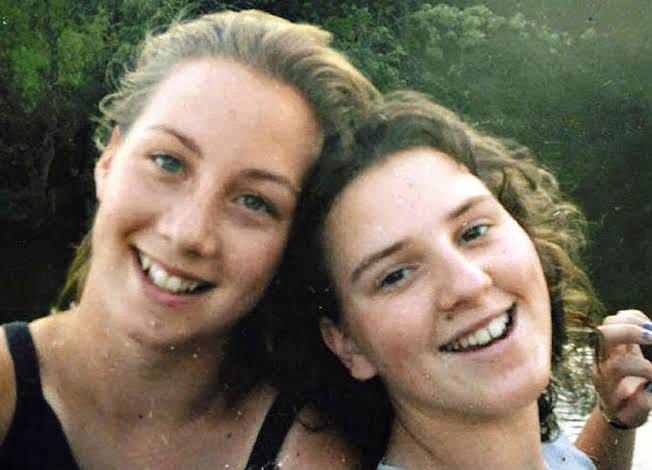
It was Ashley Freeman’s birthday. She had turned sixteen that day.
Welch is a small town in Craig County, northeastern Oklahoma tobacco country, ranch country, the kind of place where a fire at the edge of town is everyone’s business before the smoke clears. Ashley Renae Freeman had grown up in that mobile home on the rural outskirts, the daughter of Danny and Kathy, ordinary people in a tight and watchful community. Lauria Jaylene Bible had been her closest friend. The two girls had spent the evening celebrating Ashley’s birthday sixteen years old, the threshold of something and Lauria had stayed over, as she had done many times before. Lauria’s parents had given their blessing. The girls were safe together. Everyone understood that to mean something.
Love True Crime?
Unlock exclusive deep dives into chilling mysteries, unsolved cases, forgotten crimes, and shocking investigations. Get detailed timelines, fascinating evidence, and subscriber-only stories you won’t find in our free newsletter.
Subscribe for just $5/month!
Nobody saw them leave. Nobody heard a struggle. The arson consumed most of what might have told investigators what happened in those hours between the birthday celebration and dawn. The fire had been set deliberately, investigators concluded not the result of accident or malfunction, but an act designed to destroy evidence and cover the killing of two people inside. What authorities were left with was ash and two missing girls and the dead certainty that whoever murdered Danny and Kathy Freeman had also taken their daughter and her overnight guest.
The investigation stalled almost immediately. Craig County was a small jurisdiction with limited resources. Evidence collection at the fire scene was imperfect. The Freemans were described by some locals as people who attracted trouble Danny had a reputation in certain circles, and there were suggestions of involvement in drug activity a characterization that would shadow the case for years, as though the quality of the victims determined the urgency of the search. Lauria’s family felt that shadow. Her mother, Lorene Bible, spent the years after her daughter’s disappearance pushing against a current of institutional indifference, demanding that investigators pursue leads that seemed obvious to the community if not to the authorities. She was not always heard. The case drifted.
A confidential informant told investigators in 2001 that she had lived with Phil Welch, had seen the photographs, and had overheard conversations about what had happened at the Freeman home that night.
This is one of my favorite true crime books on Amazon:
True Crime Book
What investigators had though they may not have fully appreciated the weight of it at the time were witnesses. Multiple people in and around Welch had heard the same story from the same men in the years following that December night. Warren Phillip Welch II, a local figure with a significant criminal history and a reputation as a methamphetamine cook, had reportedly bragged to at least a dozen people about what had happened at the Freeman property. His associates David Pennington and Ronnie Dean Busick had done the same. The story those witnesses carried was consistent and specific: the three men had gone to the Freeman home that night to collect money a drug debt, witnesses said, money the Freemans owed or were believed to be holding. What followed, according to that community testimony, was the execution of two adults and the abduction of their daughter and her overnight guest.
The details that witnesses described were not the kind anyone wanted to hold. Phil Welch, multiple people said, had kept Polaroid photographs of the girls bound and gagged on a bed, sometimes with Welch himself visible in the frame. A confidential informant who had lived with Welch in 2000 told an Oklahoma State Bureau of Investigation agent in 2001 that she had seen the photographs, had overheard conversations about what had happened at the Freeman home, and knew that the men had taken the girls to Welch’s trailer in Picher after the murders. Witnesses said the men held the girls captive for days, raping them before ultimately killing them. The photographs were never found. Welch reportedly threatened the lives of anyone who spoke.
The bodies, according to multiple witnesses, were disposed of in a pit or mine shaft in Picher a former lead and zinc mining town several miles from Welch, its landscape riddled with old excavations, its surface contaminated by a century of heavy metal runoff, its underground geography honeycombed with flooded shafts and collapsed tunnels where things could disappear and remain disappeared. Picher had already been designated a Superfund site by the time investigators began taking the witness accounts seriously. Parts of the town had been condemned. The terrain was not hospitable to searching.
None of this produced an arrest. Phil Welch died in 2007. David Pennington died in 2015. The witnesses had spoken, the rumors had circulated for years, the families had begged for action, and two of the three men believed to be directly responsible had died without ever being charged with anything related to what happened on Ashley Freeman’s birthday.
There were distractions along the way. Two convicted killers Tommy Lynn Sells and Jeremy Jones each confessed to involvement in the girls’ disappearance and then recanted. Jones later admitted he had fabricated his story entirely to obtain better food and expanded telephone privileges while incarcerated. Sells, who killed numerous victims across multiple states, was also found to have manufactured his confession. These false confessions consumed investigative resources, generated headlines, and reopened wounds in both families that had barely begun to close. They also served, perhaps inadvertently, to muddy a record that pointed with reasonable clarity toward Welch, Pennington, and Busick.
The case broke open, finally, not through a confession or a forensic breakthrough, but through a cardboard box. In December the month is unspecified in the record, but the year was sometime around 2014 investigators found a box of case files in a Craig County Sheriff’s Office closet that had gone missing from the Oklahoma State Bureau of Investigation’s case file. Inside was documentation that had been out of the official investigative record for years, containing information that helped identify the three men and others with possible knowledge of what had happened. How the box came to be in that closet, and how long it had been there, were questions that did not receive satisfying public answers.
In April 2018, nearly two decades after the fire, the Craig County District Attorney charged Ronnie Dean Busick by then sixty-six years old and serving a sixty-day commitment in a Kansas jail on an unrelated matter with four counts of first-degree murder, two counts of kidnapping, and one count of first-degree arson. He was the last of the three men alive. Two years later, in 2020, Busick pleaded guilty not to murder, but to being an accessory to first-degree murder and to withholding information. He was sentenced to fifteen years, with ten to be served in custody and five on probation. He was released in May 2023, after serving thirty-eight months, credited for good behavior.
Thirty-eight months. For two dead parents. For two teenage girls whose final days, as the district attorney put it at the time of Busick’s charging, were “certainly horrific.” For nearly two decades of a mother searching for her daughter while the people who knew the answer lived their lives and said nothing.
True Crime Weekly is a reader-supported publication. To receive new posts and support my work, consider becoming a free or paid subscriber.
The families have never stopped looking. In 2010, the Freeman family initiated court proceedings to have Ashley declared legally dead a legal formality, a way of drawing a line around an absence that has no natural boundary. Lorene Bible has continued to speak about Lauria in interviews and public forums, refusing to let her daughter become a name on a list. Investigators have periodically searched the physical landscape witnesses described mine shafts, root cellars, the property once associated with David Pennington without result. A 2021 search of a cellar formerly connected to Pennington turned up nothing. Picher is now largely abandoned, its above-ground structures mostly gone, its underground inaccessible in ways that complicate any systematic search.
Ronnie Dean Busick, the only person ever charged in connection with the murders and abductions, is a free man. He knows, and has consistently refused to say, where the girls are.
Lauria Jaylene Bible was sixteen years old. Ashley Renae Freeman had just turned sixteen the day she died.


Leave a Reply