Evelyn Hartley was a straight-A student who sang in her church choir and played piano. On the night of October 24, 1953, she stepped out to babysit a professor’s daughter and was never seen again. Seventy years on, her case has never been solved.
On the evening of October 24, 1953, a fifteen-year-old girl named Evelyn Hartley left her family’s home in La Crosse, Wisconsin, to babysit for a professor a few blocks away. The professor was Viggo Rasmussen, a colleague of Evelyn’s father at La Crosse State College. His daughter was twenty months old. The pay was routine, the arrangement was ordinary, and the Rasmussens were attending a homecoming game that evening the kind of mild, civic, thoroughly forgettable Friday night errand that thousands of families in mid-century American college towns negotiated without incident every week. Evelyn was a responsible girl. Everyone who knew her said so. She was a straight-A student at Central High School, sang in the choir at First Presbyterian Church, and played piano. Her family trusted her to handle the evening without difficulty.
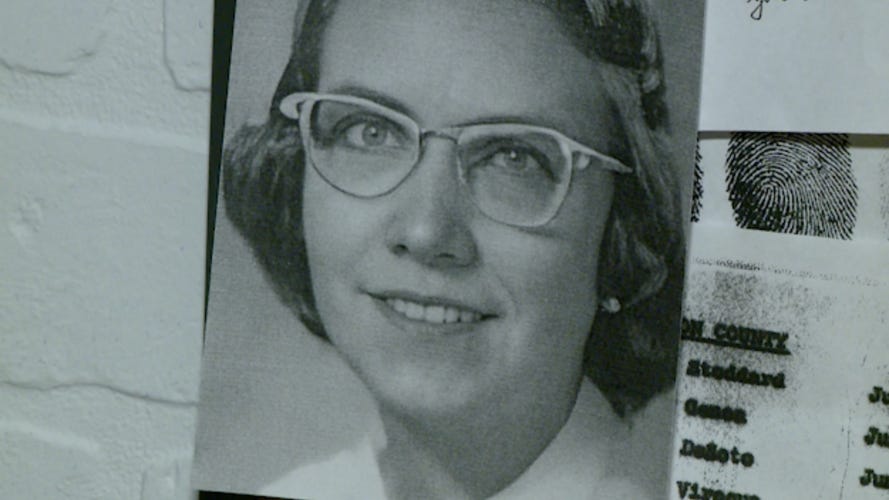
Her father expected her to call at half past eight. When the phone at the Rasmussen house went unanswered, Richard Hartley called again. Then again. When enough time had passed without an answer, he drove the few blocks to the address and found the front door locked, the lights on, the radio playing. Inside, he found furniture moved out of position. Evelyn’s schoolbooks were scattered. One of her shoes was downstairs. The other was upstairs, near her glasses broken, left on the floor above. The Rasmussens’ toddler was asleep in her crib, unharmed. Evelyn Hartley was gone.
Love True Crime?
Unlock exclusive deep dives into chilling mysteries, unsolved cases, forgotten crimes, and shocking investigations. Get detailed timelines, fascinating evidence, and subscriber-only stories you won’t find in my free newsletter.
Subscribe for just $5/month
La Crosse in 1953 was a prosperous mid-sized city on the Mississippi River, the kind of community that organized homecoming games and church choirs and believed, with genuine confidence, that bad things happened elsewhere. Richard Hartley’s discovery on Hoeschler Drive that Friday evening put an end to that confidence in a single hour. Investigators arrived and began working through what the house was telling them. A basement window was open, its screen removed from outside. A stepladder had been positioned under it from the exterior brought there, or placed deliberately, by someone who had studied the house before entering. Pry marks were found around three other windows, suggesting the intruder had tested entry points before settling on the basement. Footprints ran through the living room and along a window box. Blood matching Evelyn’s type was found inside the house and in the yard outside. Bloodied handprints appeared on the wall of a garage roughly a hundred feet away, and then on the exterior of a neighboring house beyond that.
The physical record told a coherent and terrible story. Someone had entered through the basement window, come upstairs, and confronted Evelyn. She had struggled the displaced furniture, the scattered books, the shoe left on the stairs in the violence of whatever happened suggested she had not gone quietly. The blood trail through the yard and toward the neighboring garage told the next part: whoever took her had carried her out, possibly lost control of her once, and then carried her again toward the street. Tracker dogs followed her scent as far as Coulee Drive, two blocks from the Rasmussen house. There the trail ended. The dogs found nothing beyond that point, and investigators concluded she had been put into a waiting vehicle.
Someone had entered through the basement window, come upstairs, and confronted Evelyn. She had not gone quietly.
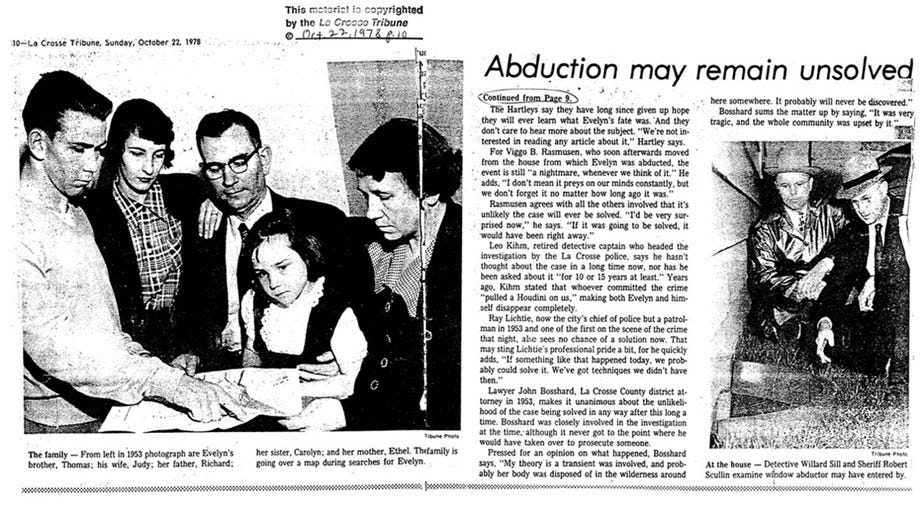
Witnesses filled in pieces that the physical evidence could not. A neighbor reported seeing two men and a young woman near the Rasmussen house at around 7:15 in the evening stumbling, she thought, as though one of them was drunk or injured. A resident nearby said they had heard screaming at some point before Richard Hartley arrived. A man named Ed Hofer said he had nearly collided with a two-toned green 1942 Buick in the vicinity; he had seen a driver, a second man, and a girl between them in the front seat. He had assumed she was intoxicated. He had driven on. The car was never found. The men inside it were never identified.
Check out one of my favorite true crime books on Amazon here:
True Crime Book
Days after Evelyn’s disappearance, bloodstained undergarments were recovered along Highway 14, southeast of the city. In Coon Valley, investigators found bloodstained sneakers and a denim jacket. The jacket’s blood matched Evelyn’s type. The suction-cup soles of the sneakers matched the footprints found in the living room of the Rasmussen house. Police brought the clothing to roughly ten thousand people across thirty-one Wisconsin communities, showing the items door to door and at public gatherings, asking if anyone recognized them. No one did. The clothing’s owner was never identified. The items were evidence of where Evelyn had been taken and what had been done to her on the way. They were not enough to find her.
The search that followed was one of the largest in Wisconsin’s history up to that point. More than a thousand community members volunteered in the days immediately after her disappearance. The National Guard was called in. Boy Scouts, the Civil Air Patrol, and U.S. Air Force personnel joined the search. Investigators had recent graves reopened. Gas station attendants across the region were asked to examine vehicles for blood. Lie detector tests were administered to Evelyn’s teachers, to students at her school, to both Richard Hartley and Viggo Rasmussen. Hundreds of cars were stopped and searched. Over the year that followed her vanishing, investigators questioned more than thirty-five hundred people in La Crosse and the surrounding area.
In the spring of 1954, authorities announced a program of mass lie detector testing for local teenage boys roughly 1,750 were eventually to be tested. The program was halted after about three hundred had been examined, when public controversy about its methods and its implicit targeting of young men forced it to stop. Whether it had produced useful information was not made public. Evelyn’s body was never found during any of these efforts.
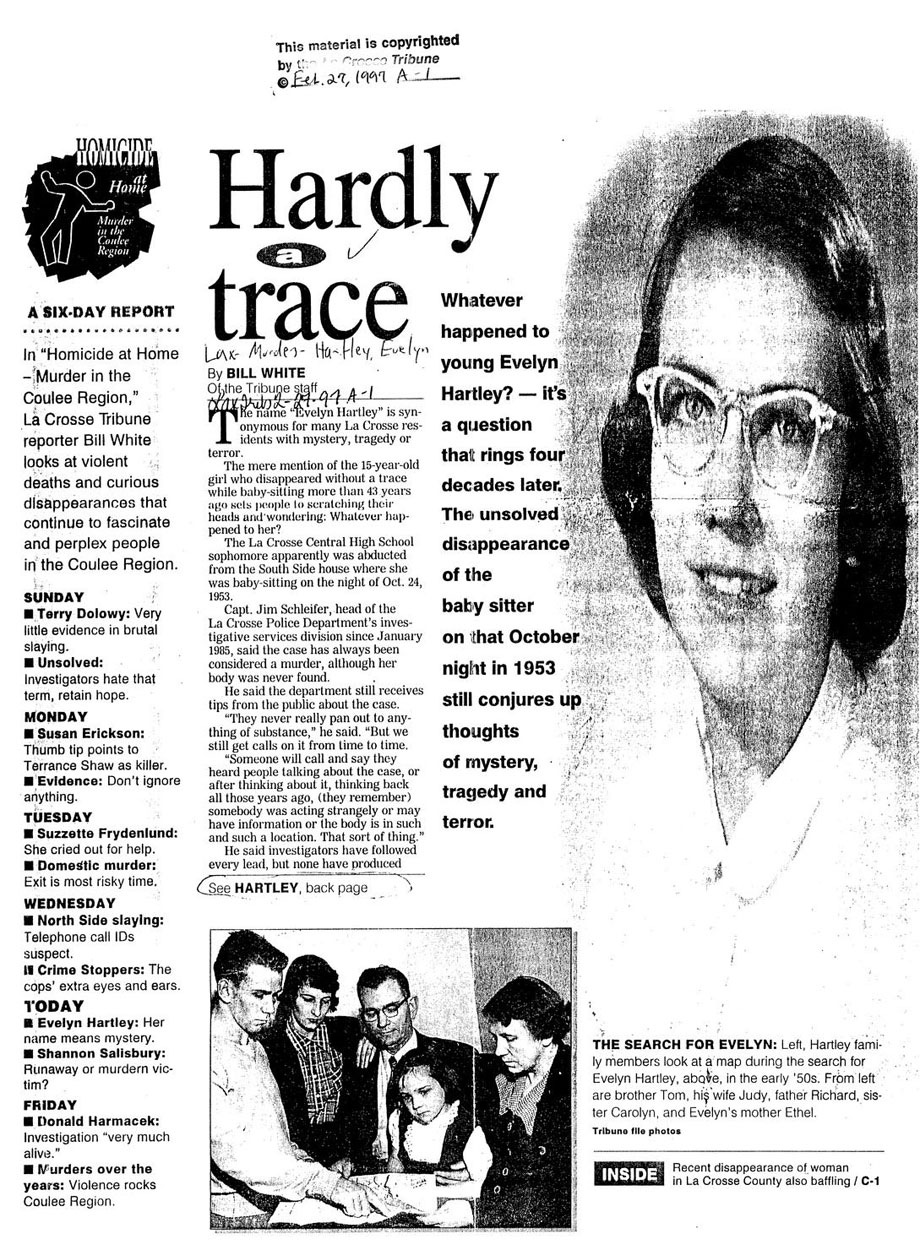
Named suspects moved through the investigation without sticking. A thirty-four-year-old La Crosse man with a history of prowling was investigated. A fifteen-year-old student from Madison attracted attention. A twenty-year-old man named Robert Snodgrass and a forty-three-year-old registered sex offender named Harold Forke were both looked at seriously. Both had alibis that investigators described as solid. No one was ever charged.
In 1957, when a farmer in Plainfield, Wisconsin roughly a hundred miles east of La Crosse was arrested and his property revealed to contain human remains, investigators returned to Evelyn’s case. Ed Gein had committed his crimes within a plausible driving distance. He had, investigators learned, been visiting a relative in La Crosse around the time of Evelyn’s disappearance. Authorities questioned him. He denied any involvement. Two polygraph tests were administered; he passed both. A thorough examination of his property found no evidence connecting him to Evelyn or to her case. He was cleared. The connection investigators had hoped for did not exist or if it did, it left no material trace in the record.
The case has never entirely escaped Gein’s shadow, partly because his crimes were so spectacular that they drew cultural gravity toward every unsolved case in the region, and partly because the proximity in time and place was real enough to keep the question alive. Netflix’s 2024 dramatization of Gein’s life portrays him as Evelyn Hartley’s killer. That portrayal is fiction. It is the kind of narrative shortcut that true crime content frequently reaches for the satisfying explanation, the closed loop, the named face in the frame that the actual evidentiary record does not support. Gein passed two polygraph tests. Nothing of Evelyn’s was found anywhere near him. The authorities who investigated him at the time did not believe he was responsible.
The most tantalizing lead came in 2004, when a man named Mel Williams made public an audio recording made at a bar in 1969. On the tape, a man named Clyde Peterson known to people who remembered him as “Tywee” could be heard apparently implicating himself, a man named Jack Gaulphair, and an unnamed third person in Evelyn’s abduction and murder. Peterson said on the tape that she had been killed and buried in La Farge, Wisconsin, a small village about eighty miles to the east. Jack Gaulphair had died by suicide in 1967. Peterson had died of a heart attack in 1974. The unnamed third man Peterson referenced was also deceased by the time the tape surfaced. All three people potentially named on it were beyond the reach of any investigation. Authorities said they would look into the lead. No further public developments were reported. Whether anyone actually searched in La Farge was not confirmed in the public record.
Richard Hartley, Evelyn’s father, reportedly never recovered from that Friday evening. He sold the house the family had been living in, fearing another break-in, and moved his family rather than remain in the neighborhood where his daughter had disappeared. He and his wife eventually relocated to Portland, Oregon, where both lived out the rest of their lives without ever learning what had happened to Evelyn. The little girl Evelyn had been babysitting the night she disappeared the Rasmussens’ twenty-month-old daughter grew up. She gave an interview in 2017 about the woman she had never met but whose absence had defined her family’s history. She called Evelyn “kind of an angel.”
The reward fund established in the weeks after Evelyn’s disappearance eventually reached sixty-six hundred dollars before it was dissolved. In La Crosse, her case remains officially open. More than seventy years have passed since anyone saw her alive.
Evelyn Grace Hartley was fifteen years old.


Leave a Reply