In late November 1980, Jeannette Bishop May former wife of one of Britain’s most powerful financiers and her friend Gabriella Guerin drove into a snowstorm in the mountains of central Italy and were never seen alive again. Their remains were found fourteen months later in a ravine. For forty-four years, the question of what killed them has not been answered. In November 2024, Italy reopened the case as a double murder.
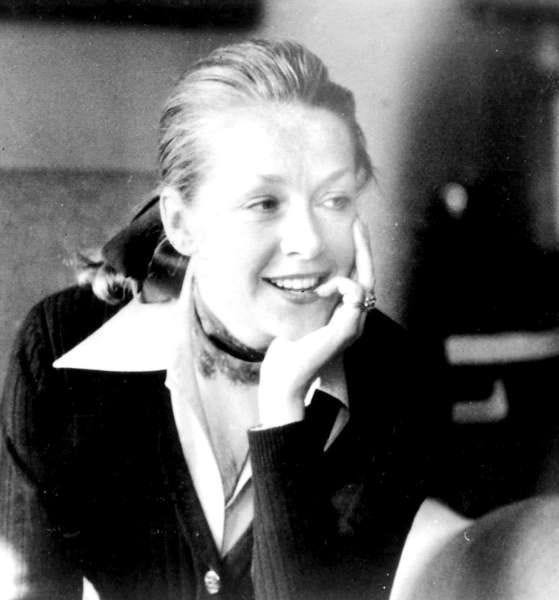
Jeannette Bishop was born in Kent, England, in 1940, the daughter of an RAF sergeant who died trying to defuse a German bomb when she was nine months old. Her mother, a hairdresser, raised her alone and sent her to a convent school at the age of four. By sixteen, Jeannette had become a model appearing in Vogue, hosting the game show Spot the Tune and she moved through a world that her origins had not prepared for her and that she had entered entirely on her own terms. In 1966, she married Evelyn de Rothschild, one of the most prominent financiers in the United Kingdom. She was twenty-six. He was thirty-five. The wedding took place in Virginia. They divorced in 1971. She kept the Rothschild name, took possession of a Chelsea house, and received a settlement of twenty-five thousand pounds.
What she built after the marriage was a quieter life than the one the Rothschild name had granted her. She developed a career in antiques and interior design. In 1975, she met Stephen May, and within a year they were married she became Jeannette May, though she had been known as Jeannette Bishop, and in the coverage that would follow her disappearance she would be called, with varying degrees of accuracy, by all three names. The couple purchased a three-hundred-year-old farmhouse in the hamlet of Schito, near Sarnano, in the Macerata province of central Italy, and in the autumn of 1980, Jeannette was there to oversee its renovation. Accompanying her was Gabriella Guerin, thirty-nine, an Italian woman who had worked as a cook for the Rothschilds and had remained close to Jeannette in the years since. Gabriella was a mother of two, fluent in multiple languages, and had come along partly as a friend and partly as a translator. The Sibillini mountain range was directly to the east. November in that part of Italy could be beautiful or unforgiving, often within hours of each other.
Love True Crime? Unlock exclusive deep dives into chilling mysteries, unsolved cases, forgotten crimes, and shocking investigations. Get subscriber-only stories you won’t find in our free newsletter.
Subscribe for just $5/month
On November 29, 1980, the two women met with a local surveyor named Nazzareno Venanzi to discuss the renovation work. During the meeting, they mentioned plans to drive up into the mountains, toward the ski area above Sarnano called Sassotetto. Venanzi warned them against it. A snowstorm was coming, he said. The roads up the mountain could become impassable quickly. The women said they understood. The following day November 30 they were seen at various points around town. A store employee saw Jeannette around 4:15 in the afternoon and noted that she had changed her clothes since earlier in the day. By 5 p.m. they had been seen returning to their boarding house. By 7:20 p.m., their small dark hatchback with Siena plates had been spotted heading uphill out of town, in the direction of the mountains Venanzi had told them not to drive into. They did not return.
By 7:20 p.m., their car had been spotted heading uphill out of town, in the direction of the mountains Venanzi had told them not to drive into. They did not return.
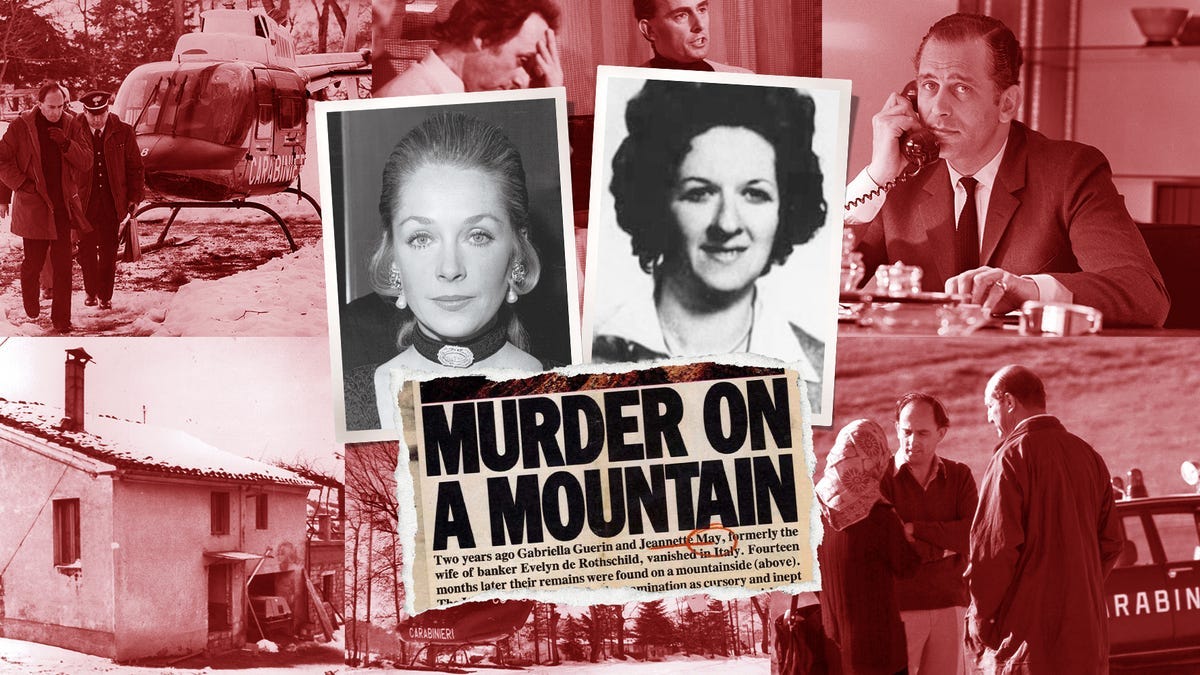
Stephen May, who was not in Italy at the time, was notified when Jeannette failed to appear for a meeting with the owner of the farmhouse they were purchasing. The alarm went up quickly, in part because of who Jeannette was a former Rothschild wife, a woman of a certain visibility and in part because kidnapping for ransom was a commonplace crime in Italy in that period. The Brigatte Rosse had been active throughout the 1970s. The Sardinian kidnapping industry had extracted money from some of the wealthiest families in Europe. When a British socialite connected to the Rothschild name went missing on an Italian mountainside, the assumption among investigators was that someone had taken her and that a ransom demand would eventually arrive. It never did.
Search teams went out as the storm permitted. Helicopters, dogs, and volunteers combed the mountain roads while the weather cooperated, then withdrew when it did not. On December 18, nearly three weeks after the women had last been seen, a police helicopter spotted their car half-buried in snow on a mountain road roughly twelve minutes’ drive from Sarnano. The vehicle was locked. The handbrake was on. The car was in neutral. The keys were inside, along with the women’s valuables. There were no signs of a struggle, no blood, nothing to indicate that anything violent had occurred near or inside the car. Some distance away, investigators found a small shepherd’s house a stone refuge used by shepherds in the warmer months, unoccupied now that appeared to have been recently used. Ashes in the fireplace. Burnt furniture. Used dishes. Something that may have been hair. The working theory was that the women had abandoned the car when it became stuck, walked to the shepherd’s house for shelter, and then for reasons that could not yet be established had not been there when rescuers arrived.
True Crime Weekly is a reader-supported publication. To receive new posts and support my work, consider becoming a free or paid subscriber.
What happened at the boarding house while Stephen May waited for news was strange in ways that would take years to fully appreciate. On December 3, a telegram arrived addressed not to Jeannette Bishop May but to “Janine May” a misspelling. It had been sent from a Rome address. It read: “I am waiting for you.” On the same day, a director of Christie’s auction house in Rome received a separate telegram at the same address, using the word “recovery” in a way that suggested something could be retrieved or arranged.
That night the night of December 3, with the women already missing for four days Christie’s Rome was burglarized. Valuable art was stolen. None of it was ever recovered. Stephen May found handwritten notes in the boarding house room with phone numbers that led nowhere clear. Anonymous calls began to come in, including one to the British newspaper the Daily Mail in January 1981, in which a caller named Ian Sayer claimed advance knowledge of the telegrams. When police traced the call to an Austrian hotel, Sayer denied any involvement. Investigators eventually concluded that the telegrams had most likely been sent as a hoax, possibly by a woman with a grudge against one of the Christie’s figures involved. What the hoax was intended to accomplish, and how the person who sent it had known about the women’s disappearance before it was public knowledge, was never fully explained.
Other threads unspooled in the months and years that followed. An antiques dealer named Sergio Vaccari came to investigators’ attention his diary reportedly contained Jeannette’s name, and he had connections to stolen Christie’s inventory. In September 1982, Vaccari was stabbed to death in London. A source later claimed he had been connected to the death of Roberto Calvi, the Vatican-linked banker whose bank had collapsed earlier that year and who was found hanging under Blackfriars Bridge in London in June 1982, his death initially ruled a suicide and later reclassified as murder. The circle of names and associations growing around Jeannette’s disappearance began to include some of the darkest corners of 1980s European organized crime and institutional corruption. None of it produced a suspect who could be named, charged, or tried.
On January 27, 1982, fourteen months after the women vanished, two hunters found boots, purses, clothing, and bones in a ravine approximately eight miles from the shepherd’s house, in a forest between Lago di Fiastra and the San Liberato hermitage. A fork that matched the ones from the shepherd’s house was among the items. Two watches were recovered. Jeannette’s manual watch had stopped at 7:20 in the morning on December 12, 1980 twelve days after the women disappeared. Gabriella’s battery-powered watch had stopped at 7:30 in the morning on December 19 nineteen days after. What those times meant whether they indicated the moment of death, the moment of some other event, or simply the moment the watches stopped functioning in the cold was never established with certainty. Wild boars had disturbed the remains. Some bones were missing. Jeannette was identified by dental records. Gabriella had none on file; she was identified by her clothing. The medical examiner found no signs of trauma and ruled both deaths accidental hypothermia, in the determination that entered the official record. The case was closed in 1989 by a Macerata magistrate who concluded that foul play could neither be proven nor entirely dismissed, an ambiguity that would define the case’s standing for the next thirty-five years.
True Crime Weekly is a reader-supported publication. To receive new posts and support my work, consider becoming a free or paid subscriber.
Stephen May had offered a reward of roughly a hundred million lire equivalent to around two hundred thousand dollars today for information leading to Jeannette alive. The hunters who found the remains sued him for the full amount and won in court. In the years that followed, various people made various claims. A 2005 DNA test on the remains buried as Gabriella’s found only her DNA confirming her identity, years after the initial identification by clothing. In 2013, a photographer named Marco Accetti came forward with claims that tied the case to the Vatican and to the long-running mystery of Emanuela Orlandi, a young woman who vanished in Rome in 1983. Investigators and Orlandi’s family both found his claims implausible and self-serving. The fox trapper who worked the area where the bodies were found said he had set traps in that location during the winter months without ever noticing the remains a detail that suggested either that the bodies had been moved to that location after death or that the trapper’s memory was unreliable. A rescue volunteer said the snow depth that winter made it impossible for Gabriella, who had been wearing a skirt when last seen, to have walked to the site on her own.
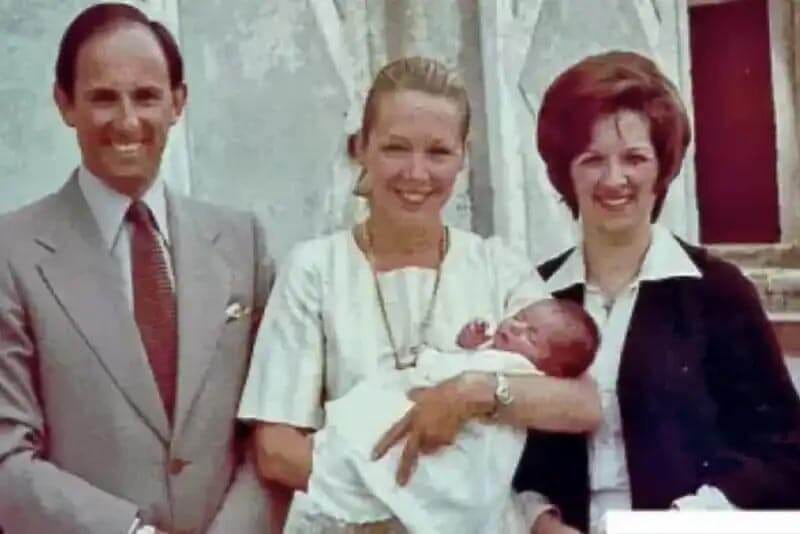
In November 2024, the Macerata prosecutor’s office announced that the case had been reopened as a double murder investigation. The prosecutor, Giovanni Fabrizio Narbone, declined to identify what had specifically prompted the review he said investigators had reread the entire record and concluded there was a chance of reaching a resolution. Witnesses who had given statements decades earlier renewed their testimony. No suspects were named. No new physical evidence was described. The case was open again, forty-four years after a surveyor warned two women not to drive into the mountains in a snowstorm.
What is known about the last hours of Jeannette Bishop May and Gabriella Guerin fits neatly into a narrative of accident two women who ignored a warning, drove into deteriorating weather, abandoned their car when it became stuck, found shelter in a shepherd’s hut, and then, when the cold returned and the shelter proved insufficient, died somewhere in the forest above the town where they were trying to renovate a farmhouse. What keeps the case from settling into that narrative is the Christie’s theft, the telegrams, the watches stopped at inexact and unexplained times, the fox trapper who found no bodies in terrain he knew intimately, the antiques dealer with connections to Vatican crime who was stabbed in London before he could be fully questioned, and the fact that the mountains above Sarnano are eight miles from where the remains were found not an impossible distance, but a strange one for two women in winter clothing, one of them in a skirt, in conditions that volunteers said were too severe for walking.


Leave a Reply